



 September 30, 2026
 2 mins to read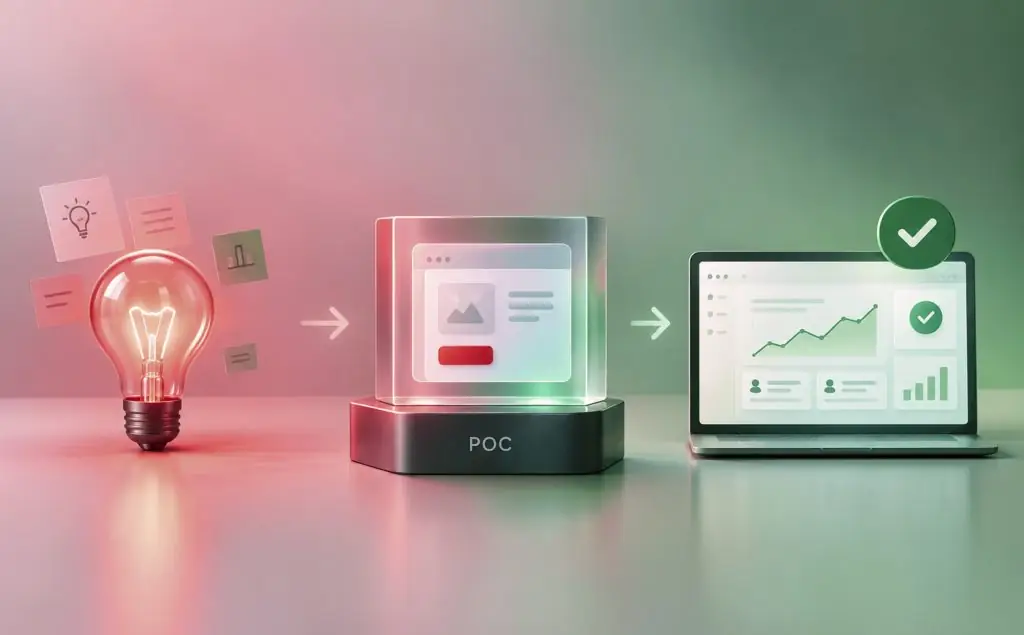
Your Saudi startup has funding, but one untested assumption can turn the next MVP sprint into expensive guesswork. Fast engineering can waste runway when teams commit capacity before learning which uncertainty could invalidate the product or force a costly redesign.
A focused POC converts that uncertainty into evidence before broader engineering begins. Bytes Technolab, an AI-first Product Engineering partner, helps Saudi startups test consequential assumptions and decide with far greater confidence whether the evidence has earned the next product investment.
Why POC Development in Saudi Arabia Comes Before MVP Spend
A funded founder should test the assumption that it can cancel planned work before committing broader engineering capacity. That choice puts decision-changing learning ahead of additional spending.
Vision 2030 Annual Report 2025 records 1,050+ technology startups established over four years and $2.4 billion raised by VC-backed startups. That activity strengthens the case for disciplined capital allocation.
High startup activity does not make engineering capacity unlimited. Each sprint should retire meaningful uncertainty instead of making an untested concept simply appear closer to launch.
POC Development in Saudi Arabia makes evidence precede commitment. Once that investment principle is clear, founders can define exactly what a focused POC should prove.
What a POC Is and What It Should Prove
A POC is a narrow experiment that tests whether one material product assumption works under defined conditions. Its main output is decision evidence, not reusable software.
For a startup POC, disposable code can be acceptable because learning matters more than polish. Scope stays deliberately small and tied to one consequential uncertainty.
A POC is not a smaller MVP or a polished prototype. It proves only what its hypothesis, test conditions, representative inputs, and measurements were designed to examine.
Treating the POC as a decision instrument limits scope drift. The next choice is whether feasibility is genuinely the uncertainty that deserves engineering effort now.
Why Choose POC, Prototype, or MVP by Risk?
Choose the artifact that matches the unknown before funding it. Feasibility calls for a POC; interaction questions suit prototypes, while market behavior requires real users.
| Stage | Question It Answers | Evidence Produced | Next Decision |
| POC | Can the critical assumption work? | Feasibility evidence | Proceed, revise, retest, or stop |
| Prototype | How should the experience work? | UX and workflow evidence | Refine the interaction |
| MVP | Will real users adopt or value it? | Behaviour and market evidence | Iterate, scale, or change |
A POC earns its place when a mechanism, dataset, integration, or operating constraint could invalidate the idea. Interface testing alone cannot retire those feasibility risks.
When feasibility is already established, skip the POC. A prototype or MVP development services can answer the next uncertainty more directly through workflow or customer evidence.

Step 1: Find the Assumption That Could Kill the Idea
Start with the assumption whose failure would force a redesign, delay, or stop decision. Testing an easy feature first can create confidence without reducing material risk.
List the dependencies before fixing the engineering scope. Include technical mechanisms, representative data, third-party integrations, operating constraints, commercial premises, and assumptions behind the core value proposition.
Before engineering begins, Product Strategy Consulting in Saudi Arabia helps teams prioritize what needs to be validated and what must become true before committing limited resources
Which assumption should a POC test first?
Use the Kill-Assumption Test on the highest-consequence uncertainty first. If failure would materially redesign, delay, or invalidate the product, that assumption deserves the first validation cycle.
For an Arabic-first support product, representative Saudi language may determine whether intent classification works well enough. Product idea validation should test that risk before interface polish.
Step 2: Set Success Criteria Before Engineering Begins
Define success and failure before anyone writes code. Otherwise, an impressive demonstration can tempt the team to reinterpret weak evidence after seeing the experiment’s results.
Write the hypothesis, representative conditions, scope boundary, excluded work, and test period together first. Leave out functionality that does not directly affect the selected assumption.
A Product Idea Validation Company in Saudi Arabia should agree to these rules before engineering starts. Criteria created after results arrive weaken the later investment decision.
What should the success criteria for a POC look like?
POC success criteria should be measurable, pre-agreed, and tied directly to the product hypothesis. Each threshold should also state what decision changes when the result misses it.
That structure stops teams from changing the definition of success after testing. It also makes an impressive technical result easier to judge against the original product risk.
Evidence Thresholds
A useful criterion connects three parts before testing starts. The metric defines what is measured, the threshold defines what constitutes acceptable evidence, and the consequence defines the next decision.
- Metric: Arabic-query classification accuracy
- Threshold: 90% on a representative sample
- Consequence: revisit model and data strategy
The 90% threshold is illustrative, not universal. Exclude UI polish, secondary features, production hardening, and unrelated workflows unless they are necessary to test the hypothesis.
Step 3: Make POC Development Services Produce Evidence
Engineer only enough to test the selected assumption under realistic conditions. Each engineering task should create a measurement, expose a constraint, or directly challenge the hypothesis.
Use representative data, real or production-like integrations, realistic volumes, and relevant cost or latency limits. Mock inputs can hide the dependency that actually requires validation.
Relevant failure cases should also be tested through POC Development services, because a clean happy path says little when real operating conditions determine whether the product remains viable.
What evidence should a POC capture?
A decision-grade POC records findings that another technical reviewer can inspect later. Capture what passed, failed, changed, and which conditions strengthened or weakened each conclusion.
Apply the Demo-vs-Evidence Test before calling the experiment complete. If the team can only say it worked, the POC produced a demonstration rather than decision-grade evidence.
- Pass and failure measurements
- Accuracy or performance results
- Integration and data behavior
- Cost and operating constraints
- Unexpected dependencies and blockers
Unexpected dependencies deserve documentation because they can alter architecture, scope, or cost after the headline threshold passes. Those caveats must remain visible in the investment decision.
Bytes Technolab keeps POC development for Saudi startups tied to measurable uncertainty and reviewable findings. The evidence should move directly into a disciplined investment verdict.
Step 4: Use a POC Development Company to Reach a Verdict
Read POC results as an investment decision rather than a demo score. A technical pass answers the tested question, but it cannot validate every condition for product success.
A credible POC Development Company should return measurements, caveats, remaining assumptions, and a recommendation. Working code alone can leave the founder with unresolved investment risk.
The POC Evidence Gate connects the tested risk with the next investment. It prevents a positive result from being interpreted more broadly than the experiment supports.
What is the final output of a POC?
A successful POC does not prove that a startup should build the complete product. It proves only that the selected assumption met its predefined threshold under stated conditions.
Risk
Risk names the assumption that is capable of invalidating the product. It keeps the result tied to the original reason the startup chose to run the POC.
Threshold
Threshold states the result agreed upon before engineering begins, clearly. It prevents the team from moving the success line after seeing a promising but incomplete outcome.
Evidence
Evidence records what happened under representative conditions, including measurements, errors, data limits, and integration behavior. It determines exactly how much confidence the experiment ultimately deserves.
Verdict
Verdict converts the findings into Go, Revise, Retest, or Stop. Each outcome states whether the assumption passed, needs another approach, needs more evidence, or failed.
Next Investment
Next Investment asks what the evidence has actually earned. Technical success alone cannot substitute for customer demand, sufficient data, dependable integrations, or acceptable operating constraints.
Five Evidence Domains
- Technical: Can the mechanism work?
- Data: Is representative data usable?
- Integration: Do dependencies behave reliably?
- Operational: Are constraints commercially workable?
- Product or Commercial: what still needs customers?
Four POC Verdicts
- Go: the critical assumption met its threshold
- Revise: The direction remains viable after the change
- Retest: evidence is incomplete or a new risk emerged
- Stop: the tested premise failed within acceptable constraints
Used together, these checks stop technical success from becoming false product confidence. The remaining uncertainty now determines whether the startup is actually ready for an MVP.
Step 5: Turns Evidence Into an MVP Decision
Approve an MVP only after the POC retires the highest-consequence feasibility risk. Remaining uncertainty should mainly require users or market behavior, not another technical experiment.
Translate discovered constraints into MVP architecture, scope, costs, and sequencing. Treat disposable POC code as learning unless engineers deliberately approve specific components for production reuse.
Set a 7- to 30-day decision window after testing carefully. Document the verdict, resolve material caveats, and deliberately choose the smallest next validation stage.

What happens after a successful POC?
A successful POC should lead toward an MVP only when broader product learning has become the main unknown. Another focused experiment can still be the better investment.
Technical feasibility alone does not make the product MVP-ready. Founders should confirm that blockers in data, integrations, costs, and operating conditions remain manageable before allocating more funding.
MVP Readiness Checks
- The core feasibility threshold has passed
- No blocking data risk remains
- Integrations work under realistic conditions
- Constraints are documented and budgetable
- The remaining risk requires real users
- Production engineering starts deliberately
Over the next 7 to 30 days, update assumptions and resolve critical caveats before allocating additional funding. MVP development services are appropriate only when the remaining uncertainty lies with real users.
Don’t Let a Working POC Become an Expensive Assumption
A successful demo can create confidence quickly, but confidence is not the decision. Before committing more runway, founders need to know exactly what the POC proved, what remains uncertain, and whether those remaining risks belong in an MVP.
Go, Revise, Retest, and Stop are all useful outcomes when they prevent a larger investment from being made on weak evidence. A POC creates value when it changes what the startup funds next.
Startups and scale-ups can work with Bytes Technolab Saudi Arabia as an AI-first Product Engineering partner when making that decision. Product strategy, POC engineering, evidence assessment, and MVP planning help connect technical findings with practical scope and investment choices.
The goal is not to move from POC to MVP as quickly as possible. It is to move forward only when the highest-risk assumption has been tested well enough to justify broader engineering.
Your next product stage should follow the uncertainty that remains. A convincing demo may start the conversation, but evidence should decide what gets built next.
Frequently Asked Questions
POC Development in Saudi Arabia can validate one high-risk assumption before broader engineering begins. Beyond feasibility, founders can use the result to update investor discussions, refine technical estimates, and decide which unanswered product questions still require customer or market evidence.
A startup should expect a POC Development Company to define evidence ownership, test conditions, review points, and decision outputs before coding begins. The final handover should make findings traceable enough for founders, engineers, and investors to understand what was proven and what remains uncertain.
No. A POC for startups is unnecessary when technical feasibility is already established and the remaining uncertainty concerns workflow, usability, adoption, or demand. In that case, a prototype, discovery exercise, or MVP may produce more relevant evidence with less delay.
After a successful POC, founders should separate technical learning from production planning. Before using MVP development services, review architecture, security, data ownership, operating costs, and remaining customer assumptions so temporary experiment choices do not quietly become permanent product decisions later.
Bytes Technolab begins by classifying the unresolved risk, not by choosing a deliverable first. Feasibility risk points to a POC, interaction risk to a prototype, and market-behaviour risk to an MVP, with mixed risks handled in the smallest useful sequence.
Table Of Content
- Why POC Development in Saudi Arabia Comes Before MVP Spend
- What a POC Is and What It Should Prove
- Why Choose POC, Prototype, or MVP by Risk?
- Step 1: Find the Assumption That Could Kill the Idea
- Which assumption should a POC test first?
- Step 2: Set Success Criteria Before Engineering Begins
- What should the success criteria for a POC look like?
- Evidence Thresholds
- Step 3: Make POC Development Services Produce Evidence
- What evidence should a POC capture?
- Step 4: Use a POC Development Company to Reach a Verdict
- What is the final output of a POC?
- Risk
- Threshold
- Evidence
- Verdict
- Next Investment
- Five Evidence Domains
- Four POC Verdicts
- Step 5: Turns Evidence Into an MVP Decision
- What happens after a successful POC?
- MVP Readiness Checks
- Don’t Let a Working POC Become an Expensive Assumption