


 October 9, 2026
 2 mins to read
Raising a seed round doesn’t mean your next check is locked in. Early-stage funding slowed down in Q2 2026, falling below last year’s quarterly average. Moving forward, startup teams need to focus every month on building real proof of value, not just product features.
Bytes Technolab is an AI-first Product Engineering partner for Australian founders after funding closes. We pressure-test MVP scope, technical priorities, measurement, and customer behavior. The goal is simple: make each funded decision produce clear evidence before more runway gets committed.
Post-Funding MVP Checklist: Start With the Risk You Funded
A post-funding MVP checklist should start with the uncertainty the round was meant to reduce. Funding gives you options. It does not make product demand safer.
Australia’s funding headline can mask a thinner early-stage market beneath it. The Cut Through Quarterly Q2 2026 shows why founders should not assume easy follow-on capital.
The common mistake is treating new capital as permission to enlarge the roadmap. Instead, each funded activity should shorten the path to credible customer evidence.
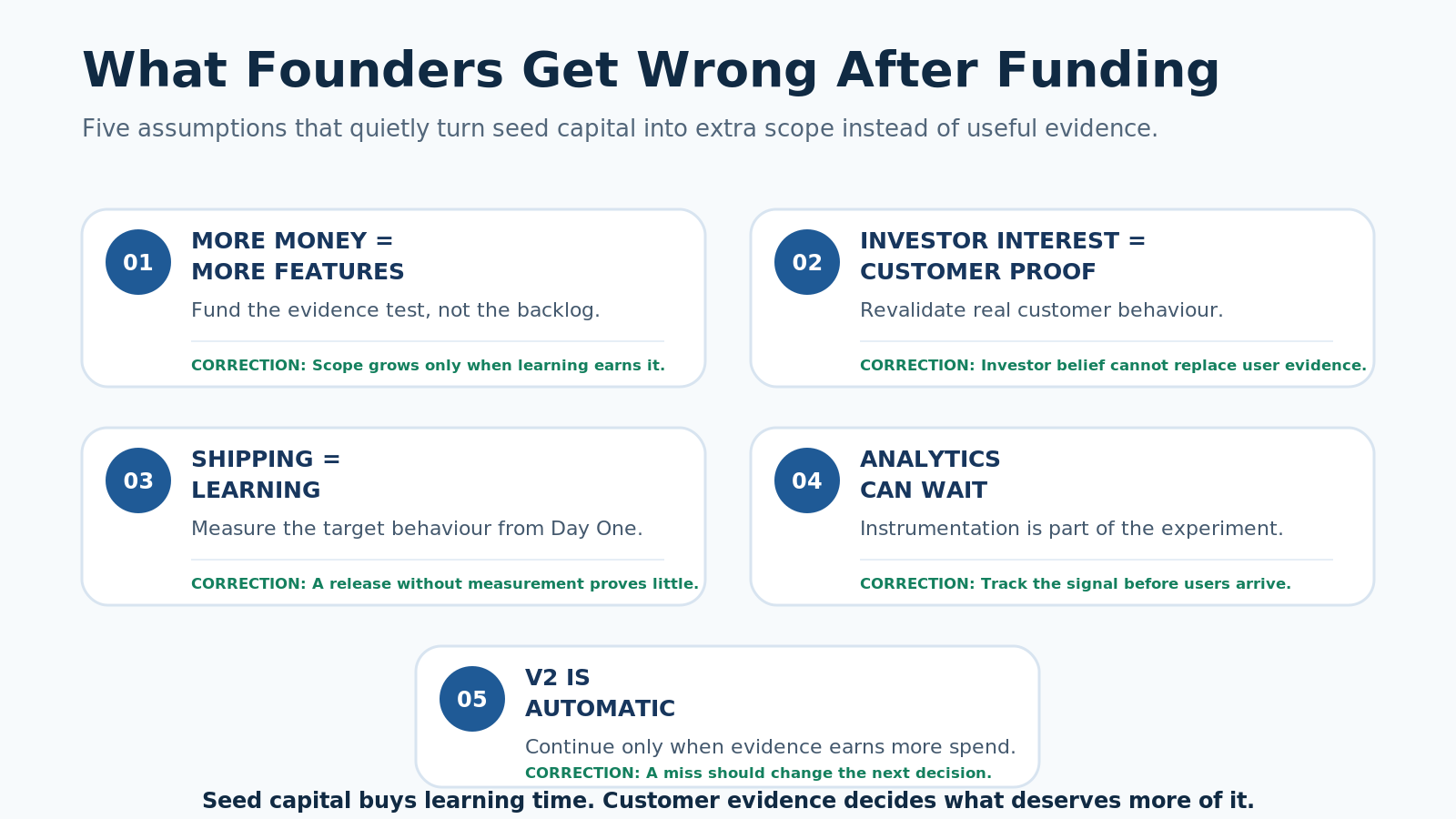
Treat the round as an evidence budget, not a feature budget. First define exactly what this capital must prove before the backlog earns another meaningful commitment.
Seed Stage MVP Gate: Define What the Round Must Prove
A seed-stage MVP needs one falsifiable post-funding thesis before scope expands. State the customer outcome that would clearly justify your next meaningful product decision.
Airtree’s Seed-stage guidance centers on product building, user feedback, and testing the value hypothesis. That is a useful decision lens after funding decisions.
Translate your fundraising story into observable customer behavior. Name who must act, what they must do, and which result would materially change founder confidence next.
What must your seed round prove before the next raise?
Your seed round must resolve the highest-risk assumption blocking the next milestone. Define one behavior and one decision threshold. Add a clear review date too.
A product discovery workshop can pressure-test that statement before engineering estimates expand. The output should be one testable claim, not another list of funded possibilities.
Ask one final question before funded scope moves forward. Could an investor hear the result and clearly understand whether your thesis became stronger or weaker?
Revalidate Customer Evidence Before Engineering Expands
Revalidate demand before engineering expands because investor conviction does not prove customer behavior. A successful raise validates a financing decision. It does not validate adoption.
LaunchVic recommends interviewing at least 20 to 30 potential customers. More importantly, it looks for real customer commitment before any build: time, attention, or money.
That distinction matters after funding. Compliments and investor enthusiasm can feel convincing. Neither reliably proves target customers will change their behavior when your product actually appears.
How do I validate that my idea is worth pursuing?
MVP startup validation becomes credible when behaviour supports the problem and proposed change. Look for repeated pain. Then look for real commitment around solving it.
Rank evidence by commitment, not enthusiasm. Paid pilots, deposits, repeated workarounds, signed trials, or active switching behavior usually carry far more decision weight than compliments.
If evidence is mostly opinion, pause feature expansion and run another focused test. Engineering should start only after customer behavior clearly justifies the next round of spending.
MVP Development for Startups: Build Only the Proof
MVP development for startups works when scope acts as an evidence filter. Every capability must explain which assumption, behavior, or measurement it enables right now.
Start with one complete user journey tied to the funded assumption. Keep trust, payment, security, or data requirements only when failure would distort that test.
Everything else faces an inclusion test before custom MVP development begins. If removing a feature preserves target behavior and measurement, defer it or simulate it.
What should be included in an MVP?
An MVP should contain the smallest credible journey that produces the behavior behind your highest-risk assumption. It must also capture that result clearly enough for review.
Keep what enables that journey, protects trust, or measures the outcome. Defer anything that can be simulated without weakening the customer evidence you actually need.
- Tests funded assumptions.
- Enables core behavior
- Protects trust or measurement.
- Resists safe manual simulation.
MVP Feature Evidence Filter
| Capability | Evidence | Manual | Decision |
| Booking | Journey | No | Build |
| Confirmation | Adoption | Yes | Simulate |
| Dashboard | Reporting | Yes | Defer |
A future feature can still matter without deserving engineering now. The next gate decides how much runway this focused test may consume before evidence appears.
Set Evidence Thresholds Before Runway Disappears
Set evidence thresholds before launch because a smaller product without a decision rule remains an uncontrolled experiment. Runway needs a deadline. It also needs a spending boundary.
Start with the behavior behind the funded hypothesis. Then decide which observable result would increase confidence enough to justify another meaningful funded product commitment later.
Do not borrow generic conversion or retention benchmarks. Your threshold should reflect the business model, target cohort, pricing logic, and decision that follows the test.
What metrics should an MVP prove before more runway is committed?
The right MVP metrics prove the behavior behind the funded hypothesis. They should never reward surface activity that leaves the core customer assumption unanswered today.
Use activation, repeat use, payment, retention, or time-to-value only when each measure supports the decision. Pick fewer metrics when one strong customer signal is enough.
Evidence Thresholds
- Metric: the behavior you need to observe.
- Threshold: the result that changes confidence.
- Deadline: when the team reviews evidence.
- Runway limit: what the test may consume.
- Decision: continue, change, narrow, or stop.
Set these conditions before users arrive. Otherwise, teams can move the goalposts after weak results and keep spending without reducing the uncertainty around the originally funded product.
Self-test: if the metric misses on review day, does everyone know what happens next? If not, the metric reports activity instead of governing a decision.
Use the Runway-to-Evidence Gate Before You Build
The Runway-to-Evidence Gate turns post-funding MVP planning into six linked decisions. It connects customer proof, scope, measurement, runway, and ownership to one clear funded assumption.
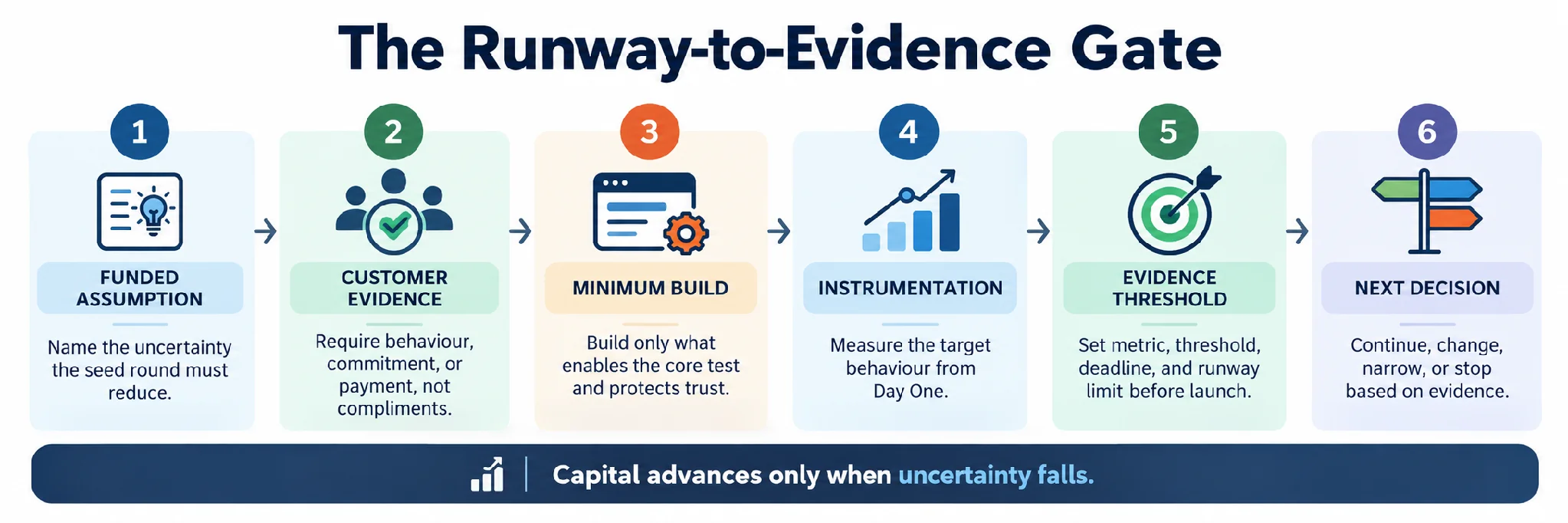
The Six Evidence Gates
Funded Assumption
Name the uncertainty the seed round must reduce. Write it as one falsifiable claim. Avoid broad goals that cannot produce a clear next product decision.
Customer Evidence
Require behavior strong enough to justify engineering. Opinions can guide discovery. Commitments, repeated workarounds, payments, or pilots provide much stronger evidence for the funded action.
Minimum Build
Build only the journey needed to produce target behavior credibly. Keep foundations that protect customer trust. Defer capabilities that do not materially change the test.
Instrumentation
Measure target behavior from Day One. Instrumentation belongs inside the experiment. Missing events can make an otherwise useful MVP result much harder for founders to interpret.
Evidence Threshold
Set the metric, threshold, deadline, and runway limit before launch. These boundaries prevent teams from redefining success when the expected customer behavior fails to materialize.
Next Decision
Assign one founder to own the next funded decision. Evidence should lead to continuing, changing, narrowing, or stopping. V2 should never become the automatic next step.
Won’t building cheaply now mean a painful rebuild later?
Minimal scope should not mean weak foundations. Bytes Technolab pressure-tests product architecture decisions against validation risk before shortcuts become expensive technical distractions during early validation.
Keep foundations durable when failure would damage trust, security, data, measurement, or iteration speed. Defer infrastructure built only for hypothetical demand, then let launch evidence govern the next spend.
Turn Launch Evidence Into the Next Decision
Launch evidence should change what gets funded next. Compare actual behavior with the threshold set before launch. Then clearly separate demand failure from execution failure.
A usability problem may justify fixing the journey and retesting. Weak payment or repeat behavior may instead require changing the hypothesis rather than polishing screens.
Founder ownership matters because teams naturally defend shipped work. One named decision owner should have authority to continue, narrow, change direction, or pause further spend.
How do I know if my MVP is ready to launch?
An MVP is ready when the hypothesis, cohort, and core journey are explicit. Instrumentation, threshold, review date, and decision ownership must also be clear before launch.
- Re-read the funded hypothesis.
- Confirm meaningful evidence exists.
- Confirm every feature supports the test.
- Confirm behavior is instrumented.
- Confirm the threshold and review date.
- Name the founder decision owner.
- Choose the possible next decisions.
An MVP development partner should challenge unnecessary funded scope before estimating it. The partner should also expose hidden assumptions that could weaken evidence after launch.
If results miss, diagnose the failure before funding more work. Separate usability, trust, pricing, and demand issues. Each problem implies a different next focused test.
The launch is not the finish line. It is the point at which customer behavior finally determines what deserves the next funded dollar of available runway.
Turn Seed Capital Into Proof, Not Scope
The seed round did not remove product risk. It changed who pays for the next experiment. That makes disciplined product learning more important after funding, not less for founders.
Keep each funded decision tied to observable customer behavior. Scope, architecture, analytics, and spending should reduce a named uncertainty within a clearly defined review period.
The strongest post-funding teams do not measure progress by backlog size. They measure how quickly real behavior turns a risky assumption into a clearer decision.
- Fund evidence, not backlog growth.
- Let behavior earn the next spend.
Bytes Technolab works as an AI-first Product Engineering partner for founders who need sharper MVP decisions. Our role is to connect engineering choices with measurable learning.
That discipline also makes difficult calls easier to defend. A deferred feature or a changed hypothesis becomes evidence-led capital allocation rather than unexplained product hesitation later.
Capital creates options, but evidence decides which options deserve more investment. The next funded dollar should follow what customers prove, not what the roadmap imagines.
Frequently Asked Questions
A post-funding MVP checklist should record the funded assumption, evidence source, decision owner, review date, runway limit, and unresolved risks. Keep a short decision log too. It should show why scope changed and which new evidence justified that funded commitment.
A seed-stage MVP can release engineering spend in evidence-linked stages rather than funding a single open backlog. Expand scope only after defined customer signals appear. This makes each new commitment depend on learning rather than on remaining available cash alone.
A focused MVP often takes about 8 to 12 weeks, though scope can extend the timeline. An Australian practitioner benchmark supports that range. The useful timeline shows when credible customer learning can begin, not just when the delivery team’s coding work finally ends.
Use a deferred-feature register beside the active MVP scope. In custom MVP development, record why each excluded capability can wait. Also note which future evidence would justify adding it and whether a manual workaround can safely preserve the current test.
Bring in an MVP development partner when scope, architecture, instrumentation, or delivery choices could consume runway before learning appears. Bytes Technolab can challenge those trade-offs early. We keep engineering tied to the customer behavior the funded MVP must clearly prove.
Table Of Content
- Post-Funding MVP Checklist: Start With the Risk You Funded
- Seed Stage MVP Gate: Define What the Round Must Prove
- What must your seed round prove before the next raise?
- Revalidate Customer Evidence Before Engineering Expands
- How do I validate that my idea is worth pursuing?
- MVP Development for Startups: Build Only the Proof
- What should be included in an MVP?
- MVP Feature Evidence Filter
- Set Evidence Thresholds Before Runway Disappears
- What metrics should an MVP prove before more runway is committed?
- Evidence Thresholds
- Use the Runway-to-Evidence Gate Before You Build
- The Six Evidence Gates
- Funded Assumption
- Customer Evidence
- Minimum Build
- Instrumentation
- Evidence Threshold
- Next Decision
- Won’t building cheaply now mean a painful rebuild later?
- Turn Launch Evidence Into the Next Decision
- How do I know if my MVP is ready to launch?
- Turn Seed Capital Into Proof, Not Scope