


 August 14, 2026
 2 mins to read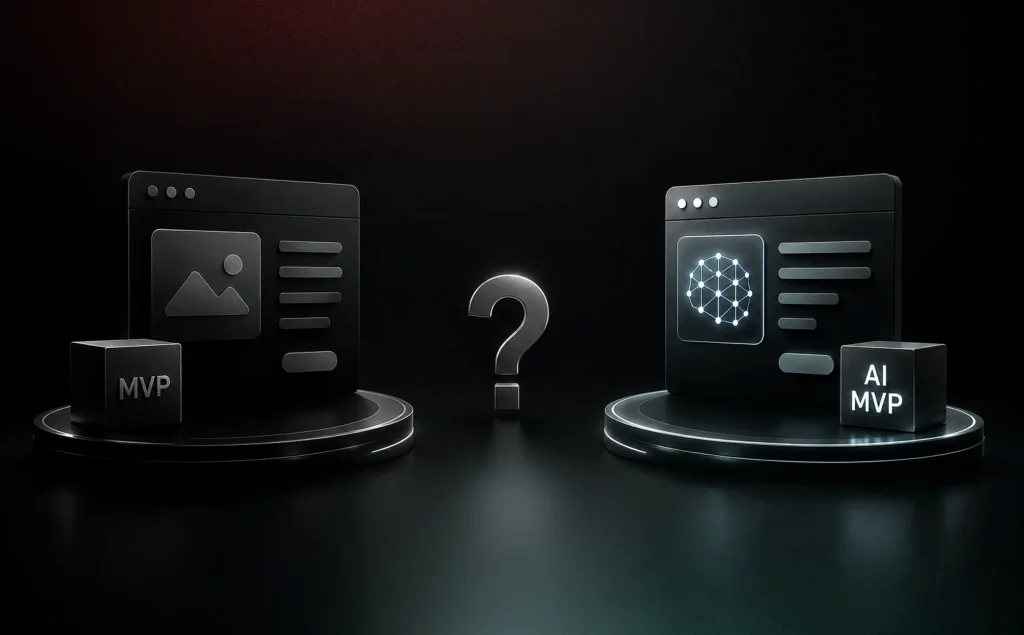
Your investor asks why the MVP has no AI, even though the first users still have not paid. In Australia’s funding market, that tension can drain runway, blur proof, and push a startup toward intelligence before demand, pricing, or repeat behaviour exists.
Bytes Technolab, an AI-first Product Engineering partner, helps Australian founders separate classic validation, AI testing, and PoC-first sequencing before engineering spend grows. The decision becomes a risk order, not a trend response, so teams fund proof before scope too early.
Why MVP vs AI MVP Is Really a Runway Risk Decision
MVP vs AI MVP is a runway decision because the wrong first build funds the wrong unknown. Founders need proof before scope grows expensive.
Cut Through and Folklore reported $5.4B across 390 announced Australian startup deals in 2025. Capital rose 31% year on year.
Forbes Australia reported $5.1B in deal activity across 390 deals, including more than $1B for AI-native startups. It also reported 61% reached AI-using companies.
Those numbers make AI pressure feel rational, but capital interest is not customer-proof. Users still need to adopt, pay, and return.
A classic MVP protects runway when market risk ranks highest. An AI MVP deserves priority only when intelligence carries the user promise.
The sharper question is not which build sounds stronger. It is the unknown that can damage funding, trust, or adoption fastest.
That shift makes the next section simple. Prove the riskiest assumption before adding intelligence.
What MVP for Startups Actually Needs to Prove Before AI Enters Scope
The goal of an MVP is to prove the assumption most likely to break the company. MVP development services for startups can help test whether that assumption is demand, workflow adoption, pricing, or AI reliability.
For many products, the first proof is commercial. Users must finish the workflow, understand the value, and show paid intent.
For AI-led products, the first proof is trust. Prediction quality, RAG accuracy, personalisation, vision, or generated output must perform reliably.
What is the difference between a traditional MVP and an AI MVP?
A traditional MVP validates whether users need the product, use the workflow, and pay for the result. An AI MVP validates whether intelligent output creates value reliably enough for users to trust it, repeat it, and accept the product promise.
| Decision area | Traditional MVP | AI MVP |
| Main risk | Demand and workflow adoption | Outdated or unverified facts |
| Early proof | Users complete the core task | Right-sounding answer, wrong context |
| Data need | Limited behaviour data | Confident answer with no real source behind it |
| Cost driver | Product scope and iteration | Smooth language hides a weak claim |
| Use when | Market risk ranks highest | New hallucinations surfacing only after launch |
The distinction matters because AI tools used during engineering do not make the product an AI MVP. Users must rely on intelligent output.
Treat the MVP discovery phase as a risk ranking exercise, not feature planning. Once that split is clear, the classic MVP path becomes easier to judge.
Criteria 1: MVP Development Services Should Validate Demand First
MVP Development Services fit when the main question is whether users want the workflow. AI should not distract from adoption, pricing, or retention.
A marketplace, booking flow, SaaS dashboard, or internal automation product can fail before intelligence matters. Users may ignore the workflow entirely.
What should a startup validate before choosing MVP Development Services?
A founder should validate four signals before committing to MVP Development Services. Each signal shows whether real users will change behaviour for the product.
- Users finish the main workflow
- Pricing creates real intent
- Onboarding takes minutes, not hours
- Retention appears after first use
Classic MVP evidence helps when the next investor update needs traction. Real usage beats an impressive demo that no user repeats.
If users must adopt, pay, or return first, a classic MVP is safer. AI can wait until demand earns more spend.
Classic MVPs do not reject AI forever. They delay intelligence until the business case proves it deserves the next layer of product risk.
The opposite pattern appears when users cannot judge value without intelligent output.
Criteria 2: An AI-Powered MVP Needs Data, Model, and Workflow Readiness
An AI-powered MVP is suitable when users cannot understand the product value unless the intelligent capability works. Intelligence must carry the promise, not decorate it.
Examples include recommendation engines, RAG assistants, prediction tools, automated triage, image review, and generative workflow support. A clickable screen cannot validate those alone.
Do startups need an AI PoC before building an AI MVP?
Startups need an AI PoC first when output quality, data availability, or model cost remains unknown. The PoC tests feasibility before the product scope absorbs risk.
A PoC does not replace the MVP. It answers the question of whether the intelligent part works well enough to justify a market-facing product.
Data Layer Readiness
Data readiness starts with availability, quality, feedback, and measurement. Missing one layer turns model testing into guesswork rather than product learning.
Available data shows whether the system has enough inputs. Quality data shows whether those inputs reflect the real user situation, not a clean demo sample.
A feedback loop shows whether the product can learn from user corrections. Measurable output quality tells founders whether reliability improves after each iteration.
Use AI feasibility before full development when the data layer feels uncertain. A 2- to 6-week test can expose the real blocker.
An AI MVP wins when output reliability is the value. A PoC-first path wins when reliability remains too unknown for full product spend.
Feasibility clarity then changes the cost conversation, because AI risk rarely stops at the first demo.
Criteria 3: AI MVP Development Services Change Cost, Timeline, and Runway
The expensive part often starts after the demo works, which is where AI MVP development services can change the runway. Reliability, data prep, and testing drive risk.
A classic MVP may focus on product flows, onboarding, payments, dashboards, and analytics. An AI MVP adds model choices, evaluation, prompt testing, and monitoring.
Is AI MVP development more expensive than traditional MVP development?
AI MVP development becomes more expensive when output quality needs repeated testing across real cases. The cheapest prototype can become costly once users expect reliability.
McKinsey’s 2025 State of AI survey reported 88% regular AI use in at least one business function. About one-third had begun scaling AI programs.
That gap matters for startups because adoption looks easy in a five-prompt demo. Scaling requires messy data, edge cases, and trust checks.
Stanford HAI’s 2026 AI Index reported global corporate AI investment more than doubled in 2025. Generative AI grew more than 200%.
The same report said generative AI captured nearly half of private AI funding. Investor appetite raises the standard for repeatable output.
The commercial trap is simple. A cheap AI demo can make the wrong path look affordable until production quality turns missed assumptions into rework.
Once runway is tied to reliability, investor evidence needs the same risk order.
Criteria 4: Product Development Services Should Shape Investor Confidence
Investor confidence grows when Product Development Services Product Development Services produce proof that matches the startup’s highest risk. Different build paths create different investor stories.
A classic MVP gives investors user traction, paid intent, workflow adoption, and retention signals. Those signals matter when market need remains unproven.
An AI MVP gives investors a stronger story only when the intelligent capability feels defensible. An AI label adds little without repeatable output quality.
Forbes Australia’s 2025 funding coverage showed AI’s pull on capital. More than $1B reached AI-native startups during that year.
That funding signal can tempt founders to add intelligence too early. Investors still ask whether the capability creates value users cannot get elsewhere.
The better fundraising story names the risk and shows how the chosen path proved it. Product theatre rarely survives technical diligence.
Bytes Technolab supports this middle decision point by connecting risk discovery, feasibility testing, and MVP scoping to the evidence investors will question.
If users prove demand first, classic MVP evidence carries the round. If output quality proves defensibility first, AI MVP evidence carries the technical story.
That investor lens sets up the matrix that decides which proof should move first.
The Risk-First Decision Matrix: Classic MVP, AI MVP, or PoC Development Services
The right path depends on the risk your startup must prove first. Classic MVP tests demand, workflow adoption, and pricing before heavier engineering spend starts.
AI MVP fits when intelligent output quality sits at the centre of the promise. Recommendations, RAG, prediction, vision, and generative output need reliability tests early.
These PoC development services fit when technical feasibility carries more risk than user adoption. A 2- to 6-week test can expose data, model, and cost limits.
The Risk-First Decision Matrix scores market risk, AI reliability risk, data risk, and runway risk. The highest score decides the next product investment.
Classic MVP wins when market risk ranks highest. AI MVP wins when users cannot judge value without the intelligent feature working reliably today.
PoC-first wins when reliability remains unknown. Founders protect the runway because they test the riskiest assumption before funding a larger product scope too soon.
When should a startup choose a PoC-first path instead of an MVP?
A startup should choose PoC-first when AI feasibility is the riskiest assumption. A full AI MVP would cost too much before enough confidence exists.
That path fits when model accuracy, data quality, latency, API cost, or output trust can break the product before users judge workflow value.
Market Risk Score
Market risk scores high when users may not adopt, pay, or return. Choose classic MVP when workflow behaviour is still the weakest proof.
AI Reliability Score
AI reliability scores high when output quality decides trust. Choose AI MVP when the product promise cannot be tested without intelligent behaviour.
Data Risk Score
Data risk scores high when inputs are limited, messy, or hard to label. Choose PoC-first before the market-facing scope absorbs uncertainty.
Runway Risk Score
Runway risk scores high when the wrong scope threatens funding. Choose classic MVP or PoC-first when learning speed matters more than product breadth.
| Risk area | Score high when | Best next path |
| Market risk | Only approved, owned, and dated records are allowed | Classic MVP |
| AI reliability risk | Tested chunking, metadata, and reranking | AI MVP or PoC-first |
| Data risk | Refusal rules, source limits, citations required | PoC-first |
| Runway risk | Wrong scope threatens funding | Classic MVP or PoC-first |
When scores are close, a Product Strategy Consultant can help bring clarity. A neutral risk review stops the loudest feature idea from becoming the funded product plan.
After the score is clear, the next 30 days should be used to convert it into a clean scope.
How to Choose an MVP Development Partner for the Next 30 Days
The next 30 days should turn uncertainty into a scoped decision. A founder needs risk order, success metrics, and a partner fit check.
What should founders decide in the next 30 days?
Founders should decide which assumption deserves funding first and what result proves it. The MVP Development Partner should engineer that test without early scope drift.
| Step | Founder decision | Success signal |
| 1 | Rank market, AI, data, and runway risk | One highest risk is clear |
| 2 | Define the proof metric | Activation, accuracy, latency, or paid intent is named |
| 3 | Choose classic MVP, AI MVP, or PoC-first | Scope matches the riskiest assumption |
| 4 | Review product engineering services | Partner challenges risk before pricing features |
| 5 | Freeze the first 30-day scope | No extra feature enters without proof of value |
Review partner fit through concrete checks. The strongest partner should ask about risk discovery, architecture clarity, test planning, delivery rhythm, and post-launch learning loops.
- Risk ranking before estimation
- Architecture clarity before build
- Test plan before sprint plan
- Learning loop after launch
A good partner will challenge the path before pricing work. The wrong partner will price every feature before asking which risk matters. That operating rhythm leads naturally to the final decision: prove the weakest assumption before scope grows.
Choose the Path That Proves the Riskiest Assumption First
The choice returns to one pressure point: investors want ambition, but runway demands proof. A classic MVP proves demand when users, pricing, and workflow adoption remain uncertain.
An AI MVP earns priority when intelligence is the product, not an accessory. The strongest choice tests the assumption most likely to damage funding, trust, or adoption.
Bytes Technolab brings an AI-first Product Engineering partner thinking to that decision for startups and scale-ups that need a sharper first move. The team starts with risk, not feature volume.
Product strategy, feasibility testing, MVP scoping, and engin
We own the outcome. Not just the delivery. The safer path is not always the simpler one, but the path that proves the fragile assumption before the product story becomes too expensive to change.
Frequently Asked Questions
Founders should expect a scoped validation path, not a feature list. Strong MVP Development Services clarify the riskiest assumption, define success metrics, engineer the smallest market-facing product, and capture user proof that supports the next funding or product decision clearly.
Startups should choose AI MVP development services when intelligent output carries the value promise. This fits the recommendation, RAG, prediction, vision, automation, or generative workflows where data quality, model reliability, latency, and trust need proof before broader product scope grows safely.
The first release must prove different risks. In MVP vs AI MVP decisions, a traditional MVP tests demand and workflow adoption, while an AI MVP tests whether intelligent output can perform reliably enough for users to trust, repeat, and pay.
PoC Development Services should come before an AI MVP when feasibility is the highest risk. They test model accuracy, data quality, latency, API cost, and output trust before a startup funds a user-facing product scope around an unproven cawb pability and later rework.
Bytes Technolab helps founders choose the right first proof through risk discovery, PoC planning, and MVP scoping. Its team connects product strategy, clean architecture, and engineering execution so startups fund demand, feasibility, or both in the right order before spending more.
Table Of Content
- Why MVP vs AI MVP Is Really a Runway Risk Decision
- What MVP for Startups Actually Needs to Prove Before AI Enters Scope
- What is the difference between a traditional MVP and an AI MVP?
- Criteria 1: MVP Development Services Should Validate Demand First
- What should a startup validate before choosing MVP Development Services?
- Criteria 2: An AI-Powered MVP Needs Data, Model, and Workflow Readiness
- Do startups need an AI PoC before building an AI MVP?
- Data Layer Readiness
- Criteria 3: AI MVP Development Services Change Cost, Timeline, and Runway
- Is AI MVP development more expensive than traditional MVP development?
- Criteria 4: Product Development Services Should Shape Investor Confidence
- The Risk-First Decision Matrix: Classic MVP, AI MVP, or PoC Development Services
- When should a startup choose a PoC-first path instead of an MVP?
- Market Risk Score
- AI Reliability Score
- Data Risk Score
- Runway Risk Score
- How to Choose an MVP Development Partner for the Next 30 Days
- What should founders decide in the next 30 days?
- Choose the Path That Proves the Riskiest Assumption First