


 June 8, 2026
 2 mins to read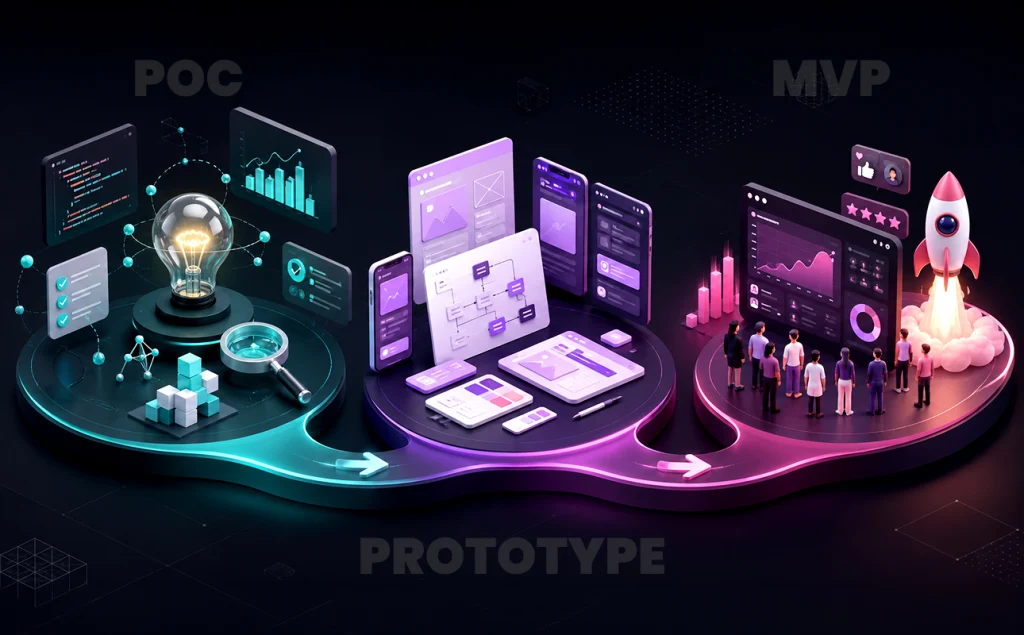
You have $30K to $60K set aside for your product, but you can’t tell your investor which stage you need first: a POC, a prototype, or an MVP. Choosing wrong burns the runway before anything is proven. Teams working with Bytes Technolab, an AI-first Product Engineering partner, get this call right before spending begins.
What Is a POC and When Does Your Product Actually Need One?
A POC, or Proof of Concept, answers one question only: can this be built at all?
It does not test design, user experience, or market demand. PoC development exists to demonstrate that a core technical idea is feasible before committing serious engineering resources.
When Does a POC Make Sense?
A POC makes sense when the technology at the centre of your product is unproven or unusual.
If you’re building an AI-powered document analysis tool, a POC tests whether a large language model can reliably extract structured data from legal files.
A fintech startup testing real-time fraud detection on novel signals runs the same kind of check.
Use this trigger test before deciding:
- Is the core technology your team has not used in production before?
- Does your product depend on a capability with no proven precedent in your stack?
- Would a failed technical assumption collapse the entire project?
If yes to any of these, PoC development is your right first step.
When Should You Skip the POC Entirely?
Skipping a POC is not cutting corners. For many products, it is the correct engineering decision.
If your product uses a standard tech stack, a SaaS platform, a marketplace, or a booking app, the technology is proven.
A POC here would consume two to four weeks of engineering time answering a question that was never in doubt.
The AI and deep tech exception is real. Gartner data from 2025 shows 30% of generative AI projects were abandoned after the POC stage.
That is not a failure rate. That is the POC doing its job: filtering ideas that cannot survive reality before six figures are spent.
That precision is what separates a POC from a prototype, which has a different job entirely.
What Is a Prototype and What Do Prototype Development Services Actually Deliver?
A prototype answers a different question: how will this product look, feel, and flow when it’s finished?
It is not a technical test. It is a visual, interactive model designed to show stakeholders, users, and investors what the experience will be like.
What Does a Prototype Actually Include?
A prototype can range from a static wireframe in Figma to a fully clickable model walking users through every screen.
Neither version has working backend logic, nor does it connect to a real database. Both are design artefacts.
Prototype Development Services focuses on user flow, interface layout, and the story your product tells when someone first touches it.
Can a Prototype Replace a POC for Investor Meetings?
For most pre-seed founders, a prototype is a more powerful investor tool than a POC.
A clickable Figma prototype showing three core user flows can be more persuasive at a pre-seed meeting than six months of backend engineering.
Investors at pre-seed are not evaluating your database architecture. They’re asking: Does this founder understand the user?
Still, a prototype cannot tell you whether your product will find a market.
It proves the design works. It cannot be proven that people will pay for what the design represents.
That gap is exactly what an MVP is engineered to close.
What Is an MVP and Why Is It Not Just a Basic Version?
An MVP is the first version of your product that real users can actually interact with.
It is far more expensive than most Australian founders expect, and far more specific in its purpose.
What Does Minimum Actually Mean?
Minimum does not mean rough, unfinished, or incomplete.
It means the smallest feature set that lets a real user complete the core task your product exists to solve.
MVP development delivers three things no prototype can match:
- Real authentication and data flow, your team can build on
- Real user behaviour you can track from day one
- A foundation for every feature decision that comes after
Research from Coherent Solutions in 2025 found that 91.3% of companies using the MVP approach successfully launched their product.
The ones that did not succeed typically skipped earlier validation stages and built too much before testing anything.
What Does MVP Development Cost in Australia?
Budget expectations for Australian founders are often significantly misaligned with market reality.
VoxturrLabs 2025 data puts typical MVP budgets at $47K to $260K, depending on scope, team location, and technical complexity.
A three to four-month build window is standard for most categories, extending to six to twelve months for fintech, health tech, or AI-native platforms. For founders actively evaluating MVP development services in Australia, these numbers are the realistic baseline to plan around.
The AI startup pattern worth knowing: if your product involves machine learning or generative AI, the most effective 2025 path is POC first, then MVP directly.
The prototype stage is often skipped when the core user experience depends on live model output rather than static interface design.
The answer depends entirely on where your product’s biggest risk sits right now.
Which One Do You Actually Need Right Now? A Scenario-Based Guide
Now that the differences are clear, the next question is which stage fits your specific situation.
The Three Trigger Scenarios
Scenario A: Your core technology is unproven.
Start with PoC development. Run a two to four-week feasibility test.
Then decide whether to prototype or move directly to MVP based on what you learn.
Scenario B: Your technology is proven, but you need investor buy-in.
Skip the POC. Go straight to a prototype.
A high-fidelity interactive model gives investors something real to respond to before any engineering budget is spent.
Scenario C: You have a validated concept and need real user feedback.
Engineer your MVP. CB Insights data shows 42% of startups fail due to no market need.
That figure represents founders who confused a prototype with a real market test.
If you are not certain which scenario describes your product, that uncertainty is the signal.
Founders who work with Bytes Technolab typically begin with a Product Discovery session, a structured conversation that maps the right entry point before any budget is committed.

The Stage You Choose Now Sets the Ceiling for Everything That Follows
Each stage has one job.
A POC proves feasibility, a prototype proves the design, and an MVP proves the market.
Choosing the wrong one does not just waste budget. It produces the wrong information, and wrong information at the start is harder to recover from than a failed experiment.
Bytes Technolab works with startups, scale-ups, and mid-enterprises across all three stages: POC Development, Prototype Development Services, and Custom MVP Software Development.
One partner across all three means no context is lost between stages, no handoff friction, and no renegotiation of decisions already made.
We do not build for today. We engineer for the AI era.
The worst outcome is not a failed POC. It is committing $50K to the wrong stage without a senior engineer to catch it first.
Frequently Asked Questions
PoC development tests whether a core technical idea can actually be built. You need it when your product depends on unproven technology, like a novel AI model or custom algorithm.
Skip it if your stack uses established, proven tools and the technology carries no risk.
MVP development typically takes three to four months, extending to six to twelve months for complex domains like fintech or AI.
Plan your runway to cover the full build window before you have paying users. Cutting the budget mid-build is the costliest mistake.
Custom MVP software development in Australia typically costs between $47K and $260K, based on scope, team location, and technical complexity.
Simpler SaaS apps sit toward the lower end. AI-native or health tech platforms with regulatory needs push toward the higher range.
Proof of Concept development is not always the first step. Skip it if your product uses proven technology, like a standard SaaS or marketplace app.
You only need a POC when the core technical capability your product depends on has no proven precedent.
Bytes Technolab works with startups, scale-ups, and mid-enterprises to engineer the right validation stage before any build begins.
The team runs structured Product Discovery sessions that map technical risk and investor readiness. Founders start with a clear, costed plan instead of guesswork.

Bhumi Patel
Client Partner
Bhumi Patel is a Client Partner at Bytes Technolab, working with organisations across Australia and New Zealand to deliver real business outcomes through AI‑powered product engineering She helps teams modernise their systems, improve operational efficiency, and bring new digital products to life with confidence. With experience across project delivery, operations, and client onboarding, Bhumi acts as the link between business goals and technology execution. She partners with startups and established enterprises to shape practical, high‑impact solutions — from AI‑first MVPs and scalable SaaS platforms to Agentic AI systems, Generative AI initiatives, and intelligent product development.
Table Of Content
- What Is a POC and When Does Your Product Actually Need One?
- When Does a POC Make Sense? A POC makes sense when the technology at the centre of your product is unproven or unusual.
- When Should You Skip the POC Entirely?
- What Is a Prototype and What Do Prototype Development Services Actually Deliver?
- What Does a Prototype Actually Include?
- Can a Prototype Replace a POC for Investor Meetings?
- What Is an MVP and Why Is It Not Just a Basic Version?
- What Does Minimum Actually Mean?
- What Does MVP Development Cost in Australia?
- Which One Do You Actually Need Right Now? A Scenario-Based Guide
- The Three Trigger Scenarios
- Scenario A: Your core technology is unproven.
- Scenario B: Your technology is proven, but you need investor buy-in.
- Scenario C: You have a validated concept and need real user feedback.
- The Stage You Choose Now Sets the Ceiling for Everything That Follows