



 October 14, 2026
 2 mins to read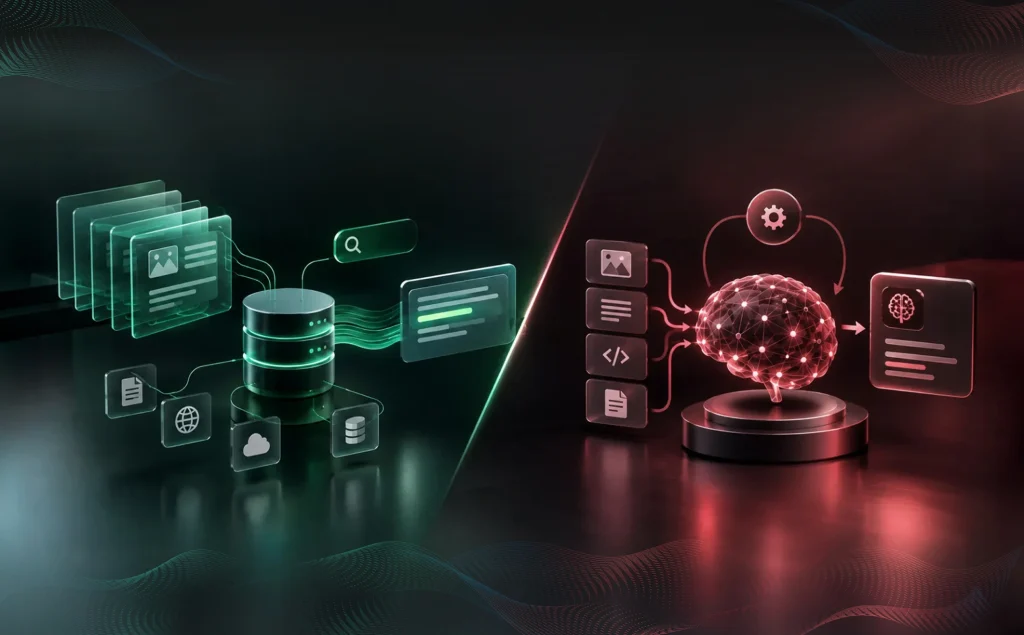
Your GenAI pilot works in demos, but production exposes a harder choice: does the model need fresher knowledge, more consistent behaviour, or both? Choose the wrong path, and you inherit repeated retraining, retrieval overhead, governance gaps, and avoidable operating costs.
The answer is not RAG or fine-tuning by default. Bytes Technolab, an AI-first Product Engineering partner, helps Australian technical teams prove whether knowledge access, model behaviour, or both deserve production investment before architecture choices become expensive and difficult to reverse.
RAG vs Fine-Tuning: Why This Choice Gets Expensive
RAG and fine-tuning become expensive when teams solve the wrong failure. One adds retrieval operations, while the other adds training, evaluation, and ongoing model lifecycle work.
Production makes those responsibilities recurring rather than temporary. Deloitte reports that 28% of Australian respondents moved at least 40% of their AI pilots into production.
That gap makes architecture discipline matter more than experimentation speed. A technique can work technically and still create unnecessary ownership when the diagnosed problem is wrong.
Why does the RAG vs. fine-tuning decision become expensive in production?
When information is missing, training may create repeated retraining without fixing freshness. When behaviour is inconsistent, retrieval can add infrastructure while leaving the behavioural failure intact.
The useful first question is therefore not which technology is stronger. It is the measurable failure the application must correct before more architecture is added.
Prompting and evaluation can expose a simpler fix first. If the problem disappears without retrieval or training, the team avoids building an operating burden it never needed.
That diagnosis sets up the comparison correctly. First identify the failure, then judge which architecture addresses it with the lowest sustainable production burden for your team.
What RAG and Fine-Tuning Actually Change
RAG changes the information available while the model answers, while fine-tuning changes learned behaviour through training. That distinction is the foundation for every later trade-off.
The difference matters because information and behaviour fail differently. Fresh policies, proprietary documents, or source evidence are knowledge problems, while repeated output patterns are behavioural problems.
Prompting and evaluation should come before either expensive path. If a stronger instruction fixes the issue consistently, adding retrieval or training may simply create avoidable ownership.
What is Retrieval-Augmented Generation (RAG)?
Retrieval-Augmented Generation connects an LLM to external information at response time. The model receives relevant context without changing its underlying parameters or retraining on every update.
What is Fine-Tuning?
Fine-tuning trains a pretrained model on selected examples to change repeated task behaviour. LLM fine-tuning is useful when evaluation shows a persistent pattern that prompting cannot fix.
What is the difference between RAG and fine-tuning?
RAG supplies external information while the model answers. Fine-tuning changes learned behaviour through training, so use it for persistent behavioural failure that survives prompting and evaluation.
- RAG asks which knowledge matters.
- Fine-tuning asks which behaviour repeats.
- Hybrid requires both needs.
The next step is practical. Compare where each option places control, maintenance, evidence, and operating responsibility before choosing the production path your team can sustain.
RAG vs Fine-Tuning: Side-by-Side Comparison
A fair RAG vs Fine-Tuning comparison uses the same production criteria for both approaches. Separate feature lists hide where responsibility, control, and maintenance actually move.
The LLM fine-tuning solutions concentrate more on datasets and model evaluation. A RAG System Solution concentrates on knowledge access, retrieval quality, permissions, and source freshness.
No approach wins every criterion because the business requirement changes the answer. The useful comparison asks what must remain current, consistent, traceable, governable, and maintainable.
How do RAG and fine-tuning compare across business criteria?
| Criterion | RAG | Fine-Tuning | Business question to ask |
| What changes | Runtime context | Model parameters | Information or behaviour? |
| Knowledge freshness | Refresh sources | Retrain for facts | How fast does knowledge change? |
| Proprietary data | Retrieve when needed | Train on examples | Must data stay externally controlled? |
| Citations | Supports sources | Not inherent | Must users verify? |
| Behaviour consistency | Prompt and context | Train repeated behaviour | Does one behaviour keep failing? |
| Update method | Refresh or re-index | Retrainan | What changes most often? |
| Latency | Adds retrieval work | Serving stack dependent | Which path meets targets? |
| Governance | Source permissions | Dataset and model controls | Which controls can teams maintain? |
| Maintenance | Retrieval quality | Dataset and regression | Who owns each pipeline? |
| Best fit | Dynamic knowledge | Durable specialised behaviour | What must stay current or consistent? |
The table narrows the decision but cannot make it automatically. Real workloads still decide which trade-off matters enough to justify another operating pipeline in production.
Freshness, Evidence, and Governance Change the Answer
RAG is strongest when business value depends on information that changes outside the model. Policies, product data, contracts, procedures, and permissions often meet that condition.
Custom RAG Development keeps those updates outside model retraining, but retrieval introduces its own failure modes. Stale indexes or weak ranking can still send unreliable context.
Trust, therefore, depends on more than connecting a vector store. Teams need source authority, freshness controls, permission boundaries, retrieval evaluation, and answer-grounding tests in production.
When should you use RAG instead of fine-tuning?
Use RAG when current or proprietary knowledge must enter responses at runtime. The case becomes stronger when users need citations, source authority, or permission-aware access.
Effective RAG Development Services need more than search infrastructure. They should include source ownership, retrieval evaluation, permissions, refresh processes, and grounding controls for production use.
Is RAG or fine-tuning better for reducing hallucinations?
Neither RAG nor fine-tuning guarantees factual reliability. RAG can improve grounding when retrieval returns authoritative context, while fine-tuning can improve performance on defined specialised tasks.
Both can still fail. Retrieved text may omit an exception, while a fine-tuned model may generate unsupported claims outside the behaviour or information tested during evaluation.
Reliability must therefore be measured directly. The architecture label alone cannot prove whether answers remain grounded, current, authorised, and dependable across representative real production cases.
Cost, Latency, and Maintenance Matter at Scale
Production cost is the work an organisation must repeat after launch, not only the initial implementation bill. RAG and fine-tuning create different recurring operational responsibilities.
RAG adds indexing, retrieval calls, search infrastructure, source refreshes, access controls, and relevance testing. Fine-tuning adds data preparation, training, regression tests, and model lifecycle work.
Latency also depends on implementation conditions rather than labels. Retrieval adds processing, while tuned model speed still depends on model size, infrastructure, provider, and workload.
Retrieval Operations
Retrieval operations succeed when the right evidence reaches the right user. Teams need tests for ranking quality, freshness, chunking, authority, permission boundaries, and retrieval relevance.
Model Operations
Model operations succeed when behavioural gains survive model and data changes. Teams need trusted examples, held-out evaluations, clear retraining criteria, version records, and regression gates.
A newer base model can change earlier assumptions. Bytes Technolab can connect evaluation, model adaptation, data, integration, monitoring, and release ownership around measurable production requirements.
Does fine-tuning make LLM responses faster than RAG?
Fine-tuning can remove retrieval for tasks that no longer need external context. However, that change does not guarantee lower end-to-end latency across every production workload.
A smaller tuned model may respond more quickly. A larger tuned model on slower infrastructure can still respond more slowly than a well-designed, efficient retrieval path.
The stronger comparison is lifecycle ownership. RAG creates retrieval operations, while fine-tuning creates model and dataset operations that teams must continually maintain, test, and evaluate.
That operating reality leads to the harder question. When does combining both approaches create enough measurable value to justify maintaining and governing both paths in production?
When RAG, Fine-Tuning, or Hybrid Wins
The right architecture follows requirements that have already been proven through evaluation. RAG fits changing evidence, while fine-tuning fits durable behaviour that strong prompting cannot control reliably enough.
Hybrid should not become the default answer because it combines two operating paths. That means two sets of decisions on evaluation, governance, maintenance, monitoring, and ownership.
Use hybrid only when knowledge and behaviour gains are independently measurable. The organisation must also show that it can operate both pipelines without weakening production control.
Can RAG and fine-tuning be used together?
RAG and fine-tuning can work together when changing knowledge and specialised behaviour are independently proven requirements. The KNOW-BEHAVE-OPERATE Framework tests both needs before adding hybrid complexity.
Know
KNOW asks what information the model must access. Test how often it changes, who may access it, and whether users need evidence before adding retrieval.
Behave
BEHAVE asks which output pattern must remain consistent. Fine-tuning enters only after prompting and evaluation expose a measurable behavioural failure that persists across representative tests.
Operate
OPERATE asks whether the organisation can maintain both paths. Retrieval needs source controls and evaluation, while fine-tuning needs model lifecycle controls, release discipline, and regression testing.
The framework turns a technology debate into a production gate. Prove knowledge value, prove behavioural value, then prove the team can sustainably own both responsibilities after launch.
If either gain is weak, use the simpler path. If operating ownership is weak, hybrid complexity has not earned production status even when both gains are present.
- KNOW -> RAG
- BEHAVE -> Fine-tuning
- KNOW + BEHAVE -> Hybrid
The decision flow keeps hybrid as an earned architecture choice. It prevents teams from adding two operating pipelines simply because both technologies are technically available.
Validate the Architecture Before You Scale It
Architecture validation should begin with a measurable failure, not a preferred technology. A focused 7- to 30-day test can compare options before major implementation spending.
Use the same evaluation set and production constraints for every alternative. Different demos prove little when each approach uses a different or selectively favourable definition of success.
An AI implementation strategy should end with a written decision record. That record prevents later model releases from reopening an architecture choice without new evidence.

What should your team validate before choosing an architecture?
- Name the measurable failure before changing architecture.
- Build tests from real production prompts.
- Test prompting and context before adding pipelines.
- Prototype retrieval for proven knowledge failures.
- Test tuning against one behavioural failure.
- Compare latency, governance, and ownership.
- Add hybrid only when both gains survive.
Teams assessing Generative AI development services in Australia should expect architecture validation first. A credible engagement should not begin with a predetermined preference for retrieval or training.
A defensible GenAI implementation strategy clearly records the decision. Capture the knowledge requirement, behavioural requirement, evaluation result, governance constraint, accountable operating owner, and chosen architecture.
Once those facts are recorded, the decision becomes repeatable. Architecture selection no longer changes simply because a new model release or vendor claim enters the discussion.
Make RAG or Fine-Tuning Earn Its Place
The RAG vs fine-tuning decision becomes manageable once the team stops choosing techniques first. Start with the failure, then prove which architecture removes it reliably.
Choose retrieval when current, controlled, or citable knowledge drives value. Choose fine-tuning when a persistent behavioural gap survives prompting and then improves measurably through targeted training.
Choose hybrid only after both gains are independently proven and operating ownership is credible. More architecture is not safer when the team cannot govern both paths.
Bytes Technolab, an AI-first Product Engineering partner, connects architecture selection with evaluation and ownership. That includes data readiness, retrieval engineering, model adaptation, governance, integration, and monitoring.
The goal is not to maximise customisation. It is to engineer the smallest system that solves the proven failure while remaining maintainable as requirements change.
That discipline gives technical leaders a decision they can defend today. Revisit it only when new evidence, workloads, models, or governance requirements materially change the case.
Frequently Asked Questions
Not every data change requires retraining. If the change affects factual knowledge, RAG can often update the accessible source without changing model weights. Retraining becomes relevant when changed data reflects a durable behaviour or task requirement that your existing model no longer handles consistently.
Use LLM fine-tuning when a repeated behavioural failure remains after strong prompting and evaluation. It fits durable requirements such as classification, output structure, specialised language, or repeated task performance where frequently changing external knowledge is clearly not the main problem.
Check the retrieval layer before changing the model. If relevant information exists but is missing, poorly ranked, stale, or inaccessible in the retrieved context, fine-tuning will not fix the underlying issue. Evaluate retrieval quality separately before treating generation as the bottleneck.
There is no universal dataset size for fine-tuning. The required volume depends on the task, model, and behaviour being changed. More important than raw volume is having high-quality examples that represent the behaviour the model must learn and a reliable evaluation set to prove the change.
Bytes Technolab can assess knowledge freshness, behavioural failures, proprietary data, permissions, evaluation needs, and operating ownership. The assessment compares prompting, retrieval, fine-tuning, and hybrid options against measurable requirements before recommending the smallest production architecture that can be governed and maintained.
Table Of Content
- RAG vs Fine-Tuning: Why This Choice Gets Expensive
- Why does the RAG vs. fine-tuning decision become expensive in production?
- What RAG and Fine-Tuning Actually Change
- What is Retrieval-Augmented Generation (RAG)?
- What is Fine-Tuning?
- What is the difference between RAG and fine-tuning?
- RAG vs Fine-Tuning: Side-by-Side Comparison
- How do RAG and fine-tuning compare across business criteria?
- Freshness, Evidence, and Governance Change the Answer
- When should you use RAG instead of fine-tuning?
- Is RAG or fine-tuning better for reducing hallucinations?
- Cost, Latency, and Maintenance Matter at Scale
- Retrieval Operations
- Model Operations
- Does fine-tuning make LLM responses faster than RAG?
- When RAG, Fine-Tuning, or Hybrid Wins
- Can RAG and fine-tuning be used together?
- Know
- Behave
- Operate
- Validate the Architecture Before You Scale It
- What should your team validate before choosing an architecture?
- Make RAG or Fine-Tuning Earn Its Place