


 July 26, 2026
 2 mins to read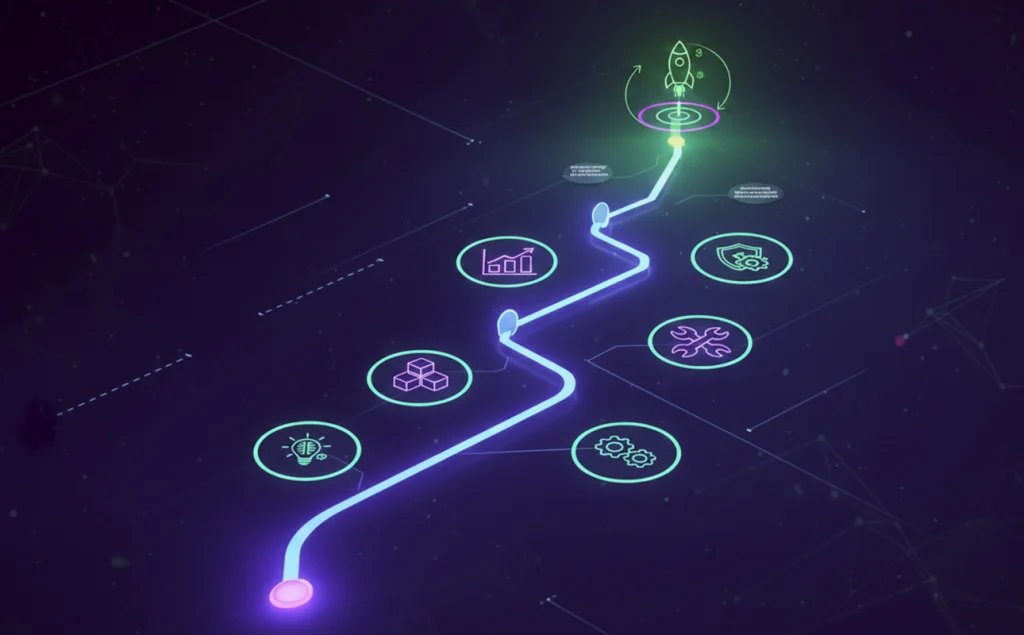
We have the idea and the budget, but our build process won’t survive real users. Most UK founders reach that critical moment too late. Teams working with Bytes Technolab, an AI-first product engineering partner, use this cycle map to spend the right budget at every stage, in the right order.
What a Digital Product Development Company Sees That Most UK Founders Miss
What experienced product teams recognise early is simple: product failure usually begins before development starts. The cycle exists to reduce that risk by validating assumptions, sequencing decisions, and protecting the budget before execution begins.
Why Does the Cycle Exist at All?
Most UK founders don’t start with the wrong idea. They start with the right idea and the wrong stage.
According to CB Insights, 42% of startups fail because they build a product nobody actually wants.
That failure doesn’t happen at launch. It happens at Stage 1, when founders skip discovery and move straight to engineering.
What Does a Structured Partner Actually Change?
A digital product development company makes stage-skipping structurally impossible.
Each stage gate requires a defined output before the next opens, and founders who skip those gates accelerate past the point where the most expensive mistakes happen.
That gap is where most UK product budgets disappear.
The 7 Stages of the Digital Product Development Cycle and What Product Development Services Actually Do
Product development services that cover the full cycle work through seven defined stages. Each stage has a distinct job and a specific output.
Sequence matters because every stage feeds the one after it.
Stage 1: What Happens During Discovery and Idea Generation?
Discovery is the highest-risk stage in the entire cycle. Most founders assume Stage 4 is the danger zone.
Stage 1 determines whether everything that follows is worth building at all.
This stage draws on two types of input: internal data from your product team and external validation from target users.
The goal is a single, testable problem statement that survives contact with real people.
Money spent on bad engineering is recoverable. Money spent engineering the wrong thing is not.
Stage 2: How Do You Screen Ideas Before Committing to One?
Idea screening filters what Discovery uncovers.
Your team evaluates each idea against four criteria:
- Technical feasibility
- Marketability and demand signal
- Resource fit for your current team
- Budget reality against expected return
Most products that fail were doomed here, before a single wireframe was drawn, because the screening assumptions were wrong.
The most common screening mistake is filtering ideas in-house only. External experts catch assumption failures that internal teams can’t see because they’re too close to the idea.
Stage 3: What Is Concept Development and When Do PoC Development Services Enter?
A screened idea becomes a product concept at Stage 3. That concept needs three things: a defined target market, a proposed price, and a mapped benefit set.
PoC development services enter the cycle here. A Proof of Concept proves technical viability before full investment is committed.
It answers the question investors actually ask: can this be built at the cost and quality you’re claiming?
Testing your concept with real users at this stage produces market validation data that changes the entire engineering plan downstream.
Stage 4: What Does Business Analysis and Marketing Strategy Actually Decide?
Stage 4 is the gate between a promising concept and a fundable product.
Business analysis here means building revenue projections, cost forecasts, and a realistic sales model.
The marketing strategy component defines how the product reaches its first users: pricing, positioning, and channel.
Founders who skip or rush this stage consistently underestimate launch costs by 40 to 60%.
You don’t need a full go-to-market plan at Stage 4. You need enough of one to know whether the numbers work.
Stage 5: How Does Product Engineering and Build Actually Work in 2025?
Stage 5 is where the product is engineered. Prototype development produces the first tangible version: testable, demonstrable, and built for feedback, not perfection.
The AI Era Build Stack
In 2025, AI-driven product development has changed this phase significantly.
AI tools now handle code generation, design iteration, and automated testing across agile sprints.
McKinsey data shows teams using AI-powered digital product engineering services reduce development time by up to 50% and cut costs by 20 to 30%.
The output at Stage 5 is not a finished product. It’s a working MVP, shipped iteratively, validated by real users at each sprint boundary.
Stage 6: Why Does Structured QA Determine Whether Early Users Stay?
Quality Assurance is not the last step before launch. It runs in parallel with Stage 5 from the first sprint.
Structured QA at this stage covers three layers:
- Functional testing across all user flows
- User acceptance testing with your target audience
- Performance testing under real traffic load
AI-automated test case generation now produces test suites in hours rather than weeks.
Teams that ship without this stage lose on average 66% of new users within two years of launch.
That retention figure comes from skipping structured QA, not from poor product design.
Stage 7: What Happens to the Cycle After Launch?
Launch is not the end of the development cycle. It’s the beginning of the most data-rich phase.
Product engineering services at Stage 7 maintain a live feedback loop: user behaviour data, conversion metrics, and support signals feed directly back into the next iteration plan.
It restarts at Stage 1 with real-world data instead of assumptions.
Where founders lose budget is at the decision points between them.

Where the Cycle Breaks Down and What Rigorous Product Engineering Services Actually Prevent
Three stage-failure patterns account for most wasted product budgets in the UK tech market.
What Are the Three Failure Points Founders Repeat Most?
First: skipping Discovery entirely and treating a founder’s instinct as validated demand. This produces a product built for a problem nobody confirmed existed.
Second: treating a PoC as an MVP. A PoC proves feasibility.
An MVP proves market fit. Conflating the two means committing full engineering spend on an idea that only passed a technical test.
Third: launching without structured QA. Early retention loss is almost always a QA failure, not a product failure.
How Do Product Engineering Services Stop the Compounding Effect?
Rigorous product engineering services prevent these failures by making each stage-gate a hard stop.
A partner who owns the cycle can’t skip Stage 1 because Stage 2 has no input without it.
The compounding cost matters: one skipped stage doesn’t cost one stage. It costs every stage after it.
For scale-ups with products already live, the risk doesn’t disappear at launch. The cycle resets.
After Launch, the Cycle Resets
Sixty-six per cent of new products fail within two years of launch.
Most were not bad products. Their teams stopped the cycle at Stage 7 instead of restarting it.
How Do Product Modernisation Services Bring Scale-Ups Back Into the Cycle?
Product Modernisation Services exist for this exact moment.
Bytes Technolab structures this re-entry as a full cycle restart, not a patch job.
Scale-ups returning to the cycle after launch need a Stage 1 data reassessment, a new Stage 2 screening pass, and updated Stage 5 engineering priorities.
The best UK digital products don’t treat launch as a finish line. They use live user data to loop back to Stage 1 every 90 to 120 days.
Owning that loop takes a partner who understands every stage of the cycle, not just the build.

Your Cycle Is Only as Strong as the Partner Who Owns It
The 7-stage cycle is not a theory. It’s a map for spending the right budget at the right stage, in the right order.
Bytes Technolab is an AI-first product engineering partner working with UK startups, scale-ups, and mid-size enterprises across every stage of the cycle.
From Product Discovery Workshop through PoC and MVP to SaaS architecture, the team owns each stage outcome, not just the code.
That approach means founders arrive at each stage gate with the evidence the next stage needs.
The cycle stays intact. The budget goes where it should.
If the runway is counting and the cycle feels unclear, the conversation worth starting is with someone who already knows every stage.
Frequently Asked Questions
A digital product development company owns each stage gate from Discovery to post-launch iteration. It validates demand, engineers the MVP, and maintains a feedback loop after launch.
The cycle stays intact under real-world pressure because every stage has a defined gate.
Rigorous product development services run stage gates, not just sprints. Every stage produces a defined output before the next one opens.
Red flags include skipping Discovery, treating a PoC as an MVP, or launching without QA. You’re working with a partner, not a task list.
A PoC proves the technology works at the claimed cost and complexity. A prototype proves the product is usable.
You need both when investors require technical validation before committing to a full build budget. They answer different questions at different stages.
AI-driven product development compresses Stage 5 and Stage 6 significantly. Code generation, design iteration, and automated test case creation now run across agile sprints at speed.
McKinsey’s 2025 data puts the time reduction at up to 50% and cost savings at 20 to 30%.
Bytes Technolab works with UK startups, scale-ups, and mid-size enterprises to run the full 7-stage cycle as a structured partner. The team covers Discovery through PoC, MVP, and SaaS architecture.
Founders get a costed, cycle-mapped product plan, not just a delivery estimate.
Table Of Content
- What a Digital Product Development Company Sees That Most UK Founders Miss
- Why Does the Cycle Exist at All?
- What Does a Structured Partner Actually Change?
- The 7 Stages of the Digital Product Development Cycle and What Product Development Services Actually Do
- Stage 1: What Happens During Discovery and Idea Generation?
- Stage 2: How Do You Screen Ideas Before Committing to One?
- Stage 3: What Is Concept Development and When Do PoC Development Services Enter?
- Stage 4: What Does Business Analysis and Marketing Strategy Actually Decide?
- Stage 5: How Does Product Engineering and Build Actually Work in 2025?
- Stage 6: Why Does Structured QA Determine Whether Early Users Stay?
- Stage 7: What Happens to the Cycle After Launch?
- Where the Cycle Breaks Down and What Rigorous Product Engineering Services Actually Prevent
- What Are the Three Failure Points Founders Repeat Most?
- How Do Product Engineering Services Stop the Compounding Effect?
- After Launch, the Cycle Resets
- How Do Product Modernisation Services Bring Scale-Ups Back Into the Cycle?
- Your Cycle Is Only as Strong as the Partner Who Owns It