



 August 31, 2026
 2 mins to read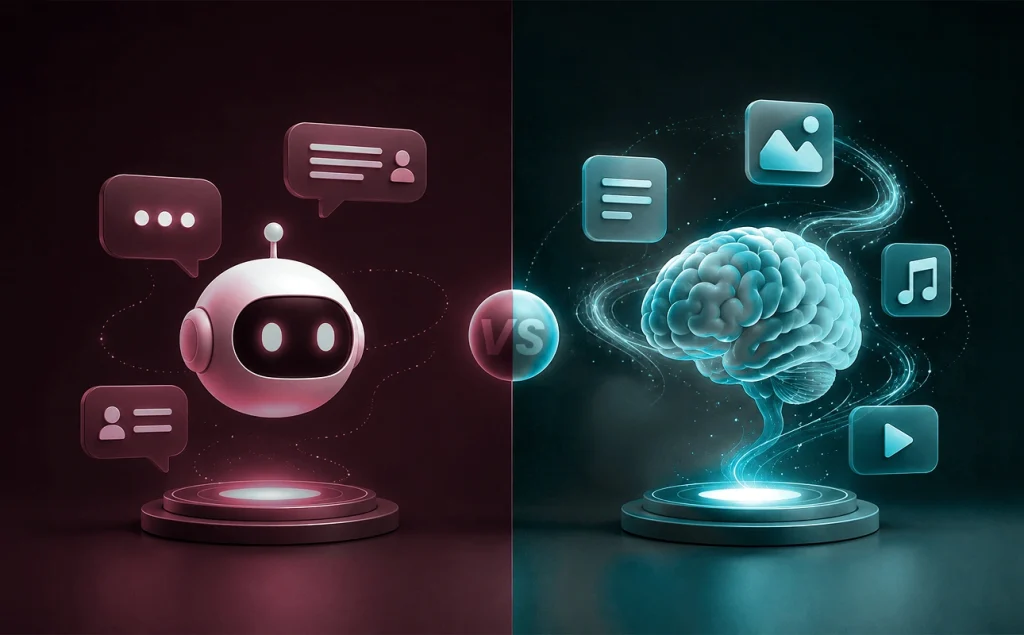
Your team approves an AI chatbot, but later finds it cannot safely handle refunds, customer data, or human handover. Treating conversational and generative AI as the same thing can lead to the wrong technology, weak controls, privacy issues, and rework.
The better approach is to decide what should talk, create, use data, follow rules, take action, or involve a person. Bytes Technolab, an AI-first Product Engineering partner, helps Australian product teams make these choices today before major development spending begins.
Why Conversational AI vs. Generative AI Is a Risky Shortcut
Two teams can both say they are building conversational AI and still create very different products. One may follow fixed flows. Another may let an LLM write most replies.
Those choices change what can go wrong. They affect customer data, CRM access, wrong answers, refunds, handover, response speed, system cost, and who owns problems after launch.
AI use is already common enough in Australia for these choices to matter. Then the Australian AI Adoption Tracker reported 41% SME adoption, five points higher than the previous quarter.
It also found 22% faster decision-making and 18% better productivity across surveyed businesses. The question is no longer only whether to use AI, but how to design it safely.
Conversational AI and Generative AI Are Not the Same Layer
Conversational AI manages an interaction. It can understand intent, remember context, guide steps, route requests, and hand work to a person.
Generative AI creates new content. Australian Government business guidance includes text, images, and computer code as common examples.
They can work together, but they do not have to. ChatGPT combines a conversational interface with generation. A foundation model is the underlying technology, while generative AI is a capability it can perform.
What is the difference between conversational AI and generative AI?
Conversational AI manages the exchange between a user and a system. Generative AI creates new output. A conversational system can use rules, retrieval, traditional NLP, generative models, or a mix, depending on how much freedom and control the use case needs.
Can conversational AI work without generative AI?
Yes. Google Cloud documents fully generative, partly generative, and deterministic conversational designs. That means generation is a design choice, not a requirement for every conversational product.
How Purpose, Outputs, and Response Control Differ
Start with the job the product must do. Conversational AI usually fits guided interaction and task completion. Generative AI usually fits creating, changing, or summarising content.
Next, decide how much variation is safe. Product recommendations may allow different wording. Account balances, refund rules, contractual commitments, and regulated instructions need much tighter control.
Hybrid design keeps flexible language separate from protected decisions. The model can speak naturally, while fixed rules govern outcomes that should remain consistent across similar cases.
How do conversational AI and generative AI differ in response control?
Conversational AI can use fixed, retrieved, or generated replies. Generative AI varies output. Hybrid systems keep sensitive decisions fixed and use generation only where variation is safe.
| Criterion | Conversational | Generative | Hybrid |
| Goal | Interaction | Content | Both |
| Input | Intent/context | Prompt/data | Both |
| Output | Replies/tasks | Content | Replies/actions |
| State | High | Optional | Selective |
| Interaction | Multi-turn | Flexible | Mixed |
| Responses | Fixed/mixed | Variable | Selective |
| Rules | Built-in | External | Separate |
| Grounding | Task-based | Fact-based | Explicit |
| Integrations | Common | Optional | Common |
| Handover | Common | External | Planned |
| Personal data | Channel | Prompt | Cross-layer |
| Hallucination | Design | eneration | Controls |
| Channels | Chat/voice | Any | Multiple |
| Evaluation | Tasks | Quality | Both |
Where Each AI Approach Fits in Practice
One product can use different AI methods at different moments. A support journey may combine conversation, trusted knowledge, generated wording, fixed rules, APIs, and human help.
A content tool may need none of that workflow logic. A service assistant may need identity, CRM, orders, permissions, ticketing, and clear handover rules.
Voice adds speech-to-text (STT), text-to-speech (TTS), interruption handling, and latency. Teams must test the full journey, not only whether the model answers correctly.

When Do You Need Support Automation Without Losing Control?
- Keep context across the conversation
- Ground replies in approved knowledge
- Escalate uncertain cases to people
Impact: Refund decisions stay rule-controlled.
When Is Content Creation the Real Job?
- Draft content from clear prompts
- Summarise approved source material
- Review important output before use
Impact: Unneeded conversation layers are avoided.
When Do Enterprise Answers Need Approved Knowledge?
- Retrieve approved enterprise information
- Apply user access permissions
- Show supporting sources when useful
Impact: Access rules protect restricted information.
When Must the AI Complete a Transaction Safely?
- Collect the required user details
- Apply fixed eligibility rules
- Call authorised business APIs
Impact: Actions follow approved rules first.
When Does Voice Add a Real-Time Constraint?
Research across ten languages found an overall mode of 0 ms and a mean response offset of 208 ms. This is human timing, not an AI target.
- Test full end-to-end latency
- Test interruptions and barge-in behaviour
- Connect telephony and human handover
Impact: Testing catches noticeable call delays.
Data, Grounding and Conversational AI Development
Conversational AI development becomes harder when the system uses business data or takes action. Identity, CRM, ERP, tickets, orders, permissions, and APIs all affect what it may do.
Conversation orchestration and chatbot engineering manage state, intent, channels, and handover. Enterprise grounding and RAG help limit answers to approved knowledge and user permissions.
An LLM, retrieval system, and transaction rule do different jobs. Keeping them separate makes errors, access, and business actions much easier to control in production.
Generation, Grounding, and Business Logic
Generation decides how an answer is written. Grounding decides which trusted facts can support it. Business logic decides what the system may decide or do.
User/Channel
- → Conversation State
- → Generation if needed
- → Approved Data
- → Rules plus APIs
- → Human Escalation
Governance and monitoring cover every layer.
For example, use conversation for navigation, grounded generation for policy answers, fixed rules for eligibility, APIs for transactions, and people for sensitive exceptions.
How do you stop the LLM from hallucinating or giving wrong answers?
No single control removes every wrong answer. Grounding, fixed rules, permissions, testing, monitoring, and human handover reduce different risks.
RAG helps with trusted sources, but not old data, wrong permissions, policy exceptions, or risky actions. Those still need separate checks.
What should stay deterministic in a generative AI experience?
Keep outcomes fixed when errors can change money, rights, safety, eligibility, contracts, or regulated instructions. Let AI explain the decision without making it.
Bytes Technolab uses Custom Conversational AI Development to mark these boundaries, keeping natural language flexible while important decisions, permissions, and actions stay controlled.
Privacy, Governance and AI Control in Australia
Risk depends on what the system does, what data it uses, how much freedom it has, and what happens when it is wrong. The AI label alone is not enough.
A fixed chatbot using sensitive personal data can be riskier than an internal writing assistant using approved non-personal information. Judge the real use case, not the category name.
Before launch, map prompts, chat records, CRM data, generated profiles, retention, provider access, sensitive information, and cross-border data flows. Define ownership and human intervention points.
How do Australian privacy rules change the AI architecture?
The OAIC says privacy obligations can apply to personal information entered into or created by AI. Incorrect or inferred information may also count when it identifies a person.
Public-facing chatbots should identify themselves as AI. Customers should know when support comes from a system rather than a person.
Human control should match risk. National AI Centre guidance recommends intervention points to pause, override, roll back, or shut down the system.
How should conversational and generative AI be measured differently?
The Australian Government AI technical standard covers value, performance, safety, reliability, data leakage, citations, adoption, abandonment, human intervention, usability, latency, and drift.
For conversation, track completion, containment, escalation, abandonment, turns to resolution, transactions, and latency. For generation, track groundedness, factuality, unsupported claims, source accuracy, safety, quality, and generation latency.
Hybrid systems need both groups plus business results. Test before launch and monitor after launch. Conversational AI development services in Australia and generative AI development services in Australia should define them early.
Use the CONTROL Test to Choose the Right Architecture
Choose the architecture by asking what the system needs to talk about, create, know, decide, and do. Do not begin with the AI label that sounds most advanced.
The CONTROL Architecture Test gives product teams seven decision gates. Together, they show where conversation, generation, grounding, fixed rules, tools, and people belong in the product.
Australian governance matters too. The National AI Centre’s six essential practices cover accountability, impact, risk, information sharing, testing, monitoring, and human control.
How do you choose conversational AI, generative AI, or a hybrid?
Use conversational AI when interaction or task flow drives the job. Use generative AI for content creation. Choose hybrid when conversation also needs trusted data, fixed rules, actions, and human escalation.
C: Conversation Requirement
Is multi-turn context needed?
O: Output Variability
How much variation is safe?
N: Needed Data and Grounding
Which trusted data is allowed?
T: Transactions, Tools and Integrations
Which tools must act?
R: Risk and Regulatory Exposure
What happens if it is wrong?
O: Oversight and Escalation
Where must people take over?
L: Latency, Lifecycle and Operational Ownership
Who owns speed, cost, and change?
| Architecture | Best fit | Control | Integration | Grounding | Risk |
| Conversation AI | Tasks | High | High | Task | Workflow |
| Generative AI | Content | Lower | Optional | Facts | Output |
| Hybrid | Mixed | High | High | Explicit | Cross-layer |
Test generative AI development services and custom generative AI solutions against CONTROL. Model price is only part of production cost. Larger enterprises should also check audit records and supplier accountability.
Where does agentic AI fit?
Generative AI creates. Conversational AI interacts. Agentic AI acts through tools. One product may use all three, but actions need permissions, monitoring, and human control.
What to Validate Before AI Development Starts
Use the next 7 to 30 days to test the idea before a large build. Start with the business problem, not the name of an AI technology.
Identify which parts need conversation, generation, trusted data, fixed rules, or actions. Compare packaged tools with the custom engineering the use case truly needs.
Choose an AI ML development partner for architecture, data, integration, governance, and production ownership, not only for familiarity with one model or API alone.
What should you validate before AI development starts?
An AI readiness assessment should test the problem, data, privacy, integrations, control, monitoring, and handover. Use a small pilot before wider rollout.
Pilot and Ownership Check
- Define the business problem.
- Classify the required outcome.
- Mark fixed outputs.
- Map personal data flows.
- List approved sources.
- Map systems and access.
- Define human handover points.
- Set task, factuality, grounding, latency, safety, and intervention measures.
- Name the production owner.
- Pilot one or two areas.
- Test voice behaviour.
- Compare tool options.
- Judge production competence.
These checks make the design testable and reduce the risk of funding a good demo that becomes hard to control after launch.
Choose the Architecture, Not the AI Label
Conversational AI and generative AI are different, but they are not automatic competitors. Conversational AI manages interaction. Generative AI creates new output. Either can work without the other.
A conversational product can use fixed flows, retrieval, generated replies, or a mix. A generative tool can create useful output without any chat experience, dialogue state, or handover logic.
Hybrid architecture makes sense when users need natural conversation plus trusted data, fixed rules, tools, and human help. It should be chosen because the use case needs it, not because hybrid sounds better.
Bytes Technolab, an AI-first Product Engineering partner, brings these parts together around the business problem, data, integrations, risk, and measurable outcomes for Australian product teams.
The aim is simple: decide what the AI may know, say, decide, and do. Keep strong controls where mistakes matter, and allow more flexibility only where the business can safely accept it.
The best question is not, “Which AI is better?” Ask, “Which layer should do each job, and where must people stay in control?” That question leads to a clearer product decision.
Frequently Asked Questions
Conversational AI manages an exchange with a user, including context, routing, and tasks. Generative AI creates new output. In Conversational AI vs. Generative AI decisions, either can work alone, while hybrid products combine them only where the use case needs both.
No. Conversational AI development focuses on how users interact with a system. It can use rules, retrieval, fixed replies, or generated replies. Generative AI focuses on creating new content, so the two terms describe different parts of an AI product.
Yes. Rules, intents, retrieval, and fixed flows can support useful conversations without generated replies. Conversational AI development Services Australia still needs privacy, integration, monitoring, and human handover because non-generative systems can also use personal data or trigger important business processes.
ChatGPT uses both ideas. The application gives users a conversational interface, while generative models create the responses. That distinction matters for custom generative AI solutions because generation can also support writing, coding, summarising, images, or analysis without a conversational journey.
Bytes Technolab reduces wrong-answer risk with approved-source grounding, fixed rules, permissions, testing, monitoring, and human escalation. Hallucinations cannot be guaranteed away, so important outputs need checks and sensitive decisions should stay under stronger business controls instead of relying on free generation.
Table Of Content
- Why Conversational AI vs. Generative AI Is a Risky Shortcut
- Conversational AI and Generative AI Are Not the Same Layer
- What is the difference between conversational AI and generative AI?
- Can conversational AI work without generative AI?
- How Purpose, Outputs, and Response Control Differ
- How do conversational AI and generative AI differ in response control?
- Where Each AI Approach Fits in Practice
- When Do You Need Support Automation Without Losing Control?
- When Is Content Creation the Real Job?
- When Do Enterprise Answers Need Approved Knowledge?
- When Must the AI Complete a Transaction Safely?
- When Does Voice Add a Real-Time Constraint?
- Data, Grounding and Conversational AI Development
- Generation, Grounding, and Business Logic
- How do you stop the LLM from hallucinating or giving wrong answers?
- What should stay deterministic in a generative AI experience?
- Privacy, Governance and AI Control in Australia
- How do Australian privacy rules change the AI architecture?
- How should conversational and generative AI be measured differently?
- Use the CONTROL Test to Choose the Right Architecture
- How do you choose conversational AI, generative AI, or a hybrid?
- C: Conversation Requirement
- O: Output Variability
- N: Needed Data and Grounding
- T: Transactions, Tools and Integrations
- R: Risk and Regulatory Exposure
- O: Oversight and Escalation
- L: Latency, Lifecycle and Operational Ownership
- Where does agentic AI fit?
- What to Validate Before AI Development Starts
- What should you validate before AI development starts?
- Pilot and Ownership Check
- Choose the Architecture, Not the AI Label