



 October 7, 2026
 2 mins to read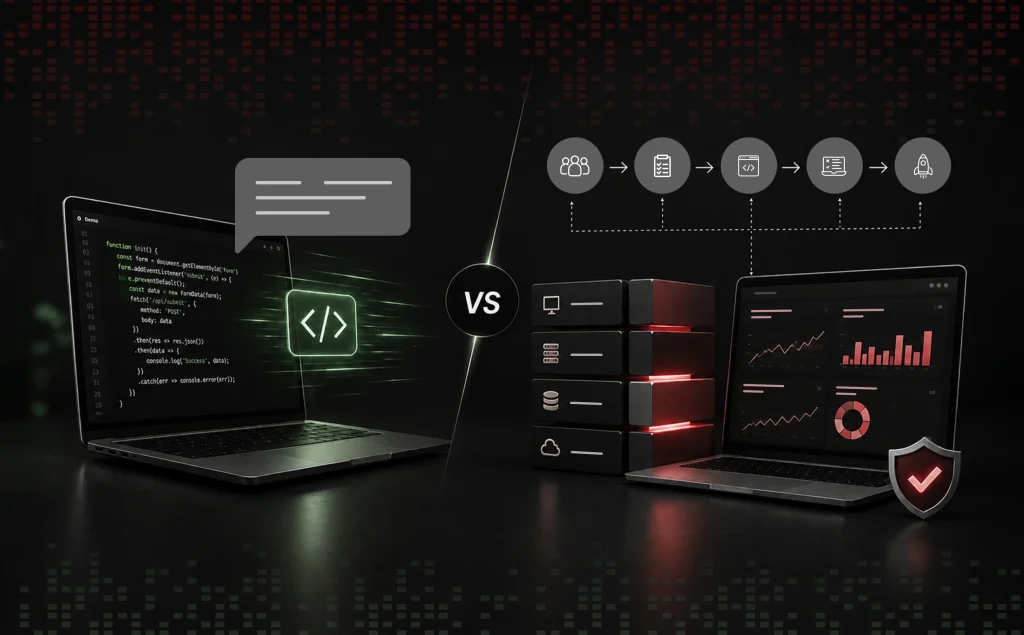
An MVP no longer needs months of work before anyone can see it. A founder can now put a simple version of an idea in front of people within days. That is why vibe coding is so tempting.
But speed alone does not make a product ready for an investor conversation.
The real vibe coding vs engineered MVP decision is about the proof you need next. Do you need to see whether people understand the idea? Or do you need to show that customers will use, return to, and value the product?
For Australian founders, that distinction matters. A quick prototype can open the first conversation. An engineered MVP can help turn that conversation into evidence.
The Question Investors Are Really Asking
Most early-stage investors do not expect a finished product. They do, however, want to understand what you have learnt, why the problem matters and what makes your business worth backing.
A polished screen is useful. It gives people something concrete to react to. But it cannot answer the questions that sit behind an investment decision:
- Is this a problem people genuinely want solved?
- Who has felt that problem often enough to care?
- Has anyone tried the product and come back?
- What changed after the founder listened to customers?
- What will the next round of funding make possible?
That is why an investor-ready MVP is not simply the quickest product you can build. It is the smallest version that helps you learn something meaningful about customers and the business.
Where Vibe Coding Earns Its Place
Vibe coding is useful when you need to bring an early idea to life quickly. It can help you show a customer what you mean, test a simple journey, or make an idea easier to discuss.
At this stage, the goal isn’t to prove that every part of the product is ready. The aim is to learn whether the idea is clear enough to spark interest.
It can be a good fit when you need to:
- test several versions of an idea before choosing one;
- show a simple concept during customer interviews;
- create an early demonstration for advisers or potential partners;
- test the wording, flow, or value of a single customer journey; or
- build a waitlist around a problem people recognise.
This is where vibe coding development can be useful, particularly when the goal is to turn an early concept into something people can interact with and respond to.
This is valuable work. Founders should not spend months building something detailed before they have heard from the people they hope will use it.
The risk comes when a quick first version is treated as final proof. A customer saying, “That looks interesting,” is different from a customer using the product to solve a real problem.
Where a Quick Prototype Can Stop Being Enough
A simple prototype may work well for a planned demonstration. Real customers bring different questions, choices, and habits.
They may leave and return later. They may use the product on a phone instead of a laptop. They may expect their information to be handled carefully. They may ask for one part of the journey to work in a way the first version did not anticipate.
If the product needs to support a pilot, collect reliable customer feedback, or demonstrate repeat use, the founder needs more than a convincing screen.
Common signs that it is time to move beyond a quick build include:
- prospective customers want to trial the product properly;
- the same fixes keep taking time or creating new issues;
- the founder cannot easily see which parts customers use and where they stop;
- the product needs to support payments, sensitive information, or a more detailed customer journey; or
- an investor wants to understand what users have actually done, rather than what they might do.
This does not mean vibe coding has failed. It means it has done its job: it helped the founder get to the next, more important question.
What an Engineered MVP Gives You
An engineered MVP is not a larger version of the same idea. It is a more deliberate version.
It focuses on one valuable customer journey and builds enough around that journey for real people to use it, give feedback and help the founder decide what should happen next.
Good MVP development for startups keeps the scope small. It avoids adding every possible feature. Instead, it makes the core experience clear, usable, and ready for learning.
That gives founders stronger evidence to take into an investor meeting:
- a customer can complete the main task the product promises to solve;
- the founder can show what customers used, where they paused, and what they asked for next;
- feedback can lead to practical improvements rather than a complete rebuild; and
- the product tells a more credible story about how the business could grow.
This is where product engineering matters. It makes the first version useful enough to test in the real world, while keeping the work focused on the decisions that matter now.
The same principle applies to an AI MVP development project. The label does not change the investor question: does this product solve a meaningful problem for a specific customer, and can the founder show evidence of that?
Vibe Coding vs Engineered MVP: Choose by the Proof You Need
The right choice depends less on the method and more on the next decision in front of you.
| If you need to… | Start with |
| Show an idea and gather first reactions | Vibe coding |
| Compare a few possible approaches quickly | Vibe coding |
| Test whether customers will use the product more than once | An engineered MVP |
| Run a pilot with prospective customers | An engineered MVP |
| Demonstrate real progress to investors | An engineered MVP |
| Turn early interest into clearer customer evidence | An engineered MVP |
Some teams describe this next step as rapid MVP engineering. The word “rapid” should not mean rushed. It should mean moving quickly towards a focused test, then learning from the result.
A custom MVP development approach is useful when the product has a specific customer journey, business model, or market need that a generic template cannot show well. The goal remains the same: build enough to test the right assumption and no more.
The Investor Proof Test
Before you decide whether your product is ready to show investors, use this simple test.
1. Does it prove that the problem is real?
Be clear about who has the problem, how they deal with it today, and why the current approach is not good enough. Customer conversations, trial interest, and early sign-ups can all help.
2. Does it prove that your solution helps?
A good MVP does not need to solve everything. It should let a customer complete one important task and show whether that experience has value.
3. Does it prove that you can learn?
Investors know the first version will change. What matters is whether you can explain what you heard from customers, what you changed because of it, and what you plan to test next.
This is the point many founders miss. Investors are not looking for a product that claims to have every answer. They want to see a founder who knows which answers still need to be found.
What to Bring to an Investor Meeting in 2027
If your MVP is part of the funding conversation, prepare five things.
A clear problem statement
Explain the customer problem in plain language. Avoid a broad market claim that could apply to everyone.
A short live demo
Show one customer journey from beginning to end. Keep it short enough for someone to understand the value without your narration doing all the work.
Evidence of customer interest
Share relevant signals: interviews, a waitlist, pilot discussions, early use or feedback. You do not need to pretend these are bigger than they are.
What you learnt
Show one or two decisions that changed because of customer feedback. This makes the business feel active and grounded.
A focused next step
Be able to explain what the funding will help you test, build, or prove next. A specific plan is more convincing than a long feature list.
Build for Learning, Then Build for Proof
Vibe coding can be the right first move when you need to test whether an idea deserves more attention. It is a fast way to get a conversation started.
An engineered MVP is the better next move when you need a product that customers can use properly, and investors can assess with confidence.
The best choice is not about picking one side forever. It is about matching the build to the proof your startup needs now.
Frequently Asked Questions
Yes, when the goal is to test an early idea, show a simple concept or collect first reactions. It is less suitable once you need reliable customer use, a pilot or evidence for an investor conversation.
It is possible, especially when you have a strong founder story, clear market insight or early signs of demand. A prototype becomes more persuasive when it is supported by customer feedback and a clear learning plan.
An investor-ready MVP shows a clear customer problem, a focused solution and evidence that real people are interested or using it. It should also help the founder explain what has been learnt and what will be tested next.
Move when customers want to use the product beyond a demonstration, when you need to run a pilot or when you need reliable evidence about customer behaviour. That is when a more deliberate build becomes valuable.
Choose a partner that will first help you narrow the customer problem and define the smallest useful product. Ask how they will support customer feedback, prioritise the first release and help you plan the next stage after launch.
Table Of Content
- The Question Investors Are Really Asking
- Where Vibe Coding Earns Its Place
- Where a Quick Prototype Can Stop Being Enough
- What an Engineered MVP Gives You
- Vibe Coding vs Engineered MVP: Choose by the Proof You Need
- The Investor Proof Test
- 1. Does it prove that the problem is real?
- 2. Does it prove that your solution helps?
- 3. Does it prove that you can learn?
- What to Bring to an Investor Meeting in 2027
- Build for Learning, Then Build for Proof