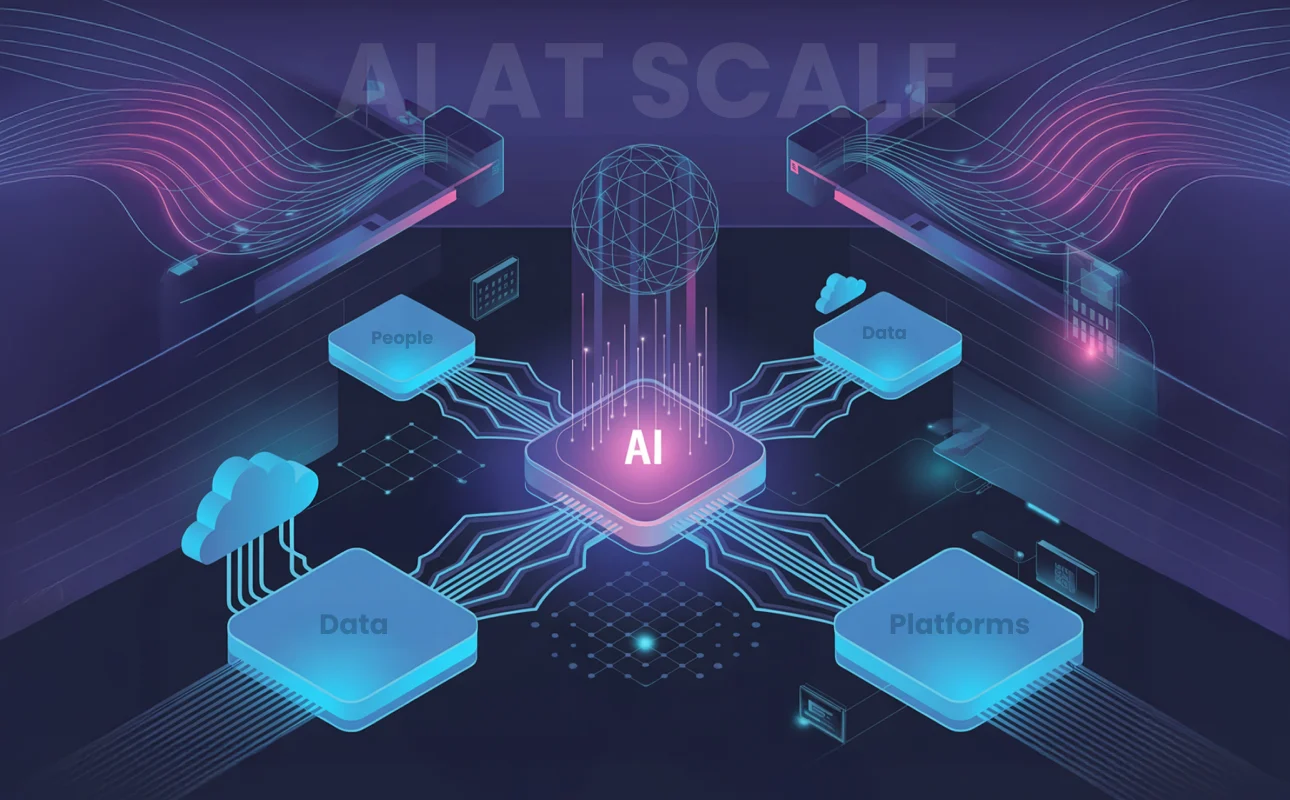

Artificial Intelligence has moved beyond experiments and isolated pilots. Enterprises across industries now recognize that scaling AI is no longer optional; it is a fundamental requirement to stay relevant in an increasingly digital-first economy. But scaling AI isn’t about plugging in algorithms or adding a new tool to your stack. It requires a full-scale rewiring of the enterprise—reshaping how people work, how data flows, and how platforms operate to create a connected, intelligent business ecosystem.

At Bytes Technolab, we work with global enterprises to help them modernize, innovate, and scale. Over the years, one truth has stood out—AI transformation is less about technology alone and more about building the right foundation where people, data, and platforms come together seamlessly. Let’s explore what it really means to rewire the enterprise for AI at scale.
Why Enterprises Need AI at Scale

AI is no longer confined to predicting customer churn or powering a chatbot. Enterprises are looking at it as a driver of large-scale transformation:

  • Banks use AI to detect fraud in real time, saving millions in potential losses.
  • Manufacturers deploy predictive maintenance systems to keep production lines running without costly downtime.
  • Retailers rely on recommendation engines and demand forecasting to optimize sales and supply chains.
  • Healthcare providers leverage AI-powered platforms to improve clinical decisions, reduce errors, and personalize patient care.

These examples show that the stakes are high. Companies that embrace AI at scale unlock efficiency, resilience, and growth. Those that lag risk being disrupted by more agile competitors. But building AI at scale is not about buying the latest platform or recruiting a few data scientists. It calls for a systematic shift across people, data, and platforms.

Rewiring People: The Human Foundation of AI

Technology only works when people are ready to adopt and adapt. For enterprises, the biggest challenge is not deploying AI models but driving cultural readiness across the workforce.

  • Building AI Fluency Across Roles

AI is often seen as a “specialist’s domain.” But in reality, everyone in an organization must understand how AI influences their role—whether it is a customer service executive using AI-powered support tools or a supply chain manager making data-driven decisions. Building AI fluency across all levels fosters confidence, reduces resistance, and accelerates adoption.

  • Redefining Roles and Responsibilities

When AI takes over repetitive tasks, human roles evolve toward higher-value activities—strategic decision-making, problem-solving, and customer engagement. Enterprises need to reimagine job descriptions, provide reskilling programs, and ensure employees see AI as an enabler rather than a threat.

  • Leadership Commitment and Change Management

AI at scale requires bold leadership. Senior executives must go beyond sponsoring projects; they must actively advocate for AI adoption, set clear goals, and communicate the vision across teams. Change management plays a central role—helping employees transition smoothly and embedding AI in everyday processes.

At Bytes Technolab, we often advise enterprise leaders to treat AI adoption as a “people-first initiative.” When people are aligned with the strategy, technology adoption becomes smoother and faster.

Modernize What Matter First

Rewiring Data: The Lifeblood of AI

AI is only as good as the data it learns from. Scaling AI in an enterprise setting means breaking away from data silos, ensuring data quality, and creating systems that allow for continuous data-driven decision-making.

  • Eliminating Silos Through Data Modernization

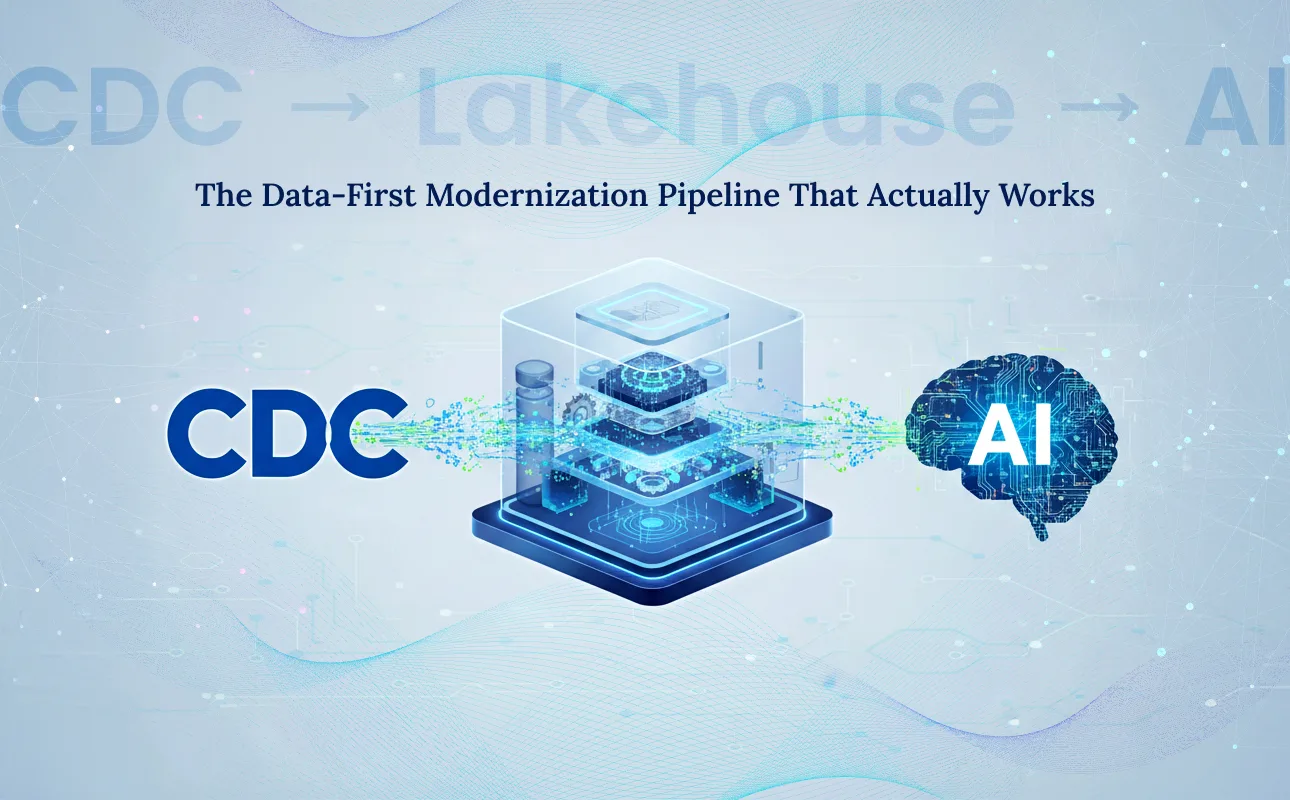
Most enterprises today struggle with fragmented legacy systems where data sits in disconnected silos—ERP, CRM, HR, marketing, finance, and beyond. AI cannot thrive in such an environment. The first step is modernizing data infrastructure, creating unified data lakes or warehouses, and enabling enterprise-wide accessibility.

  • Data Quality and Governance

Poor data leads to poor insights. Enterprises must invest in data cleansing, enrichment, and validation processes to ensure that AI outputs are accurate and trustworthy. Equally important is data governance—clear policies for data usage, compliance, security, and ethics. As regulations like GDPR and CCPA continue to expand globally, governance is not optional; it is a competitive differentiator.

  • Real-Time Data Pipelines

AI thrives on fresh data. Whether it is a retailer adjusting promotions based on customer activity or a logistics provider rerouting fleets during disruptions, real-time data is essential. Enterprises must invest in automated data pipelines and integrations that feed AI platforms continuously.

As a top enterprise digital transformation partner, Bytes Technolab helps organizations build future-ready data ecosystems. From data engineering and migration to cloud-native architectures, we empower enterprises to convert their data into a strategic asset.

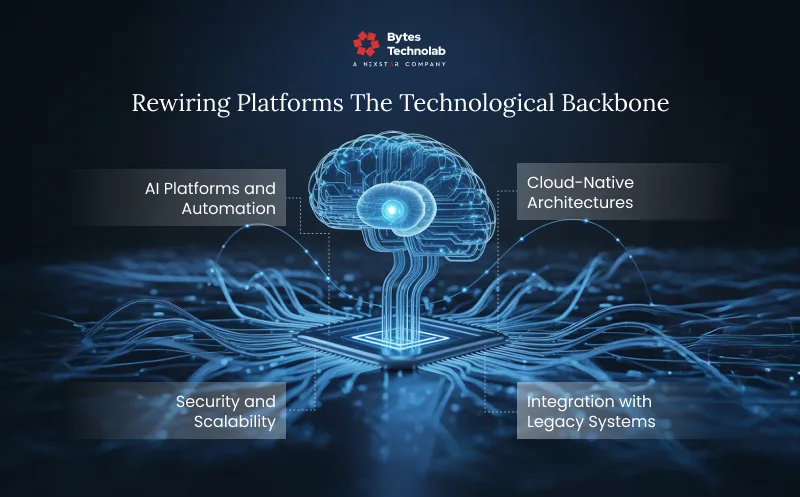
Rewiring Platforms: The Technological Backbone

While people and data create the foundation, platforms provide the execution layer. Enterprises must rethink their technology stack to enable AI-powered transformation at scale.

Rewiring Platforms: The Technological Backbone

  • Cloud-Native Architectures

Legacy infrastructure often holds enterprises back. Cloud-native architectures allow scalability, flexibility, and faster experimentation. With platforms like AWS, Azure, and Google Cloud, enterprises can run AI workloads without worrying about infrastructure bottlenecks.

  • Integration with Legacy Systems

Many enterprises still run on decades-old ERP or core banking systems. Modernizing does not always mean replacing; it often means integrating. By creating hybrid environments where AI-driven platforms coexist with legacy systems, enterprises reduce risk while still unlocking new value.

  • AI Platforms and Automation

From intelligent process automation to machine learning pipelines, enterprises need platforms that not only process data but also continuously learn and improve. The focus is not just on building AI models but on operationalizing them—making AI accessible across business units.

  • Security and Scalability

AI platforms process massive volumes of sensitive data. Cybersecurity, identity management, and compliance monitoring must be embedded into the core design. Equally critical is scalability—ensuring the system can handle millions of transactions or thousands of model inferences per second without failing.

At Bytes Technolab, we guide enterprises through platform modernization journeys—whether it’s migrating to microservices, implementing MLOps pipelines, or integrating AI into customer-facing systems.

Our ‘Perfect’ Approach to Enterprise AI Transformation

Rewiring for AI at scale is not a one-size-fits-all journey. Every enterprise has unique challenges, legacy dependencies, and strategic goals. Our approach focuses on four pillars:

  1. Assessment & Strategy: We begin by assessing the enterprise’s current readiness across people, data, and platforms, followed by a tailored AI roadmap.
  2. Data & Infrastructure Modernization: We help enterprises unify, clean, and govern their data, while modernizing platforms to handle AI workloads.
  3. AI Development & Integration: From custom AI models to pre-built accelerators, we integrate AI into core business processes.
  4. Change Management & Scaling: We work closely with stakeholders to drive adoption, build AI fluency, and scale solutions across the enterprise.

This holistic approach ensures that AI transformation is not limited to isolated experiments but becomes an enterprise-wide capability.

Real-World Impact: AI Transformation in Action

Enterprises that rewire effectively see tangible results:

  • A global manufacturer reduced downtime by 40 percent with predictive maintenance powered by AI and IoT.
  • A financial institution cut fraud losses by half through AI-driven transaction monitoring.
  • A retail chain increased customer loyalty by 30 percent using AI-powered customer personalization at scale and predictive analytics.
  • A healthcare enterprise accelerated diagnosis times by integrating AI with electronic medical records and clinical workflows.

These are not abstract benefits—they are real-world outcomes made possible when people, data, and platforms align under a clear AI transformation strategy.

Challenges on the Road to AI at Scale

The journey is not without obstacles:

  • Cultural Resistance: Employees may fear job displacement or struggle to trust AI decisions.
  • Legacy Burden: Aging systems and outdated infrastructure slow down adoption.
  • Data Privacy Concerns: Regulations and ethical challenges around personal data require careful navigation.
  • Skill Gaps: Enterprises often lack the right balance of technical expertise and domain knowledge.

Acknowledging these challenges is crucial. What separates successful enterprises is their ability to address them proactively in reskilling, modernization, and trusted partnerships.

Future Outlook: AI-First Enterprises

Looking ahead, AI will become as fundamental to enterprises as electricity. From intelligent supply chains to adaptive customer engagement, AI will power every layer of the organization.

The enterprises that succeed will be those that not only deploy AI but weave it into the fabric of their operations. They will create workforces that are AI-fluent, data systems that are seamless, and platforms that are agile.

At Bytes Technolab, we see ourselves not just as a technology vendor but as a long-term transformation partner. We help enterprises transition from fragmented pilots to AI-first organizations ready to compete and thrive in a digital economy.

Future Outlook: AI-First Enterprises

Conclusion: Rewire Today, Scale Tomorrow

Rewiring the enterprise for AI at scale is no longer a distant vision. It is a business necessity. The enterprises that invest in people readiness, data modernization, and platform evolution will lead their industries with agility and innovation. Those that delay risk being left behind.

The question is not whether your enterprise should embrace AI but whether your enterprise is ready to scale it. At Bytes Technolab, we make that transition possible, with deep expertise in enterprise digital transformation, legacy modernization, and AI integration.

Your journey to becoming an AI-powered enterprise begins with a single step: rewiring your foundation. Once people, data, and platforms are aligned, the possibilities are limitless.

Start with a readiness assessment across people, data, and platforms. Identify one or two business outcomes that matter this quarter, then trace backward to the data and processes that power those outcomes. Stand up a small cross-functional team that includes IT, data, security, and the business owner of the outcome. This creates focus, removes blockers early, and turns a pilot into a repeatable pattern you can scale.

Not always. Many enterprises succeed with a phased approach that wraps and extends legacy systems through APIs, event streams, and microservices while moving analytical and AI workloads to cloud platforms. Replace what truly limits performance or compliance. Integrate what still delivers value. This reduces risk and accelerates results.

Anchor cost and timing to clearly defined business use cases. For most enterprises, the first three to four months cover discovery, architecture, data pipelines, and an initial production release for one use case. Subsequent use cases move faster because you reuse foundations such as data models, integration patterns, and MLOps pipelines. Budget in parallel for change management, training, and governance because adoption drives ROI.

Blend domain experts with data and platform specialists. Typical core roles include a product owner from the business, a data engineer, a machine learning engineer, a solutions architect, and a change lead. As you scale, add model risk management, data governance, and security engineering. Upskill existing teams and bring in outside specialists where needed to accelerate.

Automate as much as possible. Build quality checks into pipelines, track lineage, and version datasets just like code. Define data ownership and access policies early and enforce them with role-based controls and audit logs. A small data council that meets regularly to approve definitions, retention rules, and access requests will keep the program moving while staying compliant.

DevOps focuses on application code. MLOps adds the lifecycle for data, features, and models. You will manage training pipelines, feature stores, experiment tracking, automated testing for data drift, and controlled model rollout and rollback. Treat models as living assets that require monitoring, retraining, and governance.

Pick use cases with measurable levers. For example, reduce claim cycle time, decrease unplanned downtime, lift conversion in a specific funnel, or cut fraud losses. Establish the baseline, run an A and B comparison in production, and measure uplifts against operating costs. Share wins widely inside the company to build momentum for the next wave.

Related Blogs