


 May 5, 2025
 2 mins to read
Launching a startup is a thrilling rollercoaster. You’ve got a bold idea, the passion to back it up, and maybe even a few investors on board. But here’s the raw truth: almost 9 out of 10 startups fail, and one of the biggest reasons is building too much, too soon, without validating the demand.
It’s like pouring your life savings into building a luxury hotel… without checking if tourists are actually visiting the city.
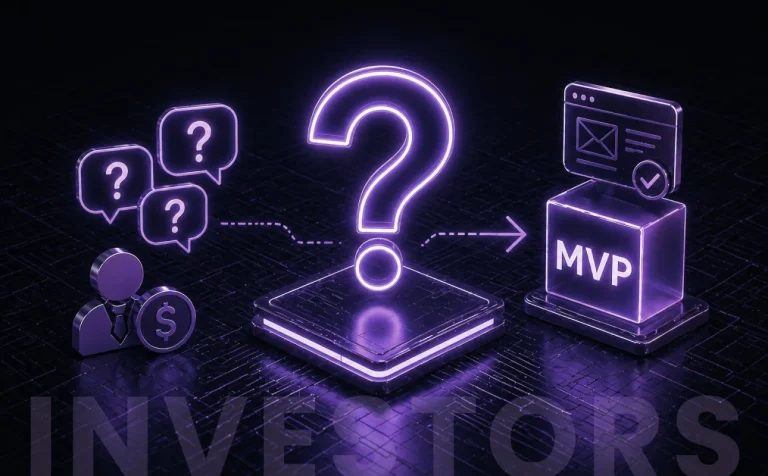
This is where MVP development services for startups becomes your safety net — a smart, strategic move that turns guesswork into insight and risk into opportunity. It’s not about building less; it’s about building right. And when done well, a Minimum Viable Product (MVP) doesn’t just test your idea — it strengthens your foundation for long-term success.
Why MVP Development is a Game-Changer for Startups?
Building software from scratch can be expensive, time-consuming, and filled with unknowns. Custom MVP software development flips that process with a structured development process that helps validate a business idea, test whether there is real market need before major initial investment, and keep the product development process focused on the core value proposition. It helps you start small, test smart, and grow with confidence.
In fact, 42% of startups fail because there is no market need, which makes early validation through market research and a learning tool mindset critical.
Let’s walk through why MVP development is more than a buzzword — it’s your startup’s risk-reduction strategy, where a proof of concept can confirm feasibility first, the MVP approach supports iterative validation, and feedback helps shape a successful MVP for startup MVP development.
1. MVP Validates Your Idea Before You Go All-In
You might think your product is the next big thing, but do your customers agree? MVPs give you early-stage feedback from real users, not just assumptions or internal opinions.
2. MVP Saves Time, Money, and Energy
Why spend six months and a full development budget building features users might not even want? With MVP development services for startups, you invest only in the core functionality first, reducing waste and increasing learning.
3. MVP Identifies Real Market Needs
Startups often change their direction if one implemented strategy goes awry. To be honest with you, that is absolutely normal considering the evolving market and changing customer demands. Startups build an MVP first to feel empowered, as it allows them to understand what users actually need. Ultimately, this process enables them to adapt quickly without overhauling an entire product.
4. Scalable MVP Improves Investor Confidence
Investors love traction. When you show them a working MVP, early users, and tangible data, you’re not just pitching a dream, and you’re showing real-world validation.
5. MVP Creates a Better Final Product
The more feedback you get early on, the better your final product becomes. An MVP is the first draft of greatness, and a good MVP evolves based on real-world insights.
What Could Go Wrong Without an MVP?
It means that some businesses treat user input as an afterthought instead of building it into an iterative development cycle, skip budget-friendly MVP development, and loosen their pockets right from the start, opting for full-sledge software application development.
Here, we will now see the growth-shattering risks associated with this approach. Explore the list of risks you invite if you ignore hiring MVP development services, from common MVP mistakes to gaps in your development process that can prevent a successful MVP. A strong feedback loop improves user satisfaction and guides future iterations and further development.
- Risk 1: Building Features Nobody Wants
You spend months perfecting tools and features that users never actually use. This wastes both time and financial resources because the MVP scope expands beyond core features and delays essential functionality. In most cases, minimum features are enough to validate demand, while additional features should come later. These are common MVP mistakes that derail an otherwise successful MVP when the development process starts too big.
- Risk 2: Development Costs and Budget Blowouts
Full-scale development is expensive. Without clear MVP scope, teams often build beyond core features and essential functionality, which raises development cost and pulls in a larger development team than the product needs at this stage; additional features should wait until after validation. Without early validation, you’re far more likely to burn through your budget chasing the wrong solution, especially when a complex MVP is treated like a first release instead of a learning milestone.
- Risk 3: Delayed Time to Market
By the time you launch, the market may have moved on, or someone else may have solved the problem better and faster. Development cost also climbs fast with a more complex MVP and depends heavily on features and team expertise, so keeping scope tight supports a faster product launch.
- Risk 4: Unscalable Foundations
You build a product that looks great but can’t handle real growth because you didn’t plan for scale early on. A typical MVP takes 2 to 4 months to develop, making it a faster path to product launch than full-scale builds. We engineer a functional MVP with the right architecture and business logic so you can validate demand without creating rework later. That foundation helps you move toward a functional product and, with iteration, a complete product that is ready for real users and real scale.
This is exactly the situation we stepped into with Striq, a real estate intelligence platform for property investors — we redeveloped their MVP onto an architecture built to scale from the start, rather than patching a foundation that couldn’t grow with them. It’s one of several projects under our real estate work.
- Risk 5: Investor Rejection
Pitching a high-cost, unvalidated idea with no user traction is a hard sell. Most investors will pass. A proof of concept development may show technical feasibility, but an MVP must be a functional product with sound business logic that helps validate market demand. A buggy MVP destroys user trust immediately.
Choose Custom MVP Software Development for Your Startup
Not all startups are the same, and your MVP shouldn’t be either. Custom MVP software development is all about creating an MVP that suits your business model, ideas, and future goals. It starts with a clear product vision, whether you’re building a mobile app, a SaaS product development, a marketplace platform, or an internal enterprise-grade tool. Every MVP built with a custom approach will be agile, user-focused, and serve one or multiple business purposes.
With custom MVP development, you don’t just get a test product. You get a lean, functional version of your future solution, ready to learn, adapt, and scale. Our startup MVP development approach is focused on shipping a functional MVP that proves real utility from day one, not just a demo. That means delivering a functional product with the right core features and architecture to support feedback and iteration.
Investors usually want more than a proof of concept—they want evidence that the MVP can validate market demand.
What Does MVP Development Actually Look Like?
A good MVP software development company does not merely assemble a few haphazard features and call it a day; a solid MVP is not created by accident or luck. Rather, there’s a well-considered product development process that keeps you quick, flexible, and targeted. In our startup MVP development work, the MVP approach turns your product vision into a functional MVP or functional product ready for validation, while a clear development process helps reduce risk and keep each step aligned to user needs. Usually, this unfolds step by step:
- Discovery & Strategy
This is where it all begins with clarity. You sit down with your MVP team and unpack the vision. What’s the core problem you’re trying to solve? Who are your users? What do you need to know before building more? This stage isn’t about jumping into wireframes or writing code. It’s about aligning based on what success looks like for your MVP (Minimum Viable Product). It’s like mapping out the route before embarking on a road trip.
- Feature Prioritization
Here’s where discipline kicks in. In most startups, it’s tempting to add every idea, every feature, every “cool” function right from the start. But MVP development is all about focus. You work with your team to sort features into two buckets: must-haves and nice-to-haves. What is the absolute minimum required to resolve the issue and collect feedback? Everything else gets shelved for later. This keeps your build lean and purposeful, avoiding what developers call “scope creep”—when projects balloon out of control.
- UX/UI Design
Knowing what you are creating will help you to shape its experience. Designers at this level create simple, user-friendly interfaces that enable quick interaction with your MVP. There is no filler. No overanalyzing. The experience should be flawless and frictionless so users may test your product without any doubt or annoyance. The experience still has to feel polished and deliberate even if you are just displaying two or three features. First impressions are crucial, even in MVPs.
- Development & Testing
With designs approved and the strategy in place, development begins. This phase is fast, hands-on, and iterative. Your developers build in small, manageable pieces, often testing as they go. If something doesn’t work, they fix it quickly. If feedback reveals a smarter path, they pivot. It’s not about perfection — it’s about progress. MVP development embraces change, which means this stage is never set in stone. Think of it like shaping clay, not carving stone. The goal? A working product, not a flawless one.
- Launch & Learn
Here’s where things get real. Your MVP is released into the wild — in other words, the hands of real users. This isn’t just a technical launch; it’s the beginning of your learning journey. You start collecting real feedback, watching how users behave, what they love, what they skip, and what frustrates them. This data is gold. It informs your next steps, helps refine your product, and guides you toward building something your audience truly wants. It’s not about having all the answers — it’s about asking the right questions and staying curious.
Conclusion: MVPs Let You Avoid the Risk of Huge Failures and Boost Growth
Startups do not fail because of bad ideas. They fail because they build without clarity. MVP development for startups is not about doing less. It’s about doing what matters first.
With a solid MVP, you’re no longer guessing. You’re learning, adapting, and making smarter decisions from day one. You’re not just building software —you’re building momentum.
When you’re ready to make that first lean move, bytes technolab is here to help you turn validation into a working product.
Who We Are and How We Can Help?
Do you have a startup idea you’re eager to launch?
We are bytes technolab, a trusted MVP development partner for startups, helping them in every stage, from vision to validation. Our MVP developers will build affordable and scalable software products and applications that reduce risk and set you up for growth.
Talk to our MVP specialists today and take the first step toward building a product your users actually want.
What Makes Bytes Technolab a Trusted MVP Development Partner?
For startup businesses, you need more than just coders. You need an experienced development team that acts as your confidante, companion, and trusted advisor—helping you move with clarity, speed, and a sharp product vision. This is where we step in as your technology partner, taking ownership of execution while guiding your startup MVP development from early validation to a complete product shaped by continuous improvement.
We’re not just another MVP development company. We consider ourselves a proven product strategy partner. Most MVP engagements reach product launch in about 2 to 4 months, depending on scope.
Here’s what makes us stand out:
- Startup-First Approach
We think lean, move fast, and understand the pressure you’re under.
Our team builds each startup mvp to validate market demand early, then supports your product vision beyond launch through continuous improvement until the MVP matures into a complete product.
- Custom MVP Development Experts
From wireframes to workflows, every detail is tailored to your unique idea and audience.
- Agile Teams That Scale With You
We’re fast today and flexible tomorrow. Our MVP developers are ready to grow alongside your product.
- Design + Tech Harmony
Our team blends beautiful UX with scalable architecture — so your MVP isn’t just functional; it’s delightful to use.
- Post-Launch Support
We stick around to help you iterate, scale, and evolve your MVP into a full product.
From startups to funded scale-ups, we’ve helped businesses in health tech, fintech, SaaS, education, and more bring their MVPs to life—and to market.
Costs vary based on complexity, features, and platform. At Bytes Technolab, we scope every MVP around core features first to keep costs lean — talk to our MVP specialists for a personalized estimate.
Most MVP development for startups takes 2 to 4 months. At Bytes Technolab, our lean, focused process helps you reach product launch faster without sacrificing a functional MVP.
A PoC tests feasibility, a prototype shows look and feel — an MVP is a functional product real users can actually use. Our team at Bytes Technolab helps you pick the right approach from day one.
Yes — AI accelerates coding, testing, and research. At Bytes Technolab, we pair these tools with experienced strategy so your MVP still nails the core value proposition.
Steady sign-ups, repeat usage, and strong user feedback are your signals. Bytes Technolab specializes in helping startups scale a validated MVP into a complete product.

Abhishek Amin
Technical Writer
Abhishek Amin is an avid content strategist and marketing expert, specializing in AI-first digital product engineering and MVP development. He possesses acute awareness of the needs of startups and enterprises to scale by leveraging cutting-edge technologies like AI. His content marketing skills work as the gatekeeper, leading brands to engage with the engineering team and build game-changing digital products.
Table Of Content
- Why MVP Development is a Game-Changer for Startups?
- What Could Go Wrong Without an MVP?
- Choose Custom MVP Software Development for Your Startup
- What Does MVP Development Actually Look Like?
- Conclusion: MVPs Let You Avoid the Risk of Huge Failures and Boost Growth
- Who We Are and How We Can Help?
- What Makes Bytes Technolab a Trusted MVP Development Partner?