
Picture this. You have an idea. It keeps you up at night. You sketch it on your notes app, talk about it with your co-founder over coffee, and finally decide it is time to build. But then someone on your team asks a simple question: “So are we building a POC, a prototype, or an MVP?

And suddenly the room goes quiet.

These three terms get thrown around constantly in startup conversations, investor pitches, and product roadmap discussions. Yet most early founders in the USA use them interchangeably, and that confusion is costly. Building the wrong thing at the wrong stage can drain your runway, frustrate your team, and send investors running. One study from CB Insights found that 35% of startups fail simply because they built something nobody actually needed. Not because the idea was bad. Because the validation sequence was skipped or confused.

This guide exists to fix that. You will walk away knowing exactly what a POC, a Prototype, and an MVP each does, when to use each one, and how they fit into a single product journey. You will also find a clear framework to help you decide where your idea actually sits right now before you spend a single rupee on development.

As you work through these decisions, having the right engineering partner makes a real difference. Bytes Technolab is an AI-first product engineering partner helping startups and scale-ups move from raw concept to validated product through structured POC development services, prototype design and development, and full MVP development services, each stage designed to reduce risk and build momentum.
What Is the Difference Between a POC, a Prototype, and an MVP

Before we get into depth, here is the clearest possible summary: each of these three tools answers a different question.

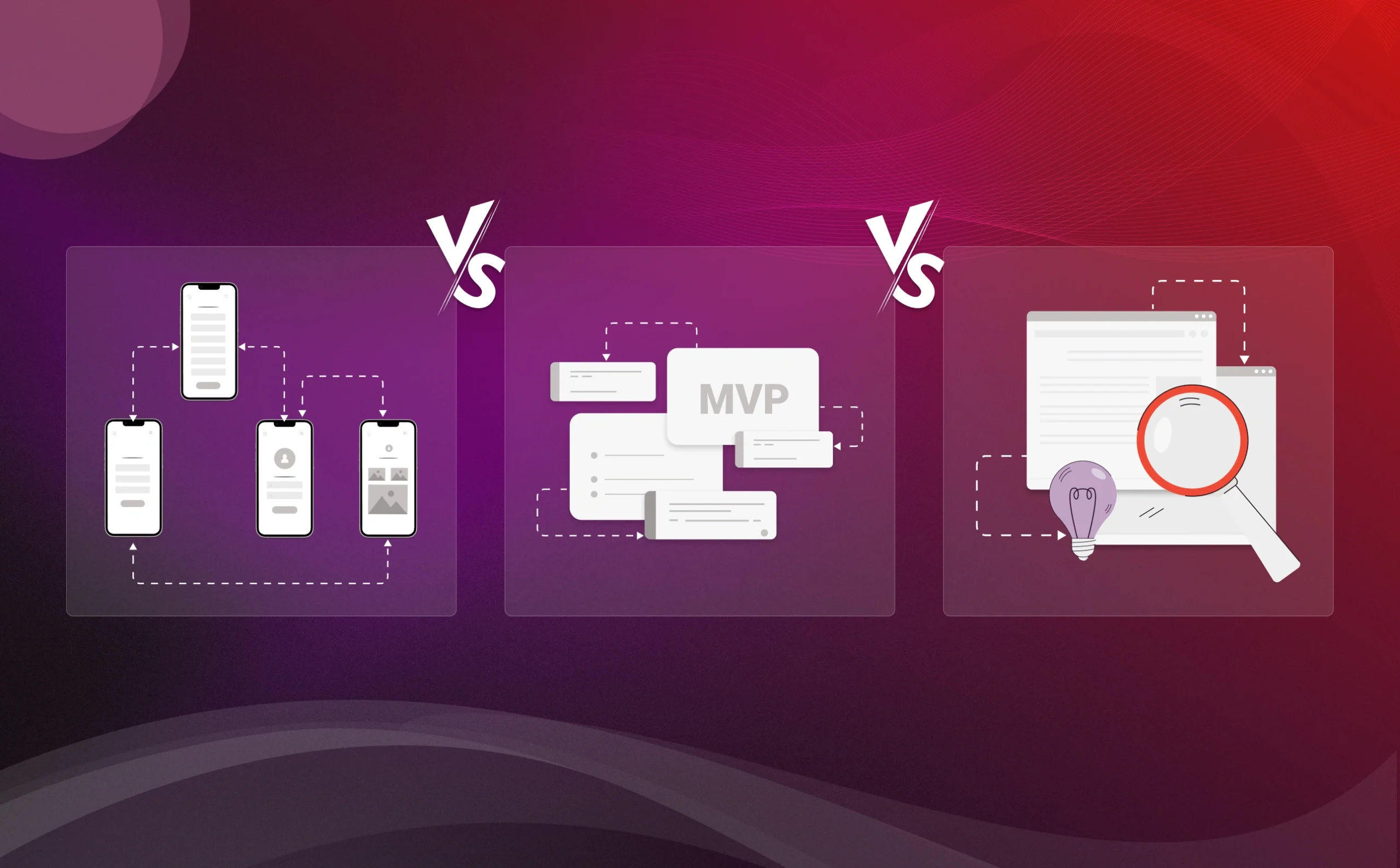
A Proof of Concept answers: “Can this idea technically work?” A Prototype answers: “Does this experience feel right to users and stakeholders?” An MVP answers: “Will real people actually use and pay for this?”

They are not competing options. They are sequential stages in a product development process in the USA startup ecosystem. Most founders who struggle with these terms are not confused about the definitions; they are confused about the purpose each stage serves and the moment each becomes relevant.

Think of it this way. Before an architect presents a building to investors, they do not construct the whole thing. They first check if the soil can support the structure (feasibility), then create a scale model (experience), and only then build the first livable floor for tenants to actually occupy (market test). POC, Prototype, and MVP follow the same logic.

The Three Core Questions They Answer

Each stage is defined by what it is trying to prove:

  • POC proves technical viability. Can technology do what you think it can?
  • Prototype proves experiential viability. Does the design make sense for users?
  • MVP proves market viability. Is there real demand and willingness to engage?

Skip any of these questions, and you carry the risk forward, usually at a much higher cost.

Stuck between PPM?

What Is a Proof of Concept and When Should You Build One

A Proof of Concept, or POC, is the earliest form of validation in product development. It is a small, focused experiment designed to answer one question: Is this idea technically possible with the resources and technology available?

Proof of concept software development is almost always internal. Nobody outside your core team sees it. It is not designed to look good, feel smooth, or impress anyone. Its only job is to confirm that the core technical assumption behind your idea actually works in practice.

Consider a founder building an AI-powered document review tool for small legal firms. Before spending months building a full product, the team runs a proof of concept to test whether a language model can accurately extract key clauses from a 40-page contract. No dashboard. No user login. Just a script and a PDF. If it works, they move forward. If it does not, they have saved months of wasted effort.

When POC Development Services Make Sense

You should prioritize proof of concept engineering when:

  • Your product depends on a technology that has not been proven in your specific context, such as AI/ML models, blockchain integrations, IoT sensor networks, or real-time data processing pipelines
  • You are entering a domain with complex compliance requirements where technical assumptions need validation early, such as healthtech or fintech
  • Your idea involves an integration between systems that have never been connected before
  • You want to show investors that the hardest technical challenge is already solved,  before asking for money

What a POC is not: it is not a demo for users, not a pitch deck replacement, and not a product. The moment you start worrying about how it looks or whether users find it intuitive, you have already moved into prototype territory.

What a POC Typically Produces

  • A Technical Feasibility Report

A short internal document or demo showing that the core mechanism works. This might be a working script, a basic API connection, or a model output — not a product, but proof that the foundation is sound.

  • A Risk-Cleared Technical Roadmap

Once your POC validates the core assumption, your engineering team can now plan the actual build with far greater confidence. They know what works, what needs rethinking, and what the architecture should look like.

What Is a Prototype and How It Fits Into Product Development

A prototype is where your product starts to have a shape. After a POC confirms technical feasibility, prototype design and development translate that feasibility into an actual user experience, screens, flows, interactions, and visual design, without necessarily building a fully functional backend.

The prototype’s job is to answer a human question, not a technical one. “Does this interface make sense?” “Will users understand what to do next?” “Does the flow match how our customers think?” These are not engineering questions. They are design and experience questions.

Prototypes range from simple wireframes sketched in Figma to high-fidelity clickable models that feel almost like a real product. The critical difference from an MVP is that prototypes are not functional. They simulate the experience without executing real business logic. A button might look like it works, but nothing is happening on the server.

Who Should See Your Prototype

This is where things get strategically interesting. Unlike a POC, prototypes are absolutely meant to be shown to people outside your team:

  • Potential investors who want to understand what you are building before committing to a seed round
  • Early users or design testers who can tell you whether the experience makes sense
  • Internal team members, including designers, engineers, and product leads, who need to align on the vision before writing production code
  • Advisory board members who can spot UX problems that your team, being too close to the idea, cannot see

A founder building a marketplace for freelance creative work might spend two weeks building a high-fidelity prototype that shows the full user journey, from signing up to posting a brief to receiving proposals. They test it with 12 potential users. Seven of them get confused on the same screen. That insight, found in a prototype phase for a fraction of the cost of full development, saves months of building the wrong flow.

Low-Fidelity vs High-Fidelity Prototypes

  1. Low-Fidelity Prototypes

These are sketches, paper mockups, or simple wireframes. They prioritize speed over polish. Use them when ideas are still fluid and you want fast directional feedback without investing in detailed design work.

  1. High-Fidelity Prototypes

These are polished, interactive mockups built in tools like Figma or InVision. They look and feel close to the real product. Use them when you need to test specific flows with real users, pitch to investors, or align a larger team on a shared vision before engineering begins.

What Is an MVP and Why Most Founders Misunderstand It

An MVP (Minimum Viable Product) is the first version of your product that real users can actually interact with in the real world. Not simulated. Not internal. Not a demo. It is a working product, released to actual users, with just enough features to deliver the core value and generate real feedback.

The word “minimum” is where most founders go wrong. Many teams describe their MVP and then list five user roles, custom dashboards, multilingual support, admin panels, and native mobile apps. That is not an MVP. That is a v1.0 product with six months of assumptions baked in.

MVP development for startups in the USA is about ruthless prioritization. What is the one core problem you are solving? What is the smallest possible version of that solution that delivers genuine value? Everything else is version two.

Think about Dropbox. Before building anything, the founders created a short video demonstrating what file syncing across devices would look like. That video was their MVP, not a fully built product, but enough to validate demand. They collected tens of thousands of signups overnight. The market told them they were onto something before a single line of production code was written.

The Three Jobs an MVP Does

MVP discovery and validation involve three distinct functions happening simultaneously:

  • Market validation: Are there real people who want this badly enough to sign up, use it, and ideally pay for it?
  • Feedback generation: What do early users actually do with the product? What do they love, ignore, or struggle with?
  • Investor traction: For fundraising rounds, an MVP with early users is exponentially more compelling than a prototype or POC

What Makes a Good MVP

A well-scoped MVP development services in the USA engagement typically produces something that:

  • Solves exactly one core user problem, end-to-end
  • Works reliably, even if it is basic
  • Can be in front of real users within 8 to 12 weeks
  • Generates measurable signals (signups, activation, retention, revenue) that inform the next build cycle

An MVP is not perfect. It is not finished. But it is real — and that reality is what generates the feedback that shapes everything that comes after.

Side-by-Side Comparison: POC vs Prototype vs MVP

Here is a structured comparison to make the distinctions crystal clear:

Dimension POC Prototype MVP
Primary Question Can this work technically? Does this experience feel right? Will people actually use this?
Audience Internal team only Investors, designers, test users Real users / early adopters
Functional? Usually not Simulated, not real Fully functional core
Design quality Irrelevant High-fidelity or low-fi Clean but minimal
Stage in the journey Pre-product Pre-product Early product
Primary output Technical validation UX validation Market validation
What it kills Technical risk Design risk Market risk

Quick summary for scanning:

  • POC = prove the engine works
  • Prototype = prove the experience makes sense
  • MVP = prove the market wants it

The POC to Prototype to MVP Journey: How All Three Connect

Most successful product teams do not choose between these three stages; they move through all three in sequence. Each one reduces a specific category of risk before the next stage begins.

This is the journey that product concept validation actually looks like in practice.

Stage 1: POC – You have a technically risky idea. Before designing anything, you run a focused experiment. A small team spends a few days or weeks proving the core technical assumption. The result is confidence – or a smart pivot.

Stage 2: Prototype — With technical feasibility confirmed, you now design the product experience. A designer builds clickable screens. You test them with real users. You discover what works and what confuses people. You refine the flow — cheaply, in design tools, not in code.

Stage 3: MVP — With both technical and experiential validation done, engineering builds the real thing. But because of stages one and two, you are not guessing anymore. You know the tech works. You know the experience resonates. Now you are just proving the market — and learning from the people who actually use it.

Teams that skip this sequence almost always end up rebuilding. They code for months, launch, and discover that either the technology was the wrong choice or the experience never made sense to users. Both of those problems could have been caught earlier and more cheaply.

When Can You Skip a Stage?

Not every startup needs all three in equal depth. Here is how to think about it honestly:

  • Skip the POC if your technology is proven and mainstream — a standard web application with no novel technical components probably does not need a POC.
  • Compress the Prototype if you have deep domain expertise and strong prior user research, a lighter prototype phase may be enough.
  • Never skip the MVP – the market always has a vote, and you cannot predict it accurately without releasing something real.

How to Decide Which Stage You Actually Need Right Now

This is the practical question most founders are really asking when they search for articles like this one. Here is a decision framework based on your current situation.

Start With a POC If:

  • Your product relies on AI, ML, blockchain, IoT, or any technology whose performance in your specific use case is genuinely unknown
  • You need to prove technical feasibility to yourself or your technical co-founder before investing in design
  • You are building something that requires complex integrations, payment rails, healthcare APIs, and real-time data feeds and you are not yet certain they can be connected the way you imagine
  • You have been told by engineers that the hardest part of your idea “might not be possible” prove it before you plan around it

Start With a Prototype If:

  • The technology is proven, but you are uncertain whether users will understand your product
  • You need to raise pre-seed funding and want something visual to show investors
  • Your team has disagreements about how the product should work a prototype resolves those debates in days, not weeks
  • You want to run usability testing to confirm that your assumptions about user behaviour are correct

Start With an MVP If:

  • You have already validated technical feasibility, and you know the experience works
  • You have a clear, narrow problem to solve, and you know your core user
  • You need market feedback – not design feedback, not technical feedback, but real usage data
  • You are ready to start generating revenue, even in small amounts, to demonstrate traction

The Mistakes Founders Make at Each Stage

Understanding the stages is one thing. Avoiding the common pitfalls is another. Here is what goes wrong most often:

At the POC stage: Founders sometimes share their POC with investors and expect market enthusiasm in return. A POC proves technical feasibility, it does not prove market demand. Just because it works does not mean anyone will pay for it. Treat your POC as an internal milestone, not a sales tool.

At the Prototype stage: The most dangerous mistake is mistaking positive feedback for market validation. When 10 friendly users tell you “this looks great,” that is not the same as those 10 users paying for it or using it daily. Prototypes validate experience, not demand.

At the MVP stage: Overbuilding. A team adds one more feature, then another, and another and six months later launches something so complex that it is impossible to understand which features drove adoption and which drove churn. The MVP should be small enough that you can actually read the signal in the noise.

The startup idea validation process works best when each stage has clear, pre-defined success criteria. Before you build your POC, write down what “success” looks like. Before you test your prototype, define what user behavior you are hoping to see. Before you launch your MVP, decide what traction metrics would give you the confidence to raise your next round.

Mistakes founder makes at each stages

Turn Your Validated Idea Into a Real Product With the Right Partner

The difference between a startup in the USA that moves fast and one that burns runway on rebuilds is rarely about the idea. It is about the sequence. POC, Prototype, MVP – when done in the right order, with the right depth at each stage, they compress learning cycles, protect your budget, and give investors the evidence they need to back you.

Bytes Technolab brings end-to-end capability across every stage of this journey. Whether you need POC development services in the USA to validate a technically complex idea, prototype design and development to align your team and impress early investors, or full MVP development services to get your core product in front of real users, the team operates as an AI-first product engineering partner that treats your outcomes as their own. Bytes Technolab works with startups, scale-ups, and mid-sized enterprises, combining product strategy, UX design, and engineering into a cohesive process so nothing gets lost between stages.

If you are ready to move from confusion to clarity, and from clarity to a product in the market, the next step is a conversation. You bring the idea. Bytes Technolab will help you figure out exactly where you are in the journey and what to build first.

MVP development services cover the end-to-end process of building the first functional version of your product – from scoping and design to engineering and launch. A good service provider helps you define the smallest valuable feature set, builds it for real users, and structures the engagement so you get market feedback within weeks, not months. The goal is learning, not perfection.

A prototype development company translates your product concept into a visual, interactive experience before any production code is written. This includes user flow mapping, wireframing, and clickable high-fidelity designs that you can test with real users or show to investors. The output is validated UX direction – and significantly reduced risk once engineering begins.

POC development services focus on one thing: proving your core technical assumption works. The team identifies your highest-risk technical hypothesis – whether that is an AI model, an API integration, or a real-time data pipeline – and builds a minimal experiment to test it. The deliverable is not a product. It is confidence and clarity before significant resources are committed.

A POC tests whether your idea is technically possible. An MVP tests whether the market actually wants it. POC MVP development serves different purposes at different stages. The POC is internal and focused on feasibility. The MVP is external and focused on demand. One kills technical risk. The other kills market risk. Both are essential for building with confidence.

Bytes Technolab combines product strategy, UX, and engineering in one team — which matters because POCs and prototypes often fail when these disciplines are siloed. The team has experience across technically complex domains, including AI-powered products, fintech integrations, and SaaS platforms. Rather than just executing what you ask for, Bytes Technolab helps you define what you actually need at each stage of validation.

Proof of concept testing is the process of running controlled technical experiments to validate whether a specific capability, integration, or model performs as expected in your target environment. For startups, this reduces risk by surfacing technical blockers early – before design, before engineering, before investor commitment. A failed POC is not a failure. It is a smart, cheap lesson that redirects your path.

A minimum viable prototype is a deliberately stripped-down version of your prototype – often just the two or three screens that represent your core user flow. Rather than designing every screen, you build the smallest clickable version that lets you test the main assumption. It saves time, keeps teams focused, and generates actionable feedback faster than a fully polished prototype would.

Bytes Technolab runs a structured MVP discovery and validation process that starts with understanding your core user problem before writing a line of code. This includes product scoping workshops, feature prioritization, and user story mapping – all designed to make sure the MVP you build actually answers a market question rather than just shipping something fast. The result is a validated product roadmap and a lean-first build focused entirely on learning.

Product Idea validation is the process of testing whether your product idea – not just the technology, but the value proposition itself – resonates with real users. It sits between a prototype test and an MVP launch. You should prioritise it when your idea is novel enough that user interest is genuinely uncertain. Early validation through concept testing can prevent months of building a product that works technically but fails commercially.

Related Blogs