


 February 17, 2025
 2 mins to read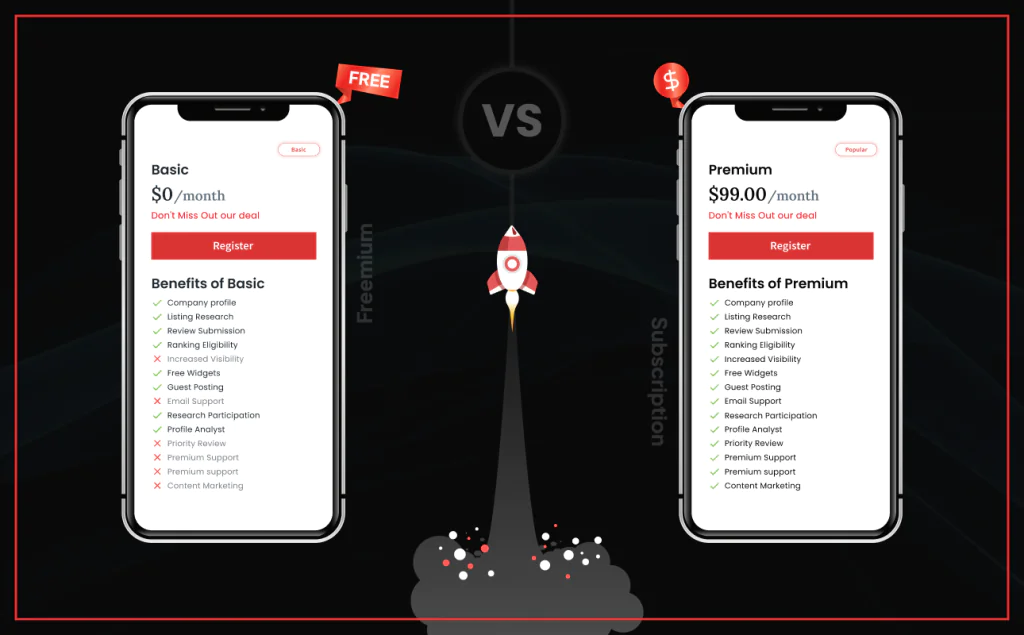
The core difference in the freemium vs subscription app model debate comes down to this: freemium gives users free access to a core app and monetizes premium features later, while a subscription model charges recurring fees for continued access and more predictable revenue.
For startups building or scaling a web or mobile product, choosing between these two app monetization strategies shapes user acquisition, retention, cash flow, and long-term product growth. As a two-decade-experienced web and mobile app development company, We’ve seen this single decision determine how fast a digital product validates its market, builds customer loyalty, and scales in a competitive space.
At Bytes Technolab, having partnered with startups across SaaS, fintech, and consumer apps for over a decade, we’ve seen this single monetization decision shape everything from early user acquisition to Series A readiness.
This guide breaks down where each model works best, the trade-offs in revenue stability, customer acquisition cost (CAC), market fit, and scalability — plus what startups should evaluate before choosing.
We’ve seen this decision play out most sharply in fintech, where trust and compliance often push founders toward subscriptions faster than in other sectors. If you’re building in this space, our fintech app development expertise covers how we help startups design monetization alongside security and regulatory requirements from day one.
In one recent AI MVP for a fintech startup project , a fintech client came to us with a raw MVP concept and left with a data platform generating 3.1x more actionable user insight — proof that the monetization model works best when it’s designed alongside the product, not bolted on afterward.
Why the Right App Monetization Strategy Matters for Startups
Monetization decisions go beyond generating cash — they shape how you build a loyal customer base, manage growth, and ensure long-term viability. Two models dominate this conversation: the freemium model and the subscription-based model. Before deciding which fits your startup, it helps to understand how each one actually works.
As a product engineering company, we also help startups scale their mobile apps over time through dedicated app consulting services at every growth phase.
What Is the Freemium Model?
“Freemium” combines “free” and “premium.” The idea is to remove the first barrier to entry by giving potential customers a version of your product they can use without paying anything. Once users see value in the free tier, the goal is to convert a percentage of them into paying customers by offering advanced features, expanded functionality, or an ad-free experience. The free tier isn’t a time-limited trial — it’s meant to offer permanent basic access, while the paid tier layers on the capabilities power users are willing to pay for.
Freemium has become a go-to app monetization strategy for startups chasing rapid user growth and early market validation. It’s especially common in consumer-facing categories — productivity tools, games, social and communication apps, and utilities — where a large top-of-funnel audience is valuable in its own right, both for the data it generates and for the market signal it sends to future investors.
According to Statista, the global SaaS market is projected to exceed $300 billion by 2026, making monetization strategy a critical factor in long-term product success.
Benefits of the Freemium Model
| Benefit | Why It Matters for Startups |
| Wider reach & rapid adoption | A free entry point lowers friction and helps you build a large user base fast, which matters as much as early revenue for many startups |
| Viral growth & word-of-mouth | A larger free user base creates more organic sharing, lowering customer acquisition costs over time |
| User engagement & feedback | Free users generate usage data that helps you iterate faster and find product-market fit |
| Low barrier to experimentation | You can test different premium feature sets and pricing tiers based on real behavior, not guesswork |
Challenges of the Freemium Model
- Low conversion rates: Typical freemium conversion sits around 2–5%, which may not be enough to sustain the business unless volume is very high. Top-performing freemium products can convert above 30%, with Spotify’s ~46.6% rate often cited as an outlier benchmark.
- Cost of free users: Server space, support, and maintenance for non-paying users add up — the model works best when the marginal cost of serving a free user stays low.
- Perceived value risk: Giving away too much for free can make users undervalue the paid tier, so the line between free and premium needs to be deliberate.
- Potential for abuse: Some users will exploit a free tier indefinitely with no intent to upgrade, adding cost without matching revenue.
When Should Startups Choose Freemium?
Freemium works well when your product can demonstrate value quickly in its basic form and you’re optimizing for broad reach and low-friction acquisition. The key is a clear, well-tested path that gives free users a compelling reason to upgrade — premium features that solve a real, felt problem rather than an artificial limitation.
What Is the Subscription-Based Model?
Where freemium is about volume and speed, the subscription-based model is about stability and predictability. Users pay a recurring fee — monthly, quarterly, or annual — for ongoing access to your product or service, creating a predictable, recurring revenue stream for the business.
This model is common in streaming, SaaS, fitness apps, and other categories with continuous updates or ongoing service delivery. Adobe Creative Cloud is a familiar example of subscription pricing built around continued access rather than a one-time purchase. We see the same pattern in healthcare apps offering subscription-based telehealth or wellness plans, and in travel & hospitality platforms bundling perks into recurring membership tiers — both categories where ongoing service, not a one-off transaction, is the product.
Subscription pricing tends to work best when the product itself keeps evolving — new content, new features, new integrations — so that the recurring charge is matched by a recurring reason to stay. B2B and SaaS tools are a natural fit here, since business buyers are already used to budgeting for ongoing software costs and expect vendors to keep improving the product over the life of the contract.
If you’re weighing whether your own product needs a fully custom SaaS build to support this kind of recurring value delivery, our breakdown of how custom SaaS development solutions drive business growth walks through what that decision actually involves.
McKinsey research shows subscription-based businesses grow revenue roughly 5x faster than S&P 500 companies and around 3x faster than traditional software businesses.
Benefits of the Subscription-Based Model
- Predictable revenue: Recurring payments make financial planning, forecasting, and scaling more precise.
- Stronger customer relationships: Because users pay repeatedly, startups have a built-in incentive to maintain quality and stay engaged with customers.
- Higher lifetime value (LTV): Subscribers who stick around tend to generate more total revenue than a comparable one-time purchase, even if the initial price point is lower.
- Continuous improvement loop: The pressure to retain paying members drives ongoing product investment, which benefits all users.
Challenges of the Subscription-Based Model
- High customer acquisition costs (CAC): Convincing users to commit to a recurring charge — especially when free alternatives exist — often requires heavier marketing and sales investment.
- Churn: Even a small monthly cancellation rate can meaningfully erode revenue if customers stop perceiving ongoing value.
- Perceived risk for users: Recurring commitment without guaranteed ROI can create hesitation; free trials help lower this barrier for complex or high-commitment products.
- Dependency on continuous value delivery: Subscriptions require ongoing updates and support to justify the recurring cost, which adds operational complexity.
When Should Startups Choose Subscriptions?
Subscription pricing suits startups that can consistently demonstrate ongoing value — frequent updates, active support, or a service users depend on regularly. A steady, recurring revenue base is also more attractive to investors because it reduces financial uncertainty and improves long-term planning.
Freemium vs Subscription App Model: Side-by-Side Comparison
| Factor | Freemium Model | Subscription Model |
| Primary strength | Fast user acquisition, viral growth | Predictable, recurring revenue |
| Entry barrier | Very low — free access to core features | Higher — requires upfront financial commitment |
| Revenue stability | Variable, dependent on conversion rate | Stable and forecastable |
| Typical conversion rate | 2–5% (up to 30%+ for top performers) | N/A — revenue tied to retention, not conversion |
| Cost structure | Ongoing cost of supporting free users | Cost weighted toward acquiring paying customers |
| Best fit | Consumer apps, broad markets, high engagement products | SaaS, B2B, niche tools, services needing ongoing support |
| Key risk | Free users never converting; infrastructure strain | Churn eroding recurring revenue |
Cost Implications of Each Model
Beyond acquisition, it’s worth thinking through the ongoing cost structure of each approach. With freemium, a sizable free user base can get expensive to operate — every non-paying user still draws on servers, customer support, and maintenance. Startups need to make sure the cost of supporting that free tier doesn’t outpace the revenue coming from premium members, which usually means building a clear conversion path and infrastructure that’s efficient at serving free users cheaply.
With a subscription model, the cost picture shifts toward finding and closing qualified customers who are ready to pay from the outset. Early acquisition can be more expensive on a per-customer basis, but the consistent, recurring income helps offset that cost over time and tends to increase overall customer lifetime value as retention improves.
Flexibility and Scalability
A freemium model gives startups room to experiment — you can test where the line sits between free and paid features, try different pricing tiers, and refine the offer based on real usage data rather than assumptions. The trade-off is that scaling freemium requires infrastructure built to handle potentially millions of free users without service quality slipping, which takes real engineering investment well before most of those users ever pay a cent.
A subscription model tends to be more straightforward to scale from a revenue-planning standpoint. Once you have a solid base of paying members, the focus shifts to reducing churn and increasing satisfaction rather than constantly widening the top of the funnel. The ongoing challenge is making sure the product keeps delivering enough value to justify the recurring charge — subscribers who stop seeing that value will cancel, no matter how strong the initial pitch was.
Market Fit and User Behavior
The right choice depends heavily on your target audience, product complexity, and whether you’re serving broad consumer demand or a niche B2B need. Ask:
→ What does the typical customer journey for my product look like?
If your product can show value quickly in its basic form, freemium is likely the better fit for attracting users.
→ How do competitors in my space monetize?
In categories like enterprise software, users often expect to pay from day one because they’re buying into ongoing value and support — which is why subscription-based models dominate there.
Key Considerations Before Choosing a Model
There’s no single checklist that guarantees the right answer, but a few questions consistently separate startups that choose well from those that pick a model and later regret it. Working through these before you commit can save months of rebuilding pricing and onboarding flows later.
- Understand your market — Will your audience expect a free tier first, or are they comfortable paying a recurring fee upfront for reliable access?
- Define your value proposition clearly — In freemium, the free tier must be genuinely useful while the premium tier offers a meaningful step up. In subscriptions, ongoing updates and support need to visibly justify the recurring cost.
- Calculate CAC under each model — Freemium can look cheaper upfront thanks to organic growth, but supporting non-paying users adds hidden cost. Subscriptions often cost more to acquire but can deliver higher lifetime value.
- Stress-test your infrastructure — A freemium model needs systems that can handle a surge of free users without straining servers or support teams.
- Let data drive iteration — Track conversion rates, churn, and engagement to see which features actually drive upgrades or renewals, and be ready to adjust pricing tiers over time.
Stay flexible — Many successful startups eventually blend both models as they mature, rather than locking into one permanently.
Final Thoughts: Which Model Works Best?
There’s no universally “better” model — only the one that fits your product, market, and growth stage. If your focus is rapid growth, freemium lowers the barrier to entry, fuels viral growth, and generates the user data you need to guide product decisions. If you’re focused on steady revenue and loyalty, a subscription model gives you predictable income and deeper customer relationships, provided you keep delivering visible value. And if your product has real depth and range, a hybrid approach — a genuinely useful free tier alongside a clearly differentiated premium subscription — can capture the strengths of both.
At Bytes Technolab, we help founders design monetization architecture during product engineering so the pricing model is built into the product from day one—not added later.
Freemium gives users permanent free access to core features and monetizes upgrades, while a subscription model charges a recurring fee for continued access to the product or service.
It depends on your product and audience. Freemium suits products that can prove value quickly and benefit from viral growth; subscriptions suit products with continuous value delivery, like SaaS or B2B tools.
Yes — a hybrid model, offering a genuinely useful free tier alongside a paid subscription tier, is common as products mature and audiences diversify.
Most freemium products convert 2–5% of free users to paid. Top performers can exceed 30%, with outliers like Spotify converting closer to 46.6%.

Bhavesh Surani
Chief Financial Officer
He has been leading global digital commerce innovation for over 20 years, transforming B2B, B2C, and D2C brands across the USA, Canada, Europe, APAC, and the Middle East. He's a proven expert at turning complex business requirements into high-performing digital solutions. With deep expertise in Magento 2, Odoo, Shopify, and cloud-native technologies, he specializes in CRM, ERP, POS, DAM, PIM Integration, etc. to drive a full-scale digital transformation. Currently mentoring 150+ engineers, Bhavesh is truly an accelerator for businesses to build a digital and future-ready ecosystem.
Table Of Content
- Why the Right App Monetization Strategy Matters for Startups
- What Is the Freemium Model?
- Benefits of the Freemium Model
- Challenges of the Freemium Model
- When Should Startups Choose Freemium?
- What Is the Subscription-Based Model?
- Benefits of the Subscription-Based Model
- Challenges of the Subscription-Based Model
- When Should Startups Choose Subscriptions?
- Freemium vs Subscription App Model: Side-by-Side Comparison
- Cost Implications of Each Model
- Flexibility and Scalability
- Market Fit and User Behavior
- Key Considerations Before Choosing a Model
- Final Thoughts: Which Model Works Best?