

 June 26, 2026
 2 mins to read
Your roadmap says AI, but the workflow still behaves like a fixed checklist. AI-First product development only matters when intelligence shapes data, UX, decisions, and product behaviour from day one. Bytes Technolab brings an AI-first Product Engineering discipline to that choice, so teams can test readiness before costly build work begins.
What Teams Misread About Becoming AI First
Most teams misread AI at first by treating it as a label for smarter features.
A Head of Product walks into a quarterly roadmap review with 3 AI ideas, 2 demo clips, and no proof that the product can learn after launch. The demo looks strong. The risk sits elsewhere.
AI ambition says the product should feel smarter. An AI feature adds a prompt, prediction, recommendation, or agent to an existing path.
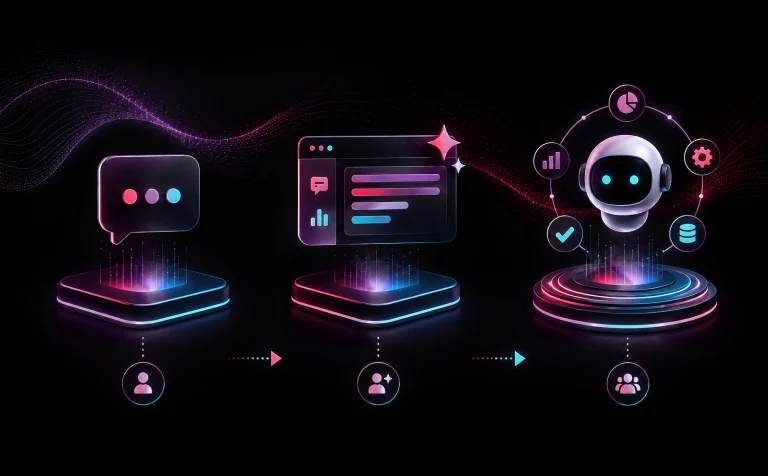
An AI-first product changes what the system asks, remembers, suggests, and refuses. A user who returns on day 30 should receive better guidance because earlier behaviour taught the product something useful.
The pressure has grown because leaders now expect AI to affect product value, not only presentation. Stanford HAI’s 2025 AI Index tracks AI across technical progress, economic influence, and societal impact, thereby raising the bar for responsible product choices.
A weak AI-first claim turns the next roadmap review into a trust problem, not a feature debate.
What AI-First product development Actually Means
AI-First product development means intelligence shapes the product before the main experience hardens.
The product starts with one learning question: what should the system understand better every time someone uses it? That question changes product discovery before interface polish, backlog sizing, or model choice.
Teams define data capture, model behaviour, user trust signals, and outcome metrics early. This is why many organizations work with an experienced product development partner that can align AI strategy, engineering, and user experience from the beginning. A support product does not become AI-first because it has a chatbot.
It becomes AI-first when every ticket, escalation, feedback rating, and resolution path teaches the system how to guide the next user with higher accuracy.
The foundation has 4 connected parts:
- Product behaviour that adapts to real use
- Data design that captures meaningful signals
- Decision logic that explains AI actions
- Human control when confidence drops
McKinsey’s 2025 State of AI shows the same pattern at the company level. AI tools are common, yet many organisations have not embedded AI deeply enough and rewiring an enterprise for AI at scale requires changes that go far beyond adding tools to existing workflows.
The test is whether intelligence changes product value, not whether AI appears on the screen.
Why AI product development Is Not Feature Decoration
AI product development changes the product’s operating model. Feature decoration changes in one visible moment.
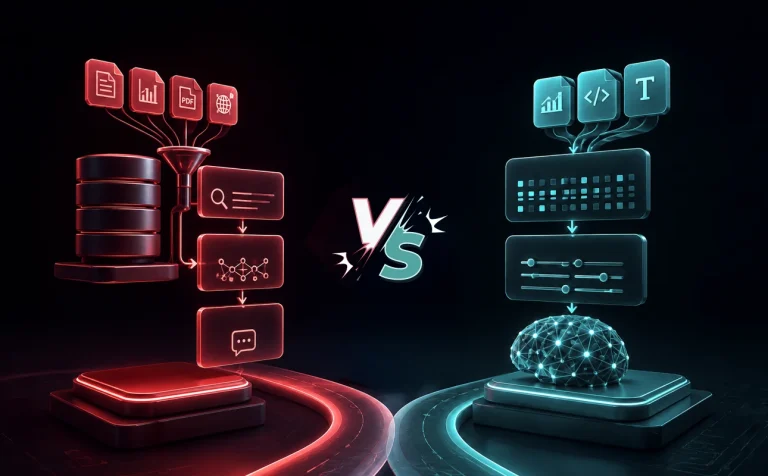
A feature add-on answers a narrow question. A product-level AI system changes how the workflow progresses, which data matters, and how success gets measured.
A sales tool with AI-written emails still runs the same workflow. A sales tool that ranks leads by live intent, explains the score, learns from closed deals, and adjusts next-best actions now has different product logic. The difference between workflow automation and true AI automation is exactly what separates feature decoration from product intelligence.”
The model does not decorate the workflow. It directs it.
Run 4 checks:
- Feature AI works even if learning stops
- Product AI loses value if feedback stops
- Feature AI improves one task
- Product AI improves the full path
The distinction matters because AI spend fails when teams fund output instead of behaviour change. Faster content, quicker summaries, or cleaner task work can help, but they do not prove the product is AI-first.
AI first becomes credible only when the workflow depends on learning. The conversation then moves from feature scope to product intelligence.

The Learning System Behind AI First Products
AI-first products work because they connect user action, data quality, model output, review, and product change inside one learning loop.
The visible AI moment is only the surface. Users judge a recommendation. Product teams must judge why that recommendation appeared, whether it helped, and whether the same behaviour deserves trust next time.
A data flywheel gives that system its rhythm. NVIDIA defines an AI data flywheel as a self-improving loop where interaction data refines AI models, produces better outcomes, and creates more valuable data for the next cycle.
How does an AI-first product keep improving after launch?
An AI-first product improves after launch when every meaningful interaction feeds a controlled learning loop. The loop captures user behaviour, model output, feedback, failure cases, and outcome data before the team changes product logic.
A 30-day review can compare accepted AI suggestions, rejected outputs, human overrides, and resolved outcomes. That review tells the team whether the model improved real work or only produced more activity.
It also shows where human review must stay active. Generative AI development can create answers, summaries, recommendations, or task flows. Evaluation decides whether those outputs deserve user trust. Product teams need model monitoring, review paths, release rules, and rollback plans for every material AI change.
Without that loop, the product only uses AI. With it, the product learns why users succeed, where they hesitate, and which model behaviours need tighter control.
The hidden system matters because AI first is not a launch state. It is a product learning habit with governance built into the work.
What Good AI First UX Looks Like
Good AI-first UX gives users context, control, and confidence when intelligence changes the path they expected.
The interface cannot hide the model behind a polished screen. Users need to know what system is used, what it suggests, and how they can correct it.
The AI-First Experience Triangle gives product teams a practical way to judge whether UX supports intelligent behaviour.
Context explains why the AI response exists. A recommendation should expose the signal behind it, such as recent activity, past preference, risk score, or workflow state.
Control gives the user a safe way to accept, reject, edit, or override the AI path. No serious product should force a model choice when the user carries the risk.
Confidence shows how much trust the system has in its own output. A 92% match score, missing data warning, or human review flag can prevent blind acceptance.
What should UI/UX change when AI becomes part of the product logic?
UI/UX must shift from a screen-flow model to a judgment-flow model when AI becomes part of the product logic.
UI UX design services need to shape how humans question, correct, and trust model behaviour. The goal is not a prettier interface. The goal is a product experience that enables users to understand AI decisions without slowing critical work.
The Triangle also reveals a hard truth: weak UX can make accurate AI feel unsafe, while clear UX can make uncertain AI manageable.
How Ready Products Start AI-First Discovery
A product is ready for AI-first discovery when core value improves through learning, not only through faster task completion.
Run 5 checks before funding a full AI build:
- Problem fit: Does intelligence change the outcome users care about?
- Data readiness: Do you capture useful signals today?
- Workflow depth: Does the product have repeat use and decision moments?
- Model value: Does AI improve judgment, not only speed?
- Trust need: Would users need control, review, or explanation?
A product that passes 3 checks deserves deeper discovery. A product that passes fewer likely needs a focused AI feature or better data groundwork first.
The 24-hour test is direct. Pull 20 real user journeys, mark every decision point, list the data available at each point, and name where AI would improve the next action.
Vague answers expose discovery debt. Specific answers show where a product development partner can test feasibility, model fit, UX risk, and product economics.

Bytes Technolab works with startups and mid-sized enterprises as an AI-first Product Engineering partner to assess intelligent products, modern systems, and growth paths before incurring heavy engineering spend.
When the current stack reveals these gaps, another internal debate only delays the decision.
Build AI First Only When Intelligence Shapes Value
AI, first and foremost, only makes sense when it changes how the product behaves, learns, and earns trust.
If AI only adds speed to an old workflow, the smarter move is to start small. That choice protects the roadmap and keeps the team from spending months on a demo that users cannot trust in real work.
The decision should not start with whether the product should use AI. It should start with where intelligence can improve the outcome that users already care about.
Selective AI works when the workflow needs speed. AI-first thinking becomes necessary when the product must learn from usage, adjust decisions, explain behaviour, and improve across repeated journeys.
Bytes Technolab helps startups, scale-ups, and mid-enterprises validate that choice through discovery, model-fit assessment, UX decision design, and responsible product architecture. Built for launch. Engineered for intelligent scale.
AI-First product development is a product approach where intelligence shapes behaviour, data capture, UX, and architecture from the start. The product learns from usage, improves decisions, and creates user value through better outcomes rather than isolated AI features alone later.
AI product development differs from traditional product development because teams must plan learning loops, model behaviour, data quality, and trust controls after launch. Traditional products follow fixed rules. AI products need measured feedback that improves repeated user journeys across real workflows.
Generative AI development supports AI-first products by producing answers, summaries, recommendations, and task flows that adapt to user context. Its value rises when teams test outputs, monitor weak cases, and feed learning back into product logic after every release cycle.
UI/UX design services matter because AI changes how users evaluate products. Users need context, correction paths, confidence cues, and safe exits when a model affects work. Strong UX turns AI behaviour into something people can question during real tasks.
Bytes Technolab helps product leaders validate AI-first ideas through discovery, model-fit assessment, UX decision design, and architecture planning. For startups, scale-ups, and mid-enterprises, the goal is clearer direction, fewer demo-led assumptions, and stronger readiness before spending grows too far.

Mitul Patel
Founder & CEO at Bytes Technolab Inc.
17+ years of experience in leading global digital initiatives by delivering transformative solutions across AI, ML, SaaS, product engineering, and enterprise-grade platforms. As a visionary strategist and mentor to 120+ tech experts, he has played a pivotal role in scaling Bytes Technolab’s presence in the USA, Canada, India, and beyond. Under his leadership, the company has delivered 300+ business-critical solutions for 500+ clients in 30+ countries, driving revenue growth through innovation in web, mobile, eCommerce, and digital transformation. Mitul combines business acumen with deep technical insight to help global startups, SMEs, and Fortune 500 enterprises accelerate their digital journeys.
Table Of Content
- What Teams Misread About Becoming AI First
- What AI-First product development Actually Means
- Why AI product development Is Not Feature Decoration
- The Learning System Behind AI First Products
- How does an AI-first product keep improving after launch?
- What Good AI First UX Looks Like
- What should UI/UX change when AI becomes part of the product logic?
- How Ready Products Start AI-First Discovery
- Build AI First Only When Intelligence Shapes Value