

 October 14, 2026
 2 mins to read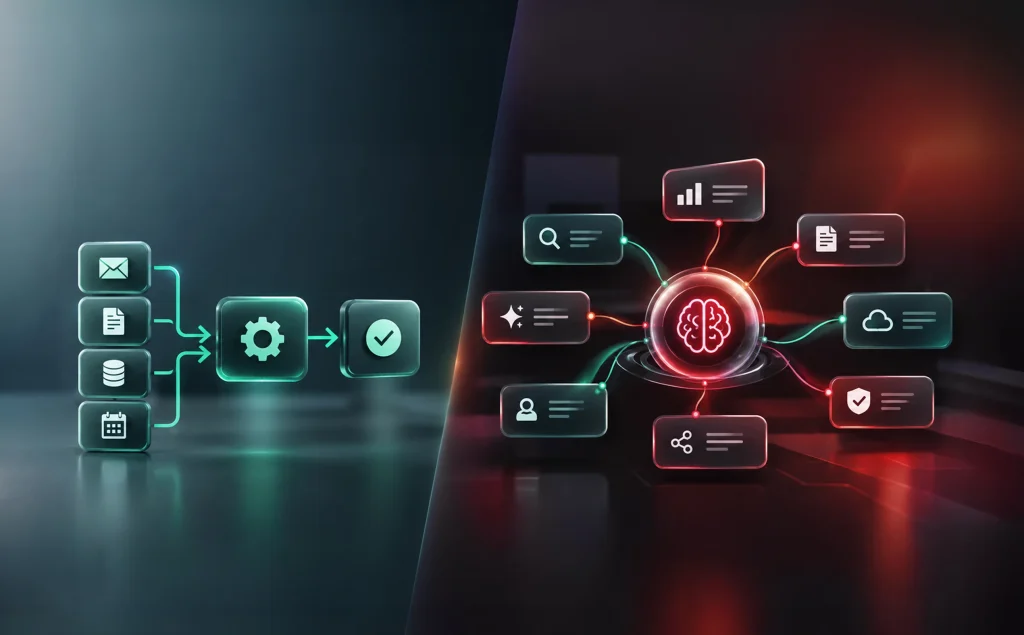
Your support workflow handles routine tickets, but exceptions still pull engineers away from product work. Fixed automation follows programmed logic, while an agent can choose subsequent actions within limits. That difference affects reliability, permissions, and what each resolved ticket costs.
The right choice depends on where in your process judgment is needed. Bytes Technolab, an AI-first Product Engineering partner, helps scale-ups and mid-enterprises assess workflow rules, AI interpretation, and bounded agents against the support outcomes their teams need to deliver with confidence.
Workflow Automation vs. Agentic AI at a Glance
Workflow automation follows predefined execution logic. Agentic AI can select subsequent actions within limits, while AI-assisted fixed workflows use models inside a programmed sequence of steps.
Rule-based automation vs. AI agents becomes clearer through that middle option. A workflow automation company should explain who controls each step. LangGraph documents this distinction.
| Criterion | Rule-based automation | AI-assisted fixed workflow | Bounded agent |
|---|---|---|---|
| Next step | Programmed rules | Programmed orchestration | Model selects within limits |
| Input handling | Defined fields | AI interprets content | AI interprets and investigates |
| Exceptions | Coded fallback | Validation and fallback | Adaptive investigation or escalation |
| Reliability checks | Rules and integrations | Rules plus AI outputs | Actions, outputs, final state |
| Operating cost | Execution and upkeep | Plus inference and review | Plus tool loops and retries |
Even predictable paths can contain incorrect AI outputs. Understanding the terminology helps your team separate control over the execution path from confidence in the actual result.
Agentic Terms Describe Different Parts of Execution
AI agent autonomous vs. automation concerns who chooses subsequent actions. The labels describe different combinations of interpretation, process coordination, and permission to change business records.
A large language model, or LLM, interprets and generates language. Connected tools let surrounding software retrieve information or execute actions following the model’s requests.
Reading a customer’s message and selecting an investigation are different responsibilities. Software can retain control of the entire process even when AI performs the initial reading.
What is Agentic AI?
Agentic AI selects and carries out actions toward a goal. It uses feedback to decide what happens next, within the tools and permissions supplied.
An agent investigating a failed order can change its next lookup after discovering a payment mismatch. Adapting during that task does not inherently mean retraining itself.
What are Agentic Workflows?
Agentic workflows combine model-driven work, tools, task state, and coordination into a process. The label varies across sources, so inspect how each proposed system operates.
IBM’s definition of agentic workflows emphasizes agents making decisions and coordinating tasks. Ask which steps remain fixed and where the model can change the execution sequence.
What are AI Agentic Workflows?
“AI agentic workflows” generally refers to the same concept as agentic workflows. Adding “AI” does not establish a separate architecture or guarantee a particular autonomy level.
What are Agentic Systems?
Agentic systems include models, tools, execution software, state, controls, and monitoring. Multiple agents are optional. Some definitions also include predefined LLM workflows under this broad umbrella.
How do AI agents compare with agentic workflows?
An AI agent is a component that selects and performs actions. An agentic workflow is the process coordinating those actions with other steps and controls.
An agent can operate inside a workflow. A workflow can also call AI while retaining its overall sequence, as the following support investigation example illustrates.
Where AI Workflow Automation Services Fit
AI Workflow Automation Services fit processes needing interpretation within a controlled sequence. A support workflow can classify free text, validate the category, and follow a programmed route.
Traditional automation vs. agentic workflows becomes practical when a ticket lacks a known resolution. An agent could inspect order history and choose another lookup.
Invoice extraction and scripted diagnostics can follow fixed paths. Discrepancy investigations are potential agentic AI use cases for CTOs when choosing additional checks improves resolution.
When does the next step need to change?
The next step needs to be flexible when new evidence determines what to investigate. Common workflow patterns address different coordination needs, without representing equivalent degrees of autonomy or decision authority.
- Chaining passes results through sequential tasks.
- Routing selects a suitable processing path.
- Parallel checks examine independent questions together.
- Evaluator-optimizer loops revise work against feedback.
- Orchestrator-worker delegation assigns subtasks dynamically.
Use fixed paths when the useful steps are known. Test agents when choosing those steps improve outcomes, then define which resulting actions the system may execute.
Keep Investigation Separate From Action Authority
Agentic AI governance must distinguish gathering evidence from changing records. A support agent can investigate a refund exception while application rules enforce eligibility and approval.
The risks of agentic AI in production include malicious instructions inside retrieved content and mistaken tool arguments. Excessive permissions can expose unrelated customer records.
AI agents for enterprise also need controlled retries. A repeated refund request must not issue another payment, even when the first tool response times out unexpectedly.
Which actions should still require approval?
Actions beyond preauthorized limits should require human approval, including exceptional refunds or access changes. Enforce every authorization check outside the model, following OWASP’s excessive agency guidance.
- Restrict tools to required operations and records.
- Validate arguments and reject unauthorized requests.
- Prevent duplicate effects when retrying actions.
- Cap investigation time, spending, and tool calls.
- Escalate missing evidence with a clear handoff.
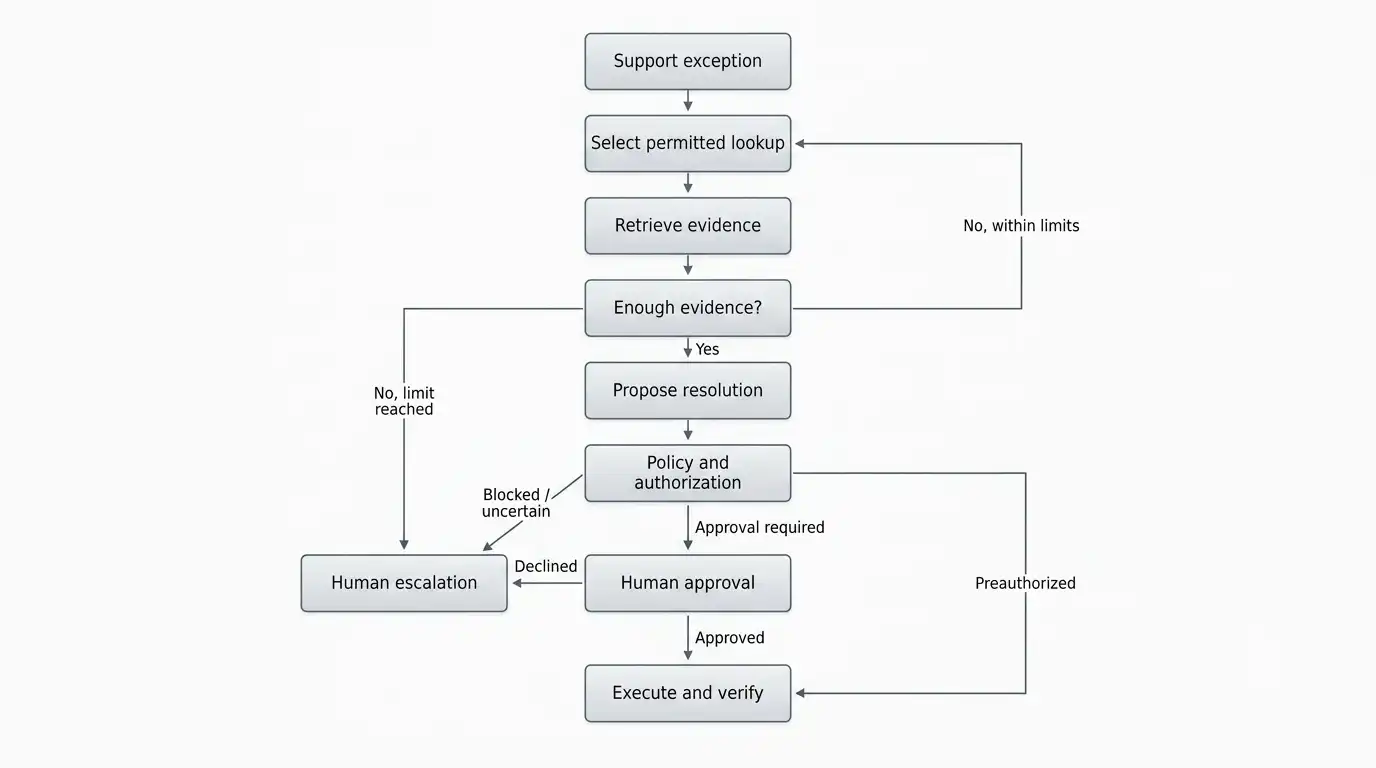
The agent varies its investigation while independent checks control execution. This illustrative process logs evidence, tool calls, approvals, and results, escalating when limits prevent resolution.
Safe permissions alone do not establish business value. Once the action boundary works, compare whether verified resolutions justify the total operating cost.
Test Authority, Evidence, and Economics Before Scaling
Choose automation by checking permitted authority, verifiable evidence, and operating economics in that order. The Authority, Evidence, and Economics framework proposed here provides 3 sequential decision checks.
Deterministic workflows vs autonomous agents should face identical acceptance criteria. Compare representative tickets and exceptions, repeating trials to expose variation in actions and final outcomes.
A successful demonstration cannot establish consistent performance across changing inputs. Verify a claimed refund against the payment record. Agent evaluation guidance distinguishes claimed success from the actual outcome.
How do you know the added autonomy pays off?
Added autonomy pays off when verified improvements justify its full cost within acceptable operating limits. Establish a baseline before comparing agent performance with your existing process.
- Authority
Define the decisions the system may make and the records it may change. If permissions cannot contain the consequences, retain human handling or redesign the process.
- Evidence
Verify completed work in the destination system. Track success, policy violations, human intervention, and duplicate actions. Measure p95 completion time: 95% of cases finish within this duration.
- Economics
Include model usage, tools, retries, review, maintenance, and rework across every attempted case. Count released staff capacity separately from cash savings when evaluating the business case.
- Cost per accepted outcome

If no outcomes qualify, report failure instead of a unit cost. Agentic AI ROI for startups must also account for initial engineering, integration investment, and runway.
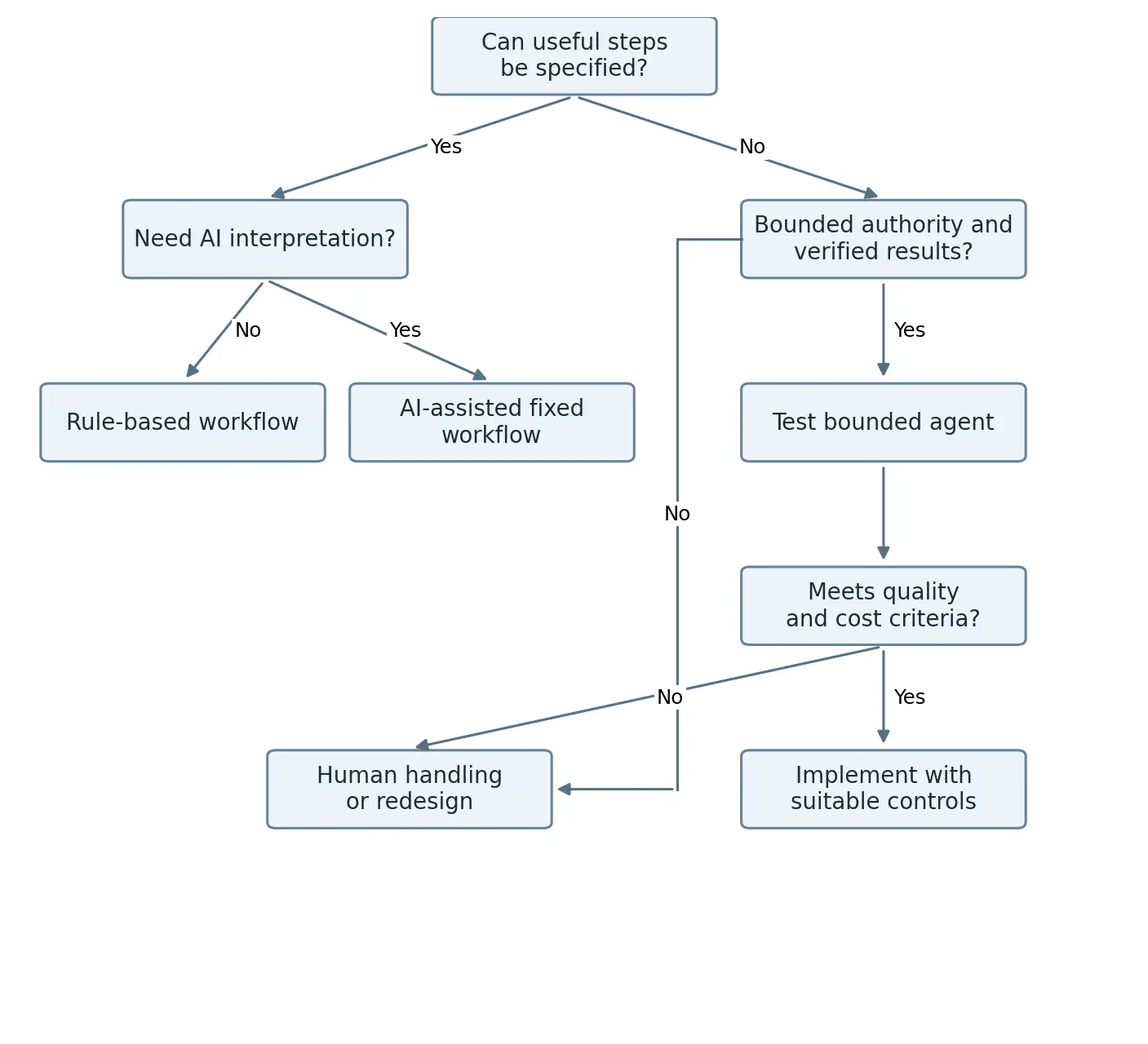
Task structure and measured results determine the choice. A hybrid approach is appropriate when warranted, and a scoped pilot provides the evidence needed to decide.
Define the Pilot Before Agentic AI Development Services
Scope Agentic AI Development Services around one measurable process before committing to an architecture. The pilot should allow workflow-only, AI-assisted, agentic, hybrid, or human handling to qualify.
1. Select one process and document baseline quality, handling time, exceptions, and cost. Agree on what an acceptable outcome means before engineering starts or demonstrations influence the decision.
2. Map integrations, data access, and allowed actions. Record approval requirements and how the system handles unavailable tools or incomplete source records.
3. Compare candidates using representative routine and exception cases. Ask any LLM development company to justify its execution design and evaluation plan without assuming custom training is necessary.
4. Define rollout limits, monitoring, recovery, and ownership. Document who pauses the system and how unfinished cases return to a human queue.
Bytes Technolab can connect this brief to Product Solution Architecture. The resulting integration design and acceptance criteria give the architecture decision a practical business basis.

Give Autonomy a Clear Business Purpose
The difference matters when it changes who controls actions, how teams verify results, or what reliable completion costs. Your support backlog gives those architectural choices a purpose.
Known paths belong in programmed workflows. Add AI interpretation where reading messy inputs creates value, and test bounded agents where evidence determines the next investigation step.
Bytes Technolab approaches this decision as an AI-first Product Engineering partner for scale-ups and mid-enterprises. Architecture review and integration design clarify what your process needs.
That starts with identifying exceptions that consume engineering time. Permission controls and evaluation planning then define how the investigation can expand without granting unnecessary access to business records.
From Pilot Evidence to Operating Decisions
Evaluation criteria and operational ownership ensure accountability after the pilot ends. A human handoff remains appropriate when uncertainty exceeds acceptable limits.
The next decision concerns one troublesome process and the smallest change that improves its verified outcomes. A reliable, affordable resolution gives that change a measurable purpose.
Frequently Asked Questions
Ask for a process baseline, exception analysis, and integration map. Establish who owns failures after launch. A workflow automation company should explain where rules suffice. It should also define measurable acceptance criteria before recommending AI or changing existing operating responsibilities.
Production work needs evaluation, authorization controls, recovery procedures, and monitoring. Agree on these deliverables before approving a prototype. Agentic AI development services should include documented tool permissions. Request regression tests, operational handover, and clear acceptance criteria covering quality, cost, and human intervention.
A complex process can work with one agent or a fixed workflow. Multiple agents aren’t automatically necessary. Compare AI agent development solutions against simpler candidates first. Additional agents should handle separable responsibilities and demonstrate benefits that justify coordination costs and failures.
Retest representative tasks, permission boundaries, tool arguments, and failure recovery. Compare verified outcomes against the previous version. Agentic AI governance should cover changes to prompts and integrations too. Check latency, operating cost, and human escalation before expanding access or replacing production components.
Architecture Review, Product Solution Architecture, and a scoped proof of concept can clarify the choice. Bytes Technolab supports scale-ups and mid-enterprises. The assessment can compare integrations, permitted actions, and acceptance criteria. Teams gain evidence for deciding which approach warrants further investment.

Bhavik Shah
Founder & Director at Bytes Technolab...
He has been driving digital growth for over 18 years by empowering global startups, SMEs, and enterprises including Fortune 500 brands with scalable software, web, mobile, and eCommerce solutions. With a proven track record of 300% revenue growth and 300+ successful deliveries, he combines strategic business leadership with technical excellence across marketplaces, SaaS, and innovation adoption. As a mentor to 140+ software experts, Bhavik bridges business vision with technology execution, helping clients scale in competitive markets across the USA, Canada, India, and beyond.
Table Of Content
- Workflow Automation vs. Agentic AI at a Glance
- Agentic Terms Describe Different Parts of Execution
- What is Agentic AI?
- What are Agentic Workflows?
- What are AI Agentic Workflows?
- What are Agentic Systems?
- How do AI agents compare with agentic workflows?
- Where AI Workflow Automation Services Fit
- When does the next step need to change?
- Keep Investigation Separate From Action Authority
- Which actions should still require approval?
- Test Authority, Evidence, and Economics Before Scaling
- How do you know the added autonomy pays off?
- Define the Pilot Before Agentic AI Development Services
- Give Autonomy a Clear Business Purpose