



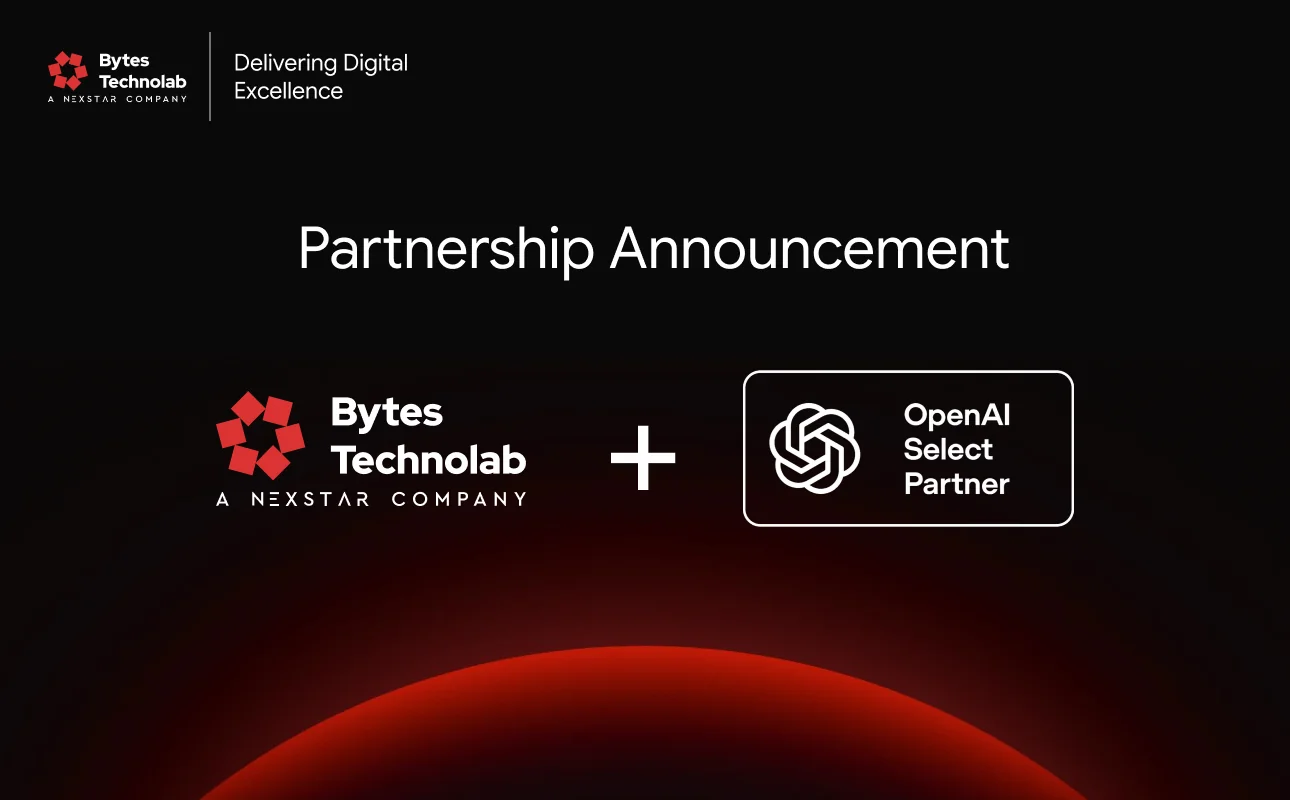
This recognition brings Bytes Technolab into the OpenAI Partner Network and builds on its custom OpenAI and AI engineering work for startups and businesses.
TEXAS, United States, October 5, 2026: Bytes Technolab, an AI-first product engineering partner, has been named an OpenAI Select Partner. The recognition places the team inside the OpenAI Partner Network and supports its work in enterprise AI product development.
As an AI and ML development Company working across the USA, Canada, the UK, Australia, and Saudi Arabia, Bytes Technolab has been building real client products with OpenAI models. The recognition gives startups and enterprises a clearer signal of what to expect from a delivery partner that works with these models every day.
What the OpenAI Select Partner Status Means
The OpenAI Partner Network is a program for partners worldwide that build, sell, and deliver AI solutions with OpenAI. Partners can move through three tiers, which are Select, Advanced, and Elite.
Select is the program's entry tier, and Bytes Technolab sees it as a starting point rather than a finish line. The team plans to deepen its
OpenAI expertise as client work grows.
For clients, the practical value is simple. The program offers technical resources, training, and certification paths, which help the team keep its OpenAI skills current.
What This Means for Enterprise Buyers
Choosing an AI delivery partner is as much a risk decision as a technical one. Buyers want to know a partner understands the technology, works closely with the model provider, and stays involved after launch.
The Select Partner status adds one more point of assurance to that list. It does not replace due diligence, so Bytes Technolab encourages buyers to review past work, security practices, and team experience as well.
Why Enterprise AI Product Development Needs More Than a Model
Access to a strong model is no longer the hard part of enterprise AI. The harder work is turning that model into a product that fits existing data, systems, security rules, and daily workflows.
Many pilots stall at this point. They work well in a demo but struggle once real users, real volumes, and real compliance needs arrive.
Bytes Technolab approaches OpenAI projects as product engineering first. The model is one component, and the product around it carries the weight, including architecture, integrations, testing, monitoring, and cost control.
Custom OpenAI Development for Real Business Needs
Custom OpenAI Development at Bytes Technolab begins with the business problem and works back to the model. The team designs solutions such as GPT-powered assistants, document and knowledge search, content generation, workflow automation, and AI agents that act inside business systems.
These solutions are built in layers. Retrieval from business data keeps answers grounded, tool connectivity lets agents work with existing software, and evaluation tests check quality before anything reaches users.
Security and governance are planned from the first sprint. Access controls, data handling rules, and human review steps are part of the design, not a late addition.
A Faster Path Through the AI Implementation Framework
Bytes Technolab runs AI engagements through its AI Implementation Framework, which has three phases. Discover and Align covers readiness audits and use case selection, Build and Implement covers engineering, and Optimize and Scale covers monitoring, retraining, and growth.
This structure helps enterprise teams move from an idea to a working release without losing months to unclear scope. It also gives leaders a clear view of what is being built, why, and how it will be measured.
How a Typical Engagement Works
A standard project begins with a brief planning stage, where our team maps out business goals, available data, and potential risks. The output is a clear scope, a success measure, and a plan for the first release.
Next comes a focused build, often a proof of concept or MVP that proves value with real users. Feedback from that release shapes the full product.
After go-live, the team keeps track of performance and costs, making ongoing tweaks to prompts and connections as needs change over time. This ongoing care keeps the product dependable as models and business rules evolve.
Hire OpenAI Developers Without Slowing Down
Some businesses want a full product built, while others need skilled engineers to join an existing team. Bytes Technolab supports both, and businesses that want to hire OpenAI developers can add specialists as an extended team.
These developers work with GPT models, retrieval pipelines, fine tuning options, and agent frameworks, and they follow the same engineering standards as full project teams. Clients can scale the team up or down as the roadmap changes.
Industries Where the Impact Shows First
Retail and eCommerce, healthcare, fintech, logistics, and education teams are already looking at where OpenAI based solutions can remove repeated manual work. In each of these fields, the best results come from narrow, well-defined use cases rather than broad promises.
Such use cases include product discovery and support assistants for online stores, document review tools for finance and compliance teams, and intake and summary tools for care providers. Each one still needs the same discipline around data, testing, and human oversight.
Building AI Products for Production, Not Just Pilots
Commenting on the news, Bhavik Shah, CTO of Bytes Technolab, said:
"Our clients rarely ask us for a model. They ask us for a product that works inside their business, stays secure, and keeps improving after launch.
Becoming an OpenAI Select Partner gives our engineers closer access to the resources and training that help us build that kind of product with confidence. We see this as a starting point.
The goal is to keep raising the quality of what we ship, from the first architecture decision to the way an AI system is monitored once real users depend on it."
What Clients Can Expect
Clients working with Bytes Technolab on OpenAI projects can expect three things. The first is clarity, with scope, cost, and success measures agreed before work begins.
The second is engineering depth, with architects and developers who build AI features for live products. The third is accountability, with regular reviews, test results, and honest reporting on what is working and what is not.
These expectations sound simple. They are also where many AI projects succeed or fail.
Built for Production, Not Just Pilots
A recurring theme in Bytes Technolab's AI work is reliability. Teams are asked to show how a solution behaves under load, how it handles edge cases, and what happens when the model is wrong.
That mindset shapes every delivery. Evaluation sets, monitoring, fallback rules, and cost tracking are treated as core features of the product.
What Comes Next
Bytes Technolab plans to use the partnership to deepen its AI and ML development work, grow its team of engineers working with OpenAI technology, and support more enterprise teams moving from experiments to production. It will also keep sharing practical guidance on building with OpenAI models, drawn from client projects.
Businesses exploring AI products can start with a readiness audit or a focused discovery session. The first step is usually one clear use case with a measurable goal.
About Bytes Technolab
Bytes Technolab is an AI-first product engineering and AI and data implementation partner that helps startups and enterprises build, modernize, and scale intelligent digital products. Its services span Custom OpenAI Development, generative AI, agentic AI, LLM development, RAG systems, workflow automation, and digital commerce.
Bytes Technolab serves clients globally with offices in the USA, Canada, the UK, Australia, and Saudi Arabia.


