 June 25, 2025
 2 mins to read

Not too long ago, the success of a retail store was mostly dependent on location, foot traffic, and the appeal of a good salesman. But by 2026, the rules have entirely changed fast forward. Algorithms, personalizing engines, and predictive analytics are now forming the game. Indeed, we are speaking of artificial intelligence.
Artificial intelligence is no more a futuristic addition-on whether you run a chain of physical stores today or a fast-growing online brand. Smart stores are running, competing, and surviving fundamentally.
From custom chatbots driving customer engagement on eCommerce websites to AI-powered conventional retail operations including automated inventory management, AI is making retail smarter, leaner, and more intuitive.
And not only are the Amazons of the planet acting in this manner. To remain relevant in a market that never stops changing, mid-sized stores, D2C brands, even B2B companies providing B2B eCommerce solutions are embracing this change.
What is artificial intelligence precisely doing in eCommerce and retail nowadays? Using what instruments are these changes occurring? Also, what should companies be alert for? Let us explore it all together.
The AI Toolkit: What’s Powering Retail Innovation?
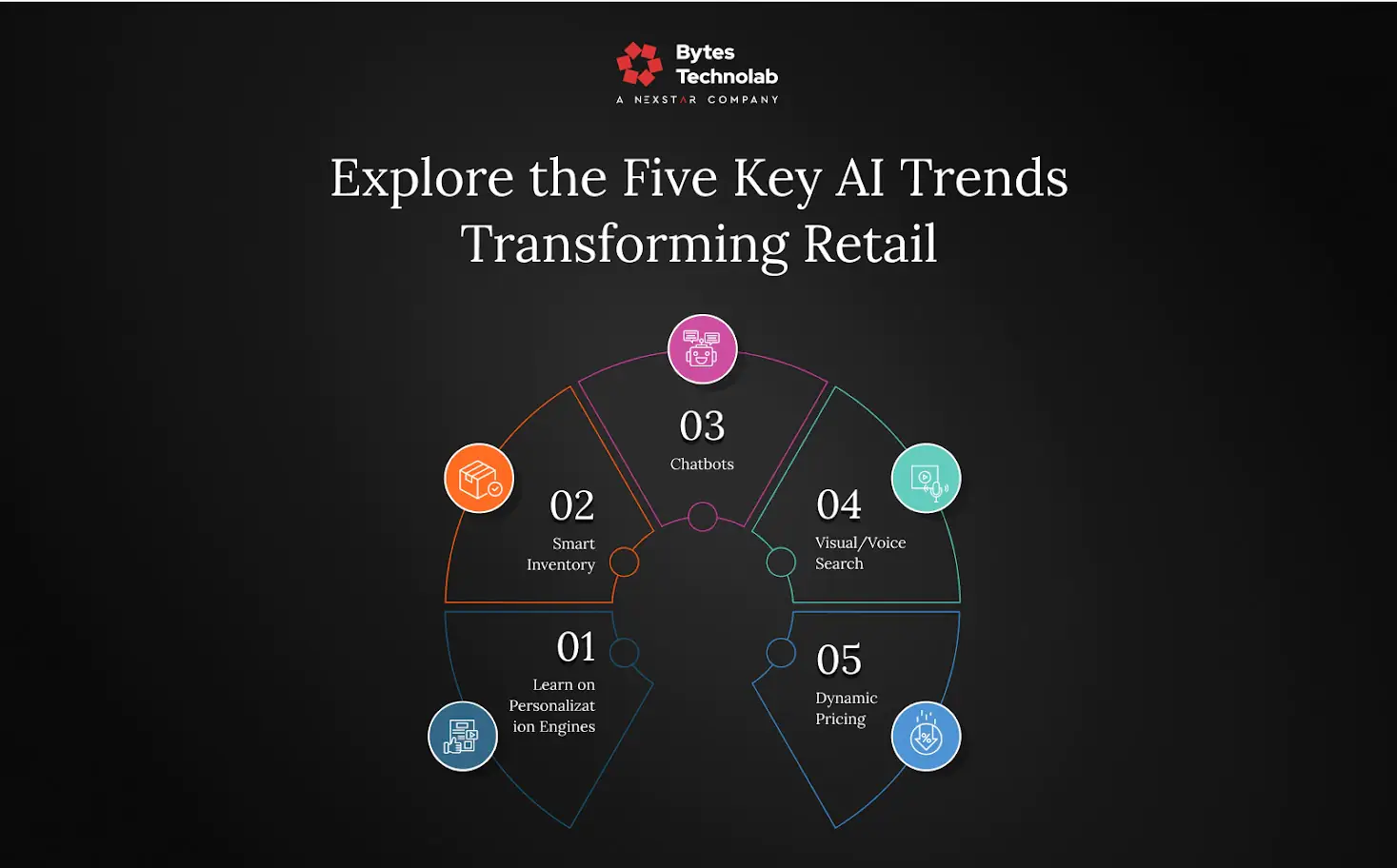
To understand the transformation, let’s start with the tools and technologies making it happen. These aren’t abstract ideas—they’re being deployed in real businesses right now.
- AI-Powered Personalization Engines
Ever feel like your favorite online store “just knows” what you like? That’s no accident. AI algorithms track browsing behavior, purchase history, time spent on a page, and broader customer behavior to create deeply personal shopping experiences. Personalized recommendations are made through algorithms analyzing user behavior.
For example, eCommerce platforms are now using AI-powered recommendation systems that adapt in real-time, showing different products to different users based on behavior. AI-driven product recommendations can increase e-commerce sales by 59%. This isn’t just boosting engagement; it’s increasing average order value and customer retention. These systems reflect AI driven personalization capabilities that improve customer experience through hyper-personalization in online shopping.
- Smart Inventory and Demand Forecasting
Traditional inventory systems relied on historical sales data and human estimation. But those days are gone. AI can now factor in dozens of signals—including sales data, weather, local events, and real time data from supply chains—using AI models to accurately forecast demand.
This is especially helpful in AI-powered traditional retail operations, where overstock and understock can both kill profitability. Retailers using AI for demand planning are reducing waste, improving availability, and learning to manage inventory with far less guesswork.
With supply chain analytics, AI systems can optimize inventory and supply chain management across forecasting, replenishment, and logistics. AI-driven forecasting and supply chain orchestration are becoming a core priority for large retailers — Gartner’s supply chain research shows top-performing supply chain organizations are investing in AI at more than twice the rate of low-performing peers to cut costs and reduce manual intervention.
See how we helped a client modernize inventory and warehouse operations in our SaaS inventory & warehouse management case study.
- Automated Customer Service with AI Chatbots
AI-powered virtual assistants aren’t just answering “Where’s my order?” anymore. They’re integrated with CRMs and order management systems to provide updates, suggest alternatives, process returns, and even upsell during live chats. Powered by natural language processing, these ai shopping assistants can understand and generate human language in ways that make virtual shopping assistants more useful across channels. In practice, they resolve up to 70% of customer queries autonomously.
For retailers offering retail and eCommerce software solutions, chatbots now play a crucial role in customer satisfaction and cost savings by managing customer interactions and customer queries across web, mobile, and messaging touchpoints. They automate customer support 24/7, reduce response time, and automate the returns process to improve customer experience.
- Visual Search and Voice Commerce
Visual search technology lets customers shop by uploading images to find similar products instantly. It’s a favorite in the fashion and home décor segments. Behind this, computer vision helps interpret visual inputs accurately. Meanwhile, voice search is gaining traction for reordering groceries or restocking office supplies.
AI is behind both, improving accessibility and speed while turning inspiration into conversion with fewer clicks.
- Dynamic Pricing
Retailers have always adjusted prices, but retail AI brings AI technologies into pricing decisions in a far more dynamic, data-driven way. Based on competitor pricing, demand patterns, inventory levels, and even weather, AI driven pricing engines can automatically adjust product prices in real time based on demand, competitor pricing, and inventory conditions, without human intervention.
Price optimization helps maximize profit margins and reduce excess inventory, especially in fashion and FMCG categories. For companies using custom retail software development, these dynamic pricing modules are becoming a must-have to remain competitive, not a nice-to-have.
Business Benefits: What AI Is Delivering to Retail & eCommerce
Implementing AI isn’t just about being trendy. It’s about solving real-world problems and improving business operations across both online and brick and mortar stores. Here’s how retail businesses are gaining an edge, as artificial intelligence is reshaping the e-commerce landscape and ai powered solutions are already used across multiple retail functions.
- Increased Efficiency
AI eliminates guesswork. From customer service automation to warehouse management, it handles routine tasks to improve operational efficiency so teams can focus on what really matters, strategy, growth, and creative innovation.
Machine learning can optimize fulfillment routing, and AI algorithms optimize transportation routes for faster deliveries.
Businesses working with a reliable retail eCommerce solutions provider are seeing operational costs drop while AI-powered automation improves day-to-day workflows and service levels.
- Better Customer Experiences
From tailored product suggestions to faster checkouts and real-time shipping updates, AI improves the online shopping journey with better recommendations and search that understands customer intent. Tailored shopping experiences also increase conversion rates. The experience feels personal, convenient, and frictionless.
And in retail, experience is everything—especially when personalization is guided by valuable insights from customer data.
- Deeper Business Intelligence
AI tools turn data into actionable insights. AI can analyze large volumes of unstructured data quickly, including customer feedback and customer sentiment, which gives teams rapid feedback on products and services. Sales trends, customer churn, and inventory turnover become clearer and easier to act on when paired with intelligent analytics and valuable insights.
This is especially crucial for mid-sized businesses that can’t afford a full data science team but still want powerful eCommerce software development services to compete.
- Higher Retention and Loyalty
AI helps you engage better, predict needs before they’re voiced, and increase customer lifetime value through more relevant engagement, while rewarding loyal customers at the right time. Companies that excel at personalization generate up to 40% more revenue than their slower-growing peers, according to McKinsey research. It’s a subtle but powerful shift from transactional to relational commerce.
Retailers using AI in loyalty programs and email campaigns are seeing higher lifetime value per customer, and that’s where the real profit lies as 67% of retail executives expect AI-driven personalization capabilities by 2027.
The Challenges: What Retailers Need to Watch Out For
AI can unlock big value, but it comes with its share of growing pains. Here’s what to watch out for.
Data Quality and Integration
AI is only as good as the data it learns from. Many retailers struggle with fragmented systems and inconsistent data. Before investing in AI, make sure your retail software development services partner helps you clean, unify, and organize your data pipelines.
- Privacy and Compliance
With more data comes more responsibility. AI solutions must comply with privacy laws like GDPR, CCPA, and others. Retailers need secure systems, transparent data practices, and a clear policy on how AI uses customer data. Modern ai systems also strengthen fraud detection by using machine learning to flag suspicious transaction activity and purchasing anomalies in real time, which helps protect online payments and customer data; that matters even more as retail shrink and fraud losses have run as high as $90–112 billion annually in the U.S., according to the National Retail Federation. We explore this alongside dynamic pricing and personalization in boosting retail sales with AI.
- Cost and Complexity
AI isn’t always plug-and-play. Custom models, machine learning engines, generative ai capabilities, and automation tools require time, talent, and integration. That’s why working with a trusted retail eCommerce solutions provider makes a difference, they help you balance innovation with feasibility. The right AI tools and high quality data are essential to unlock economic value without increasing implementation risk.
- Internal Adoption
Even the best AI tools will fall flat without team buy-in. Staff training, leadership support, and clear internal communication are key to successful rollouts, especially in traditional retail environments where digital transformation is still new.
Final Thoughts: AI Isn’t the Future of Retail, It’s the Present Need.
The retail and eCommerce space has always been competitive, but AI is reshaping how that competition plays out. It’s no longer about who has the flashiest store or the cheapest price. It’s about who understands the customer better, delivers faster, and adapts quicker.
From custom retail software development to AI-powered traditional retail operations, the opportunities are real and within reach. The retailers and eCommerce brands that embrace AI today aren’t just future-proofing their business. They’re building smarter, more agile companies right now.
Ready to Bring AI Into Your Retail Stack?
We help retail organizations apply AI capabilities across customer engagement and operations with AI-driven innovation. From custom chatbots and service-focused AI agents to predictive inventory systems, our retail software development services and eCommerce software development services are built for modern businesses ready to move forward, including generative AI workflows that can produce marketing copy and product descriptions at scale.
Whether you’re launching a new product line, modernizing your store systems, or scaling your B2B eCommerce services, we’ll help you build the right tools, with intelligence baked in.
Let’s talk about AI, strategy, and the next phase of your growth. Choosing the right AI tools helps build competitive advantage in the retail sector.
Frequently Asked Questions
At Bytes Technolab, we build retail & eCommerce software solutions tailored to your business needs, from AI-driven personalization engines to intelligent chatbots, inventory automation, and visual search tools. Whether you’re a D2C brand, a B2B distributor, or an omnichannel retailer, we help you deliver seamless digital experiences that drive results.
Absolutely. AI isn’t just for B2C. Many of our clients offering B2B eCommerce services benefit from predictive analytics, automated reordering systems, and AI-powered customer support. These tools reduce friction, improve buyer journeys, and make your B2B operations more scalable and cost-efficient.
Custom retail software development means you get a solution that’s tailored to your workflows, product catalog, customer behavior, and future growth plans. Unlike generic platforms, our solutions are built with flexibility, scalability, and your unique value proposition in mind, especially when AI tools are integrated from the ground up.
Some major benefits include improved customer retention, better demand forecasting, reduced operational costs, and more personalized shopping experiences. As a seasoned retail eCommerce solutions provider, we’ve seen AI dramatically improve conversion rates and lifetime customer value for brands across industries.
Not necessarily. While AI has advanced, it doesn’t have to be overwhelming or expensive. With the right retail software development services> partner, you can start small, like with AI chatbots or basic recommendation engines, and scale up based on ROI. We help you find the right balance between budget, complexity, and business impact.
Yes, we do. Whether you need a full AI roadmap or want help improving your existing tech stack, we offer strategy-led eCommerce software development services that begin with clear business goals. We evaluate your current systems, identify quick wins, and design scalable AI solutions aligned with your growth.
Data privacy is a top priority. All our AI integrations comply with global privacy regulations like GDPR and CCPA. We build secure, ethical, and compliant systems using best practices, so your customers’ data is protected, and your reputation stays intact while using AI-powered traditional retail operations effectively.
AI is helping traditional retailers move from manual guesswork to data-driven decisions. With tools such as smart inventory forecasting, dynamic pricing, and personalized product suggestions, AI-powered traditional retail operations are becoming more efficient, responsive, and profitable, enabling even legacy stores to stay competitive in a fast-paced market.

Abhishek Amin
Technical Writer
Abhishek Amin is an avid content strategist and marketing expert, specializing in AI-first digital product engineering and MVP development. He possesses acute awareness of the needs of startups and enterprises to scale by leveraging cutting-edge technologies like AI. His content marketing skills work as the gatekeeper, leading brands to engage with the engineering team and build game-changing digital products.