

 August 20, 2026
 2 mins to read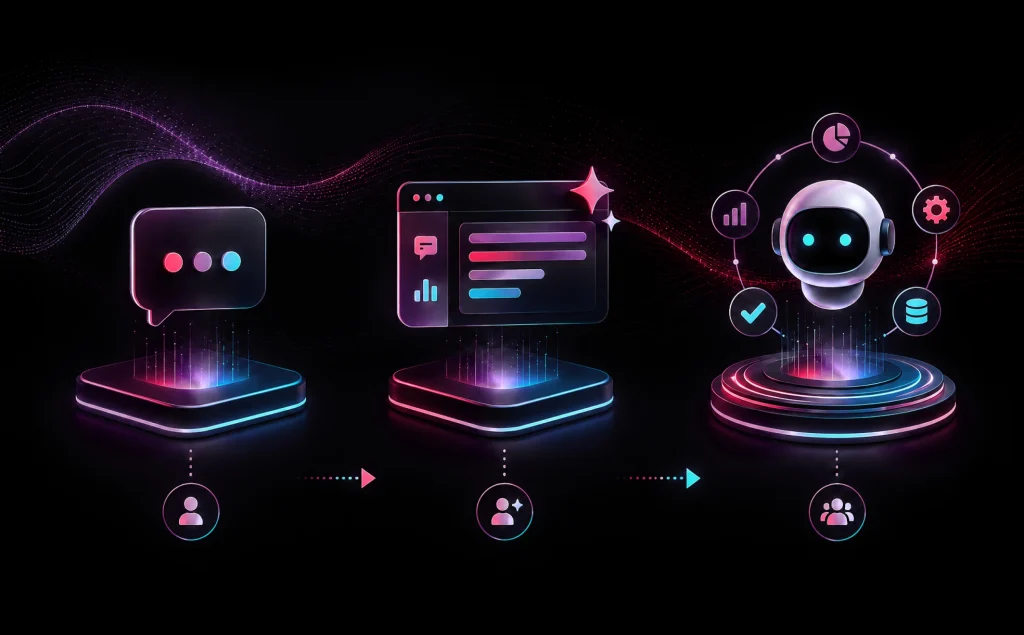
Your startup has 3 months of runway, yet investors keep asking when an agent will launch. The harder choice is whether users need execution, guided assistance, or faster answers inside a workflow already proving demand from paying customers right now.
Bytes Technolab, an AI-first Product Engineering partner, helps startups compare product value, permissions, readiness, risk, and economics. The goal is selecting the smallest model that proves demand before scarce engineering capacity funds autonomy users have not validated through measured evidence.
More Autonomy Can Burn Runway Before It Improves the Product
Autonomy adds permissions, integrations, evaluations, monitoring, recovery logic, and support exposure. A polished demonstration can hide that production burden until real customers test edge cases.
Gartner predicts more than 40% of agentic AI projects will be cancelled by the end of 2027. Costs, unclear value, and weak controls can outweigh expected gains.
Investors may ask about agents while competitors announce them. Neither signal proves first that users want software to change records, contact people, or make decisions without review.
A weak chatbot answer usually remains inside a conversation. A weak agent action can send messages, alter accounts, trigger payments, or create customer commitments.
Each added action consumes runway through tool calls, approval flows, retries, incident recovery, and support. It may delay launch while teams harden architecture users never requested.
The practical question is which control boundary preserves runway while delivering the promised outcome. Capability earns funding only after usage proves that greater authority matters.

AI Chatbot Development Services Start With the Control Boundary
AI Chatbot Development Services should define who initiates, decides, executes, and changes external state. Those boundaries classify products more reliably than product labels or polished demonstrations.
Agent washing makes labels unreliable. Gartner estimates that only about 130 products offer genuine agentic capability despite thousands of market claims using that description.
Compare every AI agent and chatbot through the same control, permission, risk, cost, and product-stage criteria. Marketing language cannot replace that capability test.
What is the difference between an AI chatbot, a copilot, and an AI agent?
| Criterion | Chatbot | Copilot | Agent |
| Initiation | User prompt | User in workflow | Goal or trigger |
| Decision authority | User | User | System within rules |
| Execution | User or handoff | User after suggestion | Connected tools |
| System access | Mainly read | Contextual read | Bounded read and write |
| Integrations | Light | Moderate | Heavy |
| Human approval | Before action | Before execution | Risk based |
| State change | Minimal | User approved | Direct external change |
| Failure exposure | Wrong answer | Wrong recommendation | Wrong action |
| Engineering burden | Low | Medium | High |
| Operating cost | Low | Medium | High |
| Product-stage fit | Early validation | Proven workflow | Validated automation |
| Best-fit job | Answer or route | Improve human work | Complete bounded work |
The control boundary shows whether the product informs, assists, or acts. The next comparison reveals how that contract changes trust and daily behaviour.
AI Agent and Chatbot Models Change Who Drives the Product Experience
The AI copilot vs AI agent decision changes the user’s role. It determines who starts work, sees context, accepts suggestions, approves actions, and corrects mistakes.
A chatbot waits for a prompt and returns an answer. That rhythm suits support, discovery, qualification, and guidance when users expect a visible conversational destination.
A Business AI Copilot sits inside the workspace. It reads permitted context, drafts the next move, and leaves judgment plus final execution with the user.
An agent starts from a goal or trigger and retains a task state. Users move from operating the workflow toward supervising delegated execution across connected tools.
Delegating work does not transfer accountability. Product owners must decide where people lead, review, approve, interrupt, or recover task-specific work across the experience.
Fewer clicks do not guarantee adoption. Broad permissions, hidden progress, unexpected actions, and repeated confirmations can make a faster workflow feel less trustworthy.
Track suggestion acceptance, correction frequency, and hidden-task abandonment. These signals reveal whether users trust assistance or tolerate it during trials.
Choose the model matching the role users want to keep. That role sets the technical burden that data, tools, and recovery paths must support.
AI Workflow Automation Depends on Data, Tools, and Workflow Stability
AI workflow automation works only when the process behaves consistently enough to test. Autonomy cannot exceed the reliability of data, APIs, identity, permissions, and recovery paths.
LLM Development Services can interpret documents and varied language. They cannot repair missing records, contradictory policies, unstable APIs, or unclear ownership between workflow stages.
Chatbot integration services usually need retrieval, analytics, read access, and human handoff. Copilots add workspace state, while agents require tested write access and persistent task memory.
Start with AI use-case identification and technical feasibility. Map inputs, decisions, exceptions, tools, permissions, completion conditions, and every point where people resolve ambiguity.
OpenAI recommends agents for workflows involving complex decisions, difficult rule sets, or substantial unstructured data. Simpler deterministic methods can remain sufficient for stable work.
Workflow Automation Services should test latency, duplicate calls, denied permissions, partial failures, and recovery. A failed tool call must not leave the product state half committed.
Begin with one agent. Multi-agent AI systems add handoffs, conflicts, shared state, and tracing, so measured single-agent limits must justify that architecture.
Test stale data, revoked access, and duplicate triggers before production. Stable happy paths do not prove reliable execution under pressure.
Readiness comes before authority. Once tools support execution, the next question is how far a wrong action can travel before people can stop it.
Human Approval and Failure Reversibility Define Safe Autonomy
Safe autonomy depends on what failure changes outside the model. A chatbot can misstate information, while an agent can alter records, contact customers, or spend money.
Least-privilege access should restrict each tool to the smallest action and data scope. Sensitive writes need approval before commitment, not review after an incident.
Prompt injection, incomplete context, and tool errors can combine during execution. Teams need authentication, authorization, audit trails, stop conditions, rollback, and named escalation owners.
Why are agents harder to build than chatbots?
Agents plan across steps, select tools, retain state, and create external effects. Each capability introduces failure paths that conversation testing alone cannot expose, so production systems need stronger evaluations, tracing, approval, rollback, and escalation.
• Limit tools by action permission
• Test rollback after every failure
• Trace decisions, tools, and outcomes
— Action Risk Classes
Risk classes should follow reversibility and commitment. Harder-to-stop actions need stronger approval, smaller limits, clearer logs, and faster recovery paths.
— Reversible actions
Drafting records or staging updates creates reversible work. Users can inspect the proposed change and restore the previous state before any external commitment.
— Reviewable actions
Sending approved messages or updating low-risk fields creates reviewable work. The system prepares execution, while a person retains final commitment authority.
— Difficult-to-reverse actions
Payments, deletions, account changes, and customer commitments create material exposure. They need explicit approval, strict limits, immutable logs, rollback planning, and immediate escalation.
Gartner predicted in 2026 that 40% of enterprises may demote or decommission autonomous agents by 2027 after governance gaps surface. Risk boundaries explain that production burden.
Engineering Cost and Unit Economics Decide What the Startup Can Sustain
Engineering cost rises with system authority, not only model choice. A chatbot needs conversation design and retrieval, while an agent adds tools, state, monitoring, and recovery.
Custom AI chatbot development can validate demand through resolution, handoffs, retention, and willingness to pay while keeping the first validation surface narrow.
A copilot adds product context, permission-aware suggestions, acceptance tracking, and review design. Its value appears when users complete meaningful work faster without surrendering judgment.
An agent adds model calls, tool latency, retries, approval checks, tracing, incident handling, and support. Every completed workflow carries variable execution and recovery expenses.
IBM’s 2025 CEO study found that 25% of AI initiatives delivered expected ROI, while only 16% had scaled across the business after sustained investment.
Track cost per successfully completed user outcome rather than monthly model spend. Cheap responses become expensive when failures require retries, review, refunds, support, or recovery.
• Cost per resolved interaction
• Cost per accepted recommendation
• Cost per completed workflow
• Human review minutes per outcome
• Failure and retry cost
Bytes Technolab connects architecture scope with product economics. Founders compare data control, integrations, evaluation datasets, model routing, maintenance, support, technical debt, and switching costs.
Economics can reject technically feasible autonomy. Product scenarios must show whether users value information, assistance, execution, or specialist coordination enough to fund it.
Match the Model to the Product Job, Not the Marketing Label
Product fit depends on outcome, authority, failure tolerance, and upgrade evidence. Microsoft reported that 46% of leaders already used agents to automate complete workstreams or business processes.
That adoption figure shows momentum, not universal suitability. Each startup still needs a task-specific human-agent ratio and proof that added authority improves measurable outcomes.
A recommended model should state readiness conditions and upgrade evidence. Without both, a use case becomes a feature pitch instead of a product decision.
When do users need trusted answers across channels?
Choose a focused chatbot for answers, guidance, qualification, or routing.
• Curated knowledge with source links
• Retrieval analytics expose missed intent
• Human handoff covers uncertainty
Impact: Repeated action requests justify testing a copilot.
When do users need help completing work inside the product?
Choose a Business AI Copilot for drafts, analysis, or recommendations.
• Product context shapes suggestions
• Permissions restrict workspace visibility
• Acceptance tracking proves value
Impact: High acceptance plus execution demand supports an agent trial.
When must the product complete a bounded workflow?
Choose one agent for a defined outcome across reliable tools.
• Stable APIs support each step
• Approval gates protect sensitive writes
• Logs and rollback expose failures
Impact: Consistent success and low reversals support broader authority.
In practice, an AI agent that reduced healthcare triage time by 48% shows how bounded agent execution performs when APIs, approval gates, and rollback logic are validated before deployment.
When can one agent no longer manage the full job?
Choose multiple agents only after one agent shows a measured limit.
• Specialist roles have clear boundaries
• Shared state remains conflict-aware
• Coordination gains exceed overhead
Impact: A measured bottleneck justifies added coordination.
Evidence gates stop extra authority before architecture expands.

AI Agent Development Services Should Pass the Minimum Necessary Autonomy Framework
AI Agent Development Services should earn their place through evidence. A startup should stop at the lowest authority level that fully completes the validated user outcome.
Technical feasibility cannot settle the choice alone. Permissions, reversibility, workflow readiness, user behavior, operating cost, and recovery decide whether more authority improves the product.
The Minimum Necessary Autonomy Framework turns those conditions into seven gates. A model progresses only when the next authority level produces measurable value without unacceptable exposure.
When should you use an agent vs. a chatbot?
Use an agent when users need a bounded outcome completed across systems. Use a chatbot when value ends with an answer, qualification, recommendation, or handoff.
Gate 1: Validated User Outcome
Name the completed outcome users value enough to adopt or pay for. Gartner’s cancellation forecast shows that technical novelty cannot replace proven demand.
Gate 2: Work Initiation
Choose whether people must start every interaction or reliable triggers should begin work. Unwanted proactive starts fail this gate immediately.
Gate 3: Decision Authority
Keep judgment with people when rules remain subjective. System decisions become acceptable only inside explicit, tested limits with clear accountability.
Gate 4: System Permissions
Grant only the access needed for the outcome. Read, write, send, purchase, delete, and commit permissions create different exposure.
Gate 5: Failure Reversibility
Confirm that incorrect actions can be detected, stopped, reversed, and explained without material harm. Irrecoverable effects block greater autonomy.
Gate 6: Technical Readiness
Data, APIs, tools, identity, state, evaluations, observability, and escalation paths must remain reliable before authority expands.
Gate 7: Unit Economics
Greater autonomy must improve completion, retention, revenue, or operating efficiency enough to cover full production, review, retry, and recovery costs.
| Decision gate | Pass evidence | Fail signal |
| User outcome | Users value completion | Demo interest only |
| Initiation | Triggers improve outcomes | Proactive work feels unwanted |
| Authority | Rules support decisions | Judgment remains subjective |
| Permissions | Access matches the job | Access exceeds the outcome |
| Reversibility | Actions stop and reverse | Material effects persist |
| Readiness | APIs and logs stay reliable | Dependencies remain unstable |
| Economics | Outcome cost creates value | Retries erase gains |
| Agent-washing test | It plans, uses tools, writes, stops, and recovers | It only rebrands chat or rules |
| Do not build yet | All gates have evidence | Answers already solve the problem |
| Increase autonomy | Measured gains beat the baseline | Added authority adds cost only |
— Evidence Thresholds
Increase authority only when real workflow tests prove demand, safe permissions, reliable recovery, stable dependencies, and positive economics. Otherwise, keep the simpler model.
Validate the Model Before Hiring an AI & ML Development Company
Validate the workflow before hiring an AI and ML Development Company. A focused 7-to-30-day test exposes weak demand, unstable integrations, unsafe permissions, and poor product economics.
Define the user outcome without naming chatbot, copilot, or agent. Map who initiates, decides, executes, reviews, recovers, and owns each failure in practice.
Assess chatbot solution providers by their willingness to recommend less autonomy. A credible partner defines success, failure, and exit conditions before proposing broader permissions.
Should you replace your chatbot with an AI agent?
Keep a chatbot when users mainly need answers. Test bounded copilot or agent functions only where repeated behavior proves execution demand and measurable gains.
1. Days 1 to 3: Define one paid outcome and its completion event.
2. Days 2 to 5: Map initiation, decisions, execution, review, and recovery.
3. Days 4 to 10: Prototype the lowest sufficient authority.
4. Days 7 to 14: Test denied access, tool failure, and rollback.
5. Days 10 to 20: Measure success, reversals, latency, review time, and cost.
6. Days 15 to 25: Add one integration or authority step.
7. Days 21 to 30: Commit budget only when results beat baseline.
Partner evaluation questions:
- Will the partner recommend less autonomy?
- How will success and failure be tested?
- Which tools and data receive access?
- Which actions require human approval?
- How are rollback and escalation handled?
- What proves multiple agents are necessary?
Commit budget only after higher authority improves value or economics. Users must justify the next level.
Build the Smallest AI Experience Users Will Pay For
The real risk was never choosing a less advanced label. It was spending runway before proving which authority users need, trust, and value enough to adopt.
Chatbots, copilots, and agents are different product contracts. Each transfers more initiation, judgment, execution, permissions, and failure responsibility from the user to the system.
Bytes Technolab, an AI-first Product Engineering partner, connects product discovery, data readiness, and architecture. Evaluation, approval design, and staged implementation support measurable startup outcomes.
Teams receive an autonomy boundary, API readiness view, evaluation plan, risk controls, and cost model. Each decision ties architecture to correct user-valued outcomes.
We own the outcome. Not just the delivery. Every added permission, integration, or agent role must earn its production burden through observed value.
Choose a chatbot when the promise ends with a trusted answer. Choose a copilot when human judgment remains central, and an agent for bounded execution.
Build the smallest AI experience users will pay for reliably. Let usage, failure data, workflow readiness, and unit economics earn each added layer of autonomy before more authority enters production.
A chatbot handles conversation, a copilot improves work while a person retains control, and an agent executes bounded tasks through tools. AI Agent Development Services therefore need permission design, evaluations, monitoring, approval rules, rollback, and recovery beyond ordinary response testing.
Choose AI Chatbot Development Services when users mainly need trusted answers, qualification, discovery, or routing. This model limits integration cost and failure exposure while the startup measures resolution quality, handoff demand, retention, and willingness to pay before funding automatic execution.
Agents create multi-step action chains involving planning, tools, state, and external systems. LLM Development Services must test denied permissions, partial completion, duplicate actions, prompt injection, stop conditions, audit trails, rollback, escalation, and recovery across the entire workflow, not only responses.
Replacement is unnecessary when conversation solves the primary job. An AI agent and chatbot can coexist, with the chatbot handling questions while copilot or agent functions address action demand. Compare adoption, reversals, review time, latency, and outcome cost before expanding.
Bytes Technolab assesses use-case value, data readiness, permissions, integrations, failure exposure, and unit economics. The team defines an AI MVP, architecture boundary, evaluation set, approval controls, cost baseline, and staged implementation plan tied to measurable evidence from real user workflows.

Bhavik Shah
Founder & Director at Bytes Technolab...
He has been driving digital growth for over 18 years by empowering global startups, SMEs, and enterprises including Fortune 500 brands with scalable software, web, mobile, and eCommerce solutions. With a proven track record of 300% revenue growth and 300+ successful deliveries, he combines strategic business leadership with technical excellence across marketplaces, SaaS, and innovation adoption. As a mentor to 140+ software experts, Bhavik bridges business vision with technology execution, helping clients scale in competitive markets across the USA, Canada, India, and beyond.
Table Of Content
- More Autonomy Can Burn Runway Before It Improves the Product
- AI Chatbot Development Services Start With the Control Boundary
- What is the difference between an AI chatbot, a copilot, and an AI agent?
- AI Agent and Chatbot Models Change Who Drives the Product Experience
- AI Workflow Automation Depends on Data, Tools, and Workflow Stability
- Human Approval and Failure Reversibility Define Safe Autonomy
- Why are agents harder to build than chatbots?
- Engineering Cost and Unit Economics Decide What the Startup Can Sustain
- Match the Model to the Product Job, Not the Marketing Label
- When do users need trusted answers across channels?
- When do users need help completing work inside the product?
- When must the product complete a bounded workflow?
- When can one agent no longer manage the full job?
- AI Agent Development Services Should Pass the Minimum Necessary Autonomy Framework
- When should you use an agent vs. a chatbot?
- Validate the Model Before Hiring an AI & ML Development Company
- Should you replace your chatbot with an AI agent?
- Build the Smallest AI Experience Users Will Pay For