


 September 9, 2026
 2 mins to read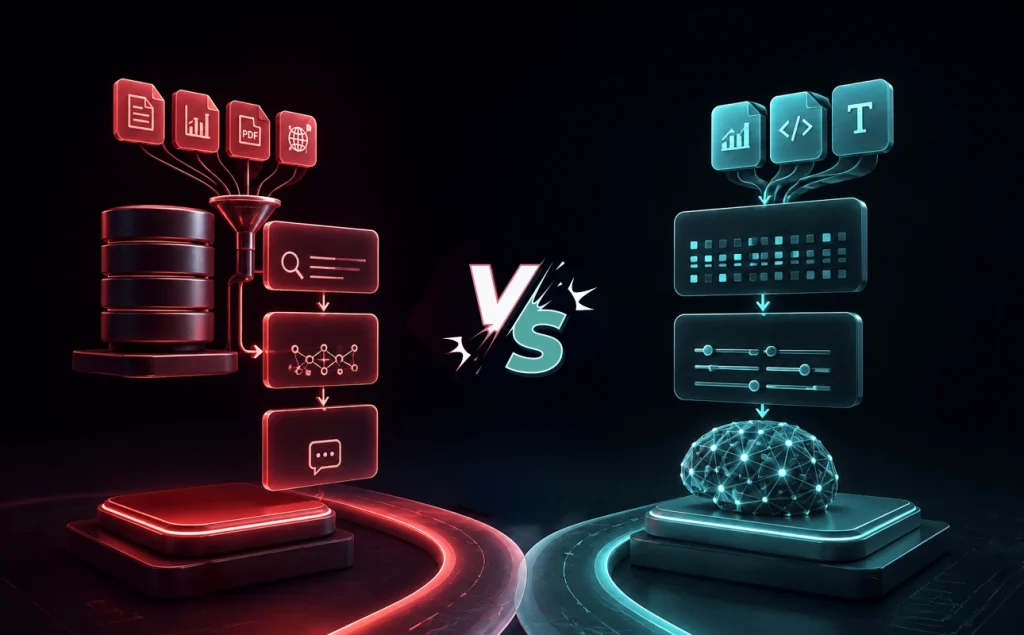
VP Engineering teams can burn months of AI budget fixing the wrong layer before anyone proves whether knowledge, retrieval, model behavior, workflow, or evaluation failed. Bad answers look similar at the interface, but each failure demands a different investment path.
Architecture decisions become safer when measured failure signals lead the choice, not technology preference. Bytes Technolab, an AI-first Product Engineering partner, helps scale-ups and mid-enterprises test RAG, fine-tuning, hybrid, or simpler paths before production dependencies become expensive to reverse later.
Wrong Architecture Burns Budget Before It Fixes AI
The expensive mistake is not choosing the less powerful technique. It is funding a technically sound solution to a failure that lies elsewhere in the system.
The Menlo Ventures estimate puts generative AI spending at $37B in 2025 versus $11.5B in 2024, a 3.2x increase. That scale raises the cost of weak architectural evidence.
Menlo surveyed 495 U.S. enterprise AI decision-makers and combined responses with a market model. Treat those figures as investment pressure, not proof of global adoption behavior.
What makes the wrong AI architecture expensive to reverse?
Reversal cost accumulates across embeddings, index schemas, chunking logic, rerankers, ACL rules, adapters, training datasets, evaluation suites, model versions, and serving infrastructure. Each dependency narrows future choices.
A working component can still be the wrong investment. Retrieval work cannot fix broken orchestration, while tuning cannot repair missing permissions or an invalid evaluation set.
Poor output is therefore only a symptom, not an architectural verdict. The next decision should locate the first failing layer before another dependency becomes expensive to unwind.
Diagnose the Failure Layer Before Choosing the Architecture
Bad answer quality is not a diagnosis. An AI architecture for enterprise should separate retrieval, generation, behavior, workflow, access, source freshness, and evaluation into measurable failure signals.
Microsoft’s retrieval-quality guidance says teams need reproducible evaluation before retrieval optimization in production systems. Without measurement, optimization becomes guesswork and may improve the wrong component.
The peer-reviewed MIRAGE benchmark uses 7,560 QA instances mapped to 37,800 retrieval entries. It evaluates retrieval and generation interaction instead of treating RAG quality as one black-box score.
What is actually failing: knowledge, retrieval, behavior, workflow, or evaluation?
The failing layer is the first component that breaks under controlled measurement. Final-answer quality alone cannot reveal whether evidence was absent, misretrieved, misused, blocked, or misjudged.
- Failure Layers
- Knowledge or source gap
- Retrieval or context gap
- Context-use or faithfulness gap
- Behavior or task gap
- Workflow or orchestration gap
- Governance or data gap
- Evaluation design gap
Relevant evidence reaching the model does not prove faithful use. Left unmanaged, this kind of context-use gap is exactly how to control AI hallucinations before they spread through workflows, so isolating it early prevents downstream cost. Once failure is isolated, RAG, tuning, hybrid, or neither can be tested against the actual constraint.
RAG Development Services and Fine-Tuning Face the Data Test
Runtime retrieval earns its place when missing, changing, proprietary, permission-aware, or citable knowledge is the measured constraint. Stable knowledge alone does not automatically justify retrieval infrastructure.
RAG Development Services should follow evidence that source access improves the failing task. Otherwise, retrieval may add tokens, latency, permissions work, and maintenance without solving quality.
Modern RAG includes hybrid search, reranking, query planning, filtering, preparation, evaluation, and monitoring. Microsoft’s RAG guidance also highlights multi-source access, token limits, response time, security, and query-time authorization.
| Decision criterion | RAG | Fine-tuning |
| Freshness | Refresh sources | Retrain or add a knowledge path |
| Traceability | Visible evidence | Harder inside weights |
| Permissions | Query-time filtering | Training and adapter controls |
| Behavior | Prompt- or model-dependent | Fits persistent measured gaps |
| Reversibility | Change retrieval artifacts | Version data, adapters, serving |
For example, our RAG-powered construction intelligence tool replaced a generic AI assistant by grounding answers in permissioned, source-specific data — the exact freshness-and-traceability test described above.
A RAG-powered model is justified when those controls improve a proven constraint. Custom RAG System Development, a Retrieval augmented generation System, or RAG-based chatbot development otherwise adds avoidable complexity.

How does data privacy differ between RAG and fine-tuning?
RAG can enforce permissions during retrieval and remove sources without retraining. Fine-tuning shifts governance toward training provenance, adapter versions, lineage, removal policies, regression evidence, and auditability.
Custom LLM Fine-Tuning Services and RAG Face Production Economics
Production economics depend on workload, not folklore. Custom LLM Fine-Tuning Services and LLM Fine-Tuning Solutions vary with training method, dataset, model size, serving mode, volume, and failure cost.
A Custom LLM Model still needs a measured baseline. Multi-Modal Fine-Tuning belongs only where image, audio, video, or mixed-input behavior creates a proven capability gap.
Thinking Machines Lab calculates that LoRA uses slightly more than two-thirds of FullFT forward/backward FLOPs per pass. Its derivation excludes attention FLOPs, which can matter for long-context workloads.
Production Economics
| Cost driver | Measurement |
| Training | FullFT, PEFT, LoRA, dataset size |
| Serving | Model size, capacity, volume |
| Inference | Tokens, context, tools |
| Latency | Required p95 time |
| Lifecycle | Retuning, indexing, regression |
| Outcome | Cost per successful task |
Does RAG introduce latency compared to fine-tuned models?
It can. RAG adds retrieval, search, embedding, and context-processing steps before generation, which can increase latency and token usage. Fine-tuned models can sometimes serve narrower tasks with shorter prompts and lower latency, but the outcome depends on the model, retrieval design, workload, and serving environment.
Is fine-tuning more expensive than implementing a RAG pipeline?
Neither architecture is inherently cheaper. Fine-tuning introduces training, deployment, inference, dataset, and model-maintenance costs, while RAG adds indexing, retrieval, embedding, storage, and additional context-processing costs.
The useful comparison is therefore not the initial implementation cost alone. Measure total cost per successful task alongside quality, latency, update frequency, maintenance effort, and expected production volume.
Hybrid AI Architecture Helps Only When Evidence Earns It
Hybrid AI Architecture is justified only when two independent constraints survive controlled testing. One should require runtime grounding or changing knowledge, while another requires persistent behaviour or task adaptation.
Combining RAG and fine-tuning can address both needs, but added complexity is not evidence of a better architecture. The additional retrieval, training, evaluation, governance, and maintenance layers must produce a measurable improvement over simpler alternatives.
Google Cloud recommends that teams [start simple] and establish a baseline before adding more techniques. Hybrid architecture should therefore be an evidence-based escalation, not the default starting point.
When is hybrid architecture actually justified?
Choose a hybrid only after two tests pass independently. Retrieval must fix a measured grounding gap, while tuning must separately fix a persistent behavior or task deficit.
Google’s operations guidance treats prompts, chains, retrieval stores, datasets, embedded models, and adapters as governed production artifacts. When these layers span multiple coordinated components, the added complexity starts to resemble AI multi-agent orchestration rather than a single retrieval or tuning decision. Hybrid therefore, adds lifecycle, rollback, and regression responsibilities.
Each added component creates another monitoring and rollback boundary. Retrieval stores, adapters, prompts, and orchestration can drift independently, increasing the risk of regressions after model, data, or permission changes.
That matters when architecture becomes expensive to reverse. A benchmark uplift must survive production volume, p95 latency, permission checks, maintenance ownership, and cost-to-change before hybrid is accepted.
When should neither RAG nor fine-tuning be the first investment?
Choose neither when prompts, model choice, source data, permissions, retrieval, context, tools, orchestration, or evaluation cause the failure. Repair that layer first, then retest the baseline.
Use a Failure-to-Architecture Matrix Before You Commit
Use the Failure-to-Architecture Decision Matrix, or FADM, before committing a budget. Its three components directly connect measurable failures to architecture fit, operating thresholds, and future reversibility.
- Failure Signal
Start with the first reproducible miss, not the preferred technology. Evidence should clearly identify whether knowledge, retrieval, context use, behaviour, workflow, governance, economics, or evaluation failed.
- Architecture Fit
Test RAG, tuning, hybrid, and neither against identical evidence. Each option earns consideration only when it removes the measured constraint without creating worse production trade-offs.
- Decision Evidence Pack
Carry quality, latency, cost, freshness, governance, maintainability, and reversibility into the final decision. RAG Systems & AI Architecture choices should survive those thresholds before production investment.
| Failure Signal | What It Usually Means | Architecture Direction |
| Facts or evidence missing | Knowledge freshness or retrieval recall failed | Use RAG for missing knowledge; repair retrieval when evidence already exists |
| Context is noisy or misused | Retrieval precision or context faithfulness failed | Filter, rechunk, rerank, or prompt first; test tuning or hybrid if it persists |
| Format drift or task miss | Behaviour or model capability failed | Test fine-tuning after prompt and model controls pass |
| p95 latency or cost fails | Architecture is economically unsuitable | Benchmark RAG, tuning, hybrid, and routing against the same threshold |
| ACL, citation, or tool failure | Governance or workflow failed | Use controlled RAG for access issues; repair tools rather than changing the model |
| The cause remains unclear | Evaluation cannot isolate the failure | Choose neither yet; improve measurement first |
| Decision Path | Production Evidence to Carry Forward | What It Must Prove |
| RAG | Grounding, freshness, retrieval latency/cost, ACL, refresh burden | Knowledge and access improve enough to justify retrieval overhead |
| Repair retrieval | Recall, precision, reranking, lineage, reindexing effort | Retrieval improves without unnecessary model changes |
| Fine-tuning | Faithfulness, task success, model latency, training cost, provenance | Behaviour improves enough to justify training and retuning |
| Hybrid | Retrieval and behaviour quality, combined latency/cost, governance | Both failure layers genuinely require separate interventions |
| Neither yet | Tool success, API reliability, auditability, integration maintenance | The failure sits outside retrieval or model adaptation |
| Final winner | Quality floor, p95 latency, cost per success, maintenance, reversibility | It clears production thresholds with the smallest long-term burden |
How do I evaluate whether RAG or fine-tuning performs better?
Use FADM on one frozen evaluation set. Compare component evidence against production thresholds, because final-answer quality alone cannot reliably identify the failing layer or justify architecture under load.
Measure retrieval correctness and coverage before judging generation. Then score grounding or faithfulness using fixed evidence, so polished final answers cannot hide weak retrieval during demonstrations or pilots.
Measure behaviour and task success against frozen cases. Test parameter adaptation only when failures persist after prompt, model, source, permission, and workflow controls pass reliably.
Add p95 latency, cost per successful task, and knowledge-update SLA. Track governance and auditability as first-class constraints, especially where permissions, lineage, or source traceability affect production acceptance.
Measure maintenance burden and reversibility beside quality. Retrieval stores, index logic, evaluation suites, adapters, datasets, model versions, and serving dependencies each create different future change costs.
The architecture with the best isolated benchmark is not necessarily the production winner. Choose the smallest path that solves the proven failure while clearing business-operational thresholds.
Run a Controlled Architecture Proof Before Production
Run a controlled proof before the production budget hardens the architecture. A 7-to-30-day exercise can clearly locate constraints across retrieval, behavior, workflow, governance, economics, and evaluation.
Keep every candidate on identical frozen cases and operating limits. Changing prompts, datasets, model versions, permissions, latency targets, or scoring rules during comparison destroys comparability.
Microsoft recommends retrieval evaluation first, while Google recommends a simple baseline. Added complexity should beat that reference under identical conditions of quality, cost, latency, and governance.
What should an architecture proof measure before production?
An architecture proof should isolate component quality before comparing complete systems. It should preserve the same data snapshot, permissions, model versions, scoring rules, and production thresholds.
- Freeze normal, difficult, edge, and known-failure cases.
- Record the base model and prompt baseline.
- Score retrieval correctness, coverage, precision, and noise.
- Test behavior and narrow-task performance separately.
- Compare prompt-only, RAG, tuned, and hybrid variants conditionally.
- Measure quality, faithfulness, p95 latency, tokens, cost per success, update SLA, security, governance, maintenance, and reversibility.
- Select the smallest threshold-clearing architecture; reject unproven complexity.
After proof, Bytes Technolab can use Product Solution Architecture Services to convert measured evidence into implementation choices. The result does not presume which technology should win.
AI Consulting and Strategy can address readiness, data, evaluation, and governance. The AI Implementation Partner path, including RAG or full-stack engineering, should follow the validated constraint.

Choose the Smallest Architecture That Solves the Proven Failure
RAG is not automatically cheaper, and fine-tuning is not automatically more accurate. Each earns investment only when measured evidence ties it directly to the failing layer.
Hybrid is not automatically more mature, and simpler is not automatically better. Every option must meet the required thresholds for quality, latency, cost, freshness, governance, maintenance, and reversibility.
Bytes Technolab keeps the architecture fit before the implementation scope. It tests retrieval, model behavior, workflow, permissions, evaluation, and production economics against one frozen representative evidence set.
That sequence protects engineering capacity and makes change paths visible. It also prevents a technically impressive component from becoming expensive debt that fails to address the original failure.
External knowledge may justify retrieval, while persistent task failure may justify model adaptation. Both together require separate proofs, and neither remains a valid outcome when simpler repairs win.
The decision is therefore not about choosing the most advanced stack. Keep measuring the proven failure until the smallest threshold-clearing architecture becomes the obvious next production move.
Frequently Asked Questions
Choose retrieval when tests prove that current, proprietary, permission-aware, or citable knowledge is the limiting constraint. RAG Development Services make sense when source updates or traceability matter, but not when prompt behavior, workflow logic, permissions, or evaluation cause the failure.
Use tuning when a persistent, measurable behavior or narrow-task gap remains after simpler controls pass. Custom LLM Fine-Tuning Services also require suitable training data, evaluation criteria, and production economics that justify parameter adaptation instead of prompt, model, or workflow changes.
RAG can enforce document permissions during retrieval and remove sources without retraining model weights. An AI architecture for enterprise using fine-tuning instead needs training-data provenance, adapter versioning, lineage, regression testing, removal policies, and production audit records across the model lifecycle.
Compare both on one frozen evaluation set under the same operating limits. RAG Systems & AI Architecture decisions should score retrieval correctness, grounding, task success, p95 latency, cost per successful task, freshness, auditability, maintenance, and reversibility before declaring a production winner.
An Architecture Review can cover failure attribution, retrieval, model behavior, evaluation, cost, latency, governance, maintenance, and reversibility for technical teams. The result is an evidence-backed path toward RAG, tuning, hybrid, or simpler fixes without presupposing which technology must be sold.

Bhavik Shah
Founder & Director at Bytes Technolab...
He has been driving digital growth for over 18 years by empowering global startups, SMEs, and enterprises including Fortune 500 brands with scalable software, web, mobile, and eCommerce solutions. With a proven track record of 300% revenue growth and 300+ successful deliveries, he combines strategic business leadership with technical excellence across marketplaces, SaaS, and innovation adoption. As a mentor to 140+ software experts, Bhavik bridges business vision with technology execution, helping clients scale in competitive markets across the USA, Canada, India, and beyond.
Table Of Content
- Wrong Architecture Burns Budget Before It Fixes AI
- What makes the wrong AI architecture expensive to reverse?
- Diagnose the Failure Layer Before Choosing the Architecture
- What is actually failing: knowledge, retrieval, behavior, workflow, or evaluation?
- RAG Development Services and Fine-Tuning Face the Data Test
- Custom LLM Fine-Tuning Services and RAG Face Production Economics
- Hybrid AI Architecture Helps Only When Evidence Earns It
- Use a Failure-to-Architecture Matrix Before You Commit
- How do I evaluate whether RAG or fine-tuning performs better?
- Run a Controlled Architecture Proof Before Production
- What should an architecture proof measure before production?
- Choose the Smallest Architecture That Solves the Proven Failure