RAG vs Fine-Tuning: Which GenAI Approach Is Right for Your Business?

Your GenAI pilot works in demos, but production exposes a harder choice: does the model need fresher knowledge, more consistent behaviour, or both? Choose the wrong path, and you inherit repeated retraining, retrieval overhead, governance gaps, and avoidable operating costs.

The answer is not RAG or fine-tuning by default. Bytes Technolab, an AI-first Product Engineering partner, helps Australian technical teams prove whether knowledge access, model behaviour, or both deserve production investment before architecture choices become expensive and difficult to reverse.

RAG vs Fine-Tuning: Why This Choice Gets Expensive

RAG and fine-tuning become expensive when teams solve the wrong failure. One adds retrieval operations, while the other adds training, evaluation, and ongoing model lifecycle work.

Production makes those responsibilities recurring rather than temporary. Deloitte reports that 28% of Australian respondents moved at least 40% of their AI pilots into production.

That gap makes architecture discipline matter more than experimentation speed. A technique can work technically and still create unnecessary ownership when the diagnosed problem is wrong.

Why does the RAG vs. fine-tuning decision become expensive in production?

When information is missing, training may create repeated retraining without fixing freshness. When behaviour is inconsistent, retrieval can add infrastructure while leaving the behavioural failure intact.

The useful first question is therefore not which technology is stronger. It is the measurable failure the application must correct before more architecture is added.

Prompting and evaluation can expose a simpler fix first. If the problem disappears without retrieval or training, the team avoids building an operating burden it never needed.

That diagnosis sets up the comparison correctly. First identify the failure, then judge which architecture addresses it with the lowest sustainable production burden for your team.

What RAG and Fine-Tuning Actually Change

RAG changes the information available while the model answers, while fine-tuning changes learned behaviour through training. That distinction is the foundation for every later trade-off.

The difference matters because information and behaviour fail differently. Fresh policies, proprietary documents, or source evidence are knowledge problems, while repeated output patterns are behavioural problems.

Prompting and evaluation should come before either expensive path. If a stronger instruction fixes the issue consistently, adding retrieval or training may simply create avoidable ownership.

What is Retrieval-Augmented Generation (RAG)?

Retrieval-Augmented Generation connects an LLM to external information at response time. The model receives relevant context without changing its underlying parameters or retraining on every update.

What is Fine-Tuning?

Fine-tuning trains a pretrained model on selected examples to change repeated task behaviour. LLM fine-tuning is useful when evaluation shows a persistent pattern that prompting cannot fix.

What is the difference between RAG and fine-tuning?

RAG supplies external information while the model answers. Fine-tuning changes learned behaviour through training, so use it for persistent behavioural failure that survives prompting and evaluation.

  • RAG asks which knowledge matters.
  • Fine-tuning asks which behaviour repeats.
  • Hybrid requires both needs.

The next step is practical. Compare where each option places control, maintenance, evidence, and operating responsibility before choosing the production path your team can sustain.

RAG vs Fine-Tuning: Side-by-Side Comparison

A fair RAG vs Fine-Tuning comparison uses the same production criteria for both approaches. Separate feature lists hide where responsibility, control, and maintenance actually move.

The LLM fine-tuning solutions concentrate more on datasets and model evaluation. A RAG System Solution concentrates on knowledge access, retrieval quality, permissions, and source freshness.

No approach wins every criterion because the business requirement changes the answer. The useful comparison asks what must remain current, consistent, traceable, governable, and maintainable.

How do RAG and fine-tuning compare across business criteria?

Criterion RAG Fine-Tuning Business question to ask
What changes Runtime context Model parameters Information or behaviour?
Knowledge freshness Refresh sources Retrain for facts How fast does knowledge change?
Proprietary data Retrieve when needed Train on examples Must data stay externally controlled?
Citations Supports sources Not inherent Must users verify?
Behaviour consistency Prompt and context Train repeated behaviour Does one behaviour keep failing?
Update method Refresh or re-index Retrainan What changes most often?
Latency Adds retrieval work Serving stack dependent Which path meets targets?
Governance Source permissions Dataset and model controls Which controls can teams maintain?
Maintenance Retrieval quality Dataset and regression Who owns each pipeline?
Best fit Dynamic knowledge Durable specialised behaviour What must stay current or consistent?

The table narrows the decision but cannot make it automatically. Real workloads still decide which trade-off matters enough to justify another operating pipeline in production.

Freshness, Evidence, and Governance Change the Answer

RAG is strongest when business value depends on information that changes outside the model. Policies, product data, contracts, procedures, and permissions often meet that condition.

Custom RAG Development keeps those updates outside model retraining, but retrieval introduces its own failure modes. Stale indexes or weak ranking can still send unreliable context.

Trust, therefore, depends on more than connecting a vector store. Teams need source authority, freshness controls, permission boundaries, retrieval evaluation, and answer-grounding tests in production.

When should you use RAG instead of fine-tuning?

Use RAG when current or proprietary knowledge must enter responses at runtime. The case becomes stronger when users need citations, source authority, or permission-aware access.

Effective RAG Development Services need more than search infrastructure. They should include source ownership, retrieval evaluation, permissions, refresh processes, and grounding controls for production use.

Is RAG or fine-tuning better for reducing hallucinations?

Neither RAG nor fine-tuning guarantees factual reliability. RAG can improve grounding when retrieval returns authoritative context, while fine-tuning can improve performance on defined specialised tasks.

Both can still fail. Retrieved text may omit an exception, while a fine-tuned model may generate unsupported claims outside the behaviour or information tested during evaluation.

Reliability must therefore be measured directly. The architecture label alone cannot prove whether answers remain grounded, current, authorised, and dependable across representative real production cases.

Cost, Latency, and Maintenance Matter at Scale

Production cost is the work an organisation must repeat after launch, not only the initial implementation bill. RAG and fine-tuning create different recurring operational responsibilities.

RAG adds indexing, retrieval calls, search infrastructure, source refreshes, access controls, and relevance testing. Fine-tuning adds data preparation, training, regression tests, and model lifecycle work.

Latency also depends on implementation conditions rather than labels. Retrieval adds processing, while tuned model speed still depends on model size, infrastructure, provider, and workload.

Retrieval Operations

Retrieval operations succeed when the right evidence reaches the right user. Teams need tests for ranking quality, freshness, chunking, authority, permission boundaries, and retrieval relevance.

Model Operations

Model operations succeed when behavioural gains survive model and data changes. Teams need trusted examples, held-out evaluations, clear retraining criteria, version records, and regression gates.

A newer base model can change earlier assumptions. Bytes Technolab can connect evaluation, model adaptation, data, integration, monitoring, and release ownership around measurable production requirements.

Does fine-tuning make LLM responses faster than RAG?

Fine-tuning can remove retrieval for tasks that no longer need external context. However, that change does not guarantee lower end-to-end latency across every production workload.

A smaller tuned model may respond more quickly. A larger tuned model on slower infrastructure can still respond more slowly than a well-designed, efficient retrieval path.

The stronger comparison is lifecycle ownership. RAG creates retrieval operations, while fine-tuning creates model and dataset operations that teams must continually maintain, test, and evaluate.

That operating reality leads to the harder question. When does combining both approaches create enough measurable value to justify maintaining and governing both paths in production?

When RAG, Fine-Tuning, or Hybrid Wins

The right architecture follows requirements that have already been proven through evaluation. RAG fits changing evidence, while fine-tuning fits durable behaviour that strong prompting cannot control reliably enough.

Hybrid should not become the default answer because it combines two operating paths. That means two sets of decisions on evaluation, governance, maintenance, monitoring, and ownership.

Use hybrid only when knowledge and behaviour gains are independently measurable. The organisation must also show that it can operate both pipelines without weakening production control.

Can RAG and fine-tuning be used together?

RAG and fine-tuning can work together when changing knowledge and specialised behaviour are independently proven requirements. The KNOW-BEHAVE-OPERATE Framework tests both needs before adding hybrid complexity.

Know

KNOW asks what information the model must access. Test how often it changes, who may access it, and whether users need evidence before adding retrieval.

Behave

BEHAVE asks which output pattern must remain consistent. Fine-tuning enters only after prompting and evaluation expose a measurable behavioural failure that persists across representative tests.

Operate

OPERATE asks whether the organisation can maintain both paths. Retrieval needs source controls and evaluation, while fine-tuning needs model lifecycle controls, release discipline, and regression testing.

The framework turns a technology debate into a production gate. Prove knowledge value, prove behavioural value, then prove the team can sustainably own both responsibilities after launch.

If either gain is weak, use the simpler path. If operating ownership is weak, hybrid complexity has not earned production status even when both gains are present.

  • KNOW -> RAG
  • BEHAVE -> Fine-tuning
  • KNOW + BEHAVE -> Hybrid

The decision flow keeps hybrid as an earned architecture choice. It prevents teams from adding two operating pipelines simply because both technologies are technically available.

Validate the Architecture Before You Scale It

Architecture validation should begin with a measurable failure, not a preferred technology. A focused 7- to 30-day test can compare options before major implementation spending.

Use the same evaluation set and production constraints for every alternative. Different demos prove little when each approach uses a different or selectively favourable definition of success.

An AI implementation strategy should end with a written decision record. That record prevents later model releases from reopening an architecture choice without new evidence.

rag-vs-fine-tuning

What should your team validate before choosing an architecture?

  1.       Name the measurable failure before changing architecture.
  2.       Build tests from real production prompts.
  3.       Test prompting and context before adding pipelines.
  4.       Prototype retrieval for proven knowledge failures.
  5.       Test tuning against one behavioural failure.
  6.       Compare latency, governance, and ownership.
  7.       Add hybrid only when both gains survive.

Teams assessing Generative AI development services in Australia should expect architecture validation first. A credible engagement should not begin with a predetermined preference for retrieval or training.

A defensible GenAI implementation strategy clearly records the decision. Capture the knowledge requirement, behavioural requirement, evaluation result, governance constraint, accountable operating owner, and chosen architecture.

Once those facts are recorded, the decision becomes repeatable. Architecture selection no longer changes simply because a new model release or vendor claim enters the discussion.

Make RAG or Fine-Tuning Earn Its Place

The RAG vs fine-tuning decision becomes manageable once the team stops choosing techniques first. Start with the failure, then prove which architecture removes it reliably.

Choose retrieval when current, controlled, or citable knowledge drives value. Choose fine-tuning when a persistent behavioural gap survives prompting and then improves measurably through targeted training.

Choose hybrid only after both gains are independently proven and operating ownership is credible. More architecture is not safer when the team cannot govern both paths.

Bytes Technolab, an AI-first Product Engineering partner, connects architecture selection with evaluation and ownership. That includes data readiness, retrieval engineering, model adaptation, governance, integration, and monitoring.

The goal is not to maximise customisation. It is to engineer the smallest system that solves the proven failure while remaining maintainable as requirements change.

That discipline gives technical leaders a decision they can defend today. Revisit it only when new evidence, workloads, models, or governance requirements materially change the case.

 

The Post-Funding MVP Checklist: What Australian Seed-Stage Founders Get Wrong

Raising a seed round doesn’t mean your next check is locked in. Early-stage funding slowed down in Q2 2026, falling below last year’s quarterly average. Moving forward, startup teams need to focus every month on building real proof of value, not just product features.

Bytes Technolab is an AI-first Product Engineering partner for Australian founders after funding closes. We pressure-test MVP scope, technical priorities, measurement, and customer behavior. The goal is simple: make each funded decision produce clear evidence before more runway gets committed.

Post-Funding MVP Checklist: Start With the Risk You Funded

A post-funding MVP checklist should start with the uncertainty the round was meant to reduce. Funding gives you options. It does not make product demand safer.

Australia’s funding headline can mask a thinner early-stage market beneath it. The Cut Through Quarterly Q2 2026 shows why founders should not assume easy follow-on capital.

The common mistake is treating new capital as permission to enlarge the roadmap. Instead, each funded activity should shorten the path to credible customer evidence.

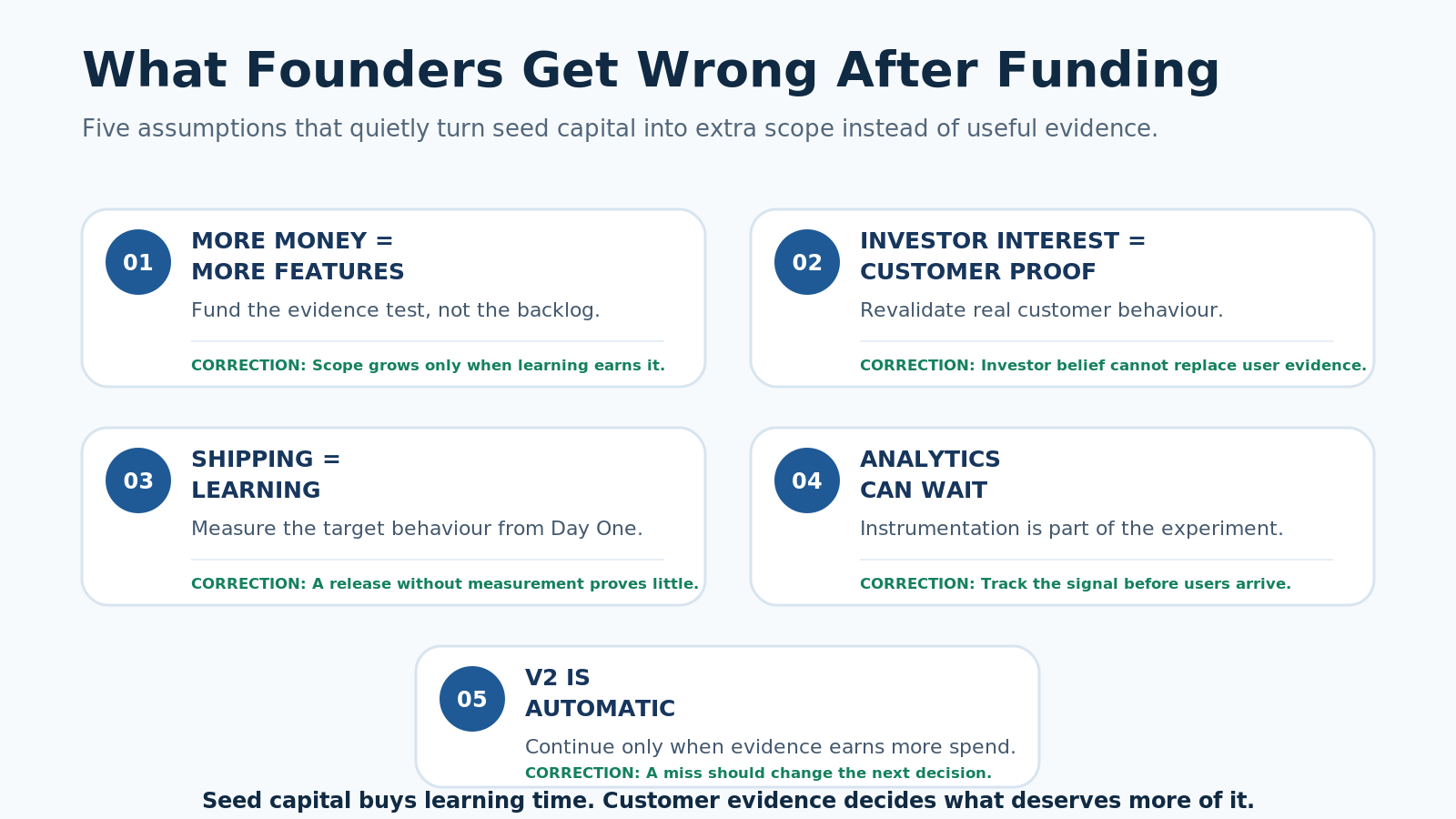
what -founders-get-wrong

Treat the round as an evidence budget, not a feature budget. First define exactly what this capital must prove before the backlog earns another meaningful commitment.

Seed Stage MVP Gate: Define What the Round Must Prove

A seed-stage MVP needs one falsifiable post-funding thesis before scope expands. State the customer outcome that would clearly justify your next meaningful product decision.

Airtree’s Seed-stage guidance centers on product building, user feedback, and testing the value hypothesis. That is a useful decision lens after funding decisions.

Translate your fundraising story into observable customer behavior. Name who must act, what they must do, and which result would materially change founder confidence next.

What must your seed round prove before the next raise?

Your seed round must resolve the highest-risk assumption blocking the next milestone. Define one behavior and one decision threshold. Add a clear review date too.

A product discovery workshop can pressure-test that statement before engineering estimates expand. The output should be one testable claim, not another list of funded possibilities.

Ask one final question before funded scope moves forward. Could an investor hear the result and clearly understand whether your thesis became stronger or weaker?

Revalidate Customer Evidence Before Engineering Expands

Revalidate demand before engineering expands because investor conviction does not prove customer behavior. A successful raise validates a financing decision. It does not validate adoption.

LaunchVic recommends interviewing at least 20 to 30 potential customers. More importantly, it looks for real customer commitment before any build: time, attention, or money.

That distinction matters after funding. Compliments and investor enthusiasm can feel convincing. Neither reliably proves target customers will change their behavior when your product actually appears.

How do I validate that my idea is worth pursuing?

MVP startup validation becomes credible when behaviour supports the problem and proposed change. Look for repeated pain. Then look for real commitment around solving it.

Rank evidence by commitment, not enthusiasm. Paid pilots, deposits, repeated workarounds, signed trials, or active switching behavior usually carry far more decision weight than compliments.

If evidence is mostly opinion, pause feature expansion and run another focused test. Engineering should start only after customer behavior clearly justifies the next round of spending.

MVP Development for Startups: Build Only the Proof

MVP development for startups works when scope acts as an evidence filter. Every capability must explain which assumption, behavior, or measurement it enables right now.

Start with one complete user journey tied to the funded assumption. Keep trust, payment, security, or data requirements only when failure would distort that test.

Everything else faces an inclusion test before custom MVP development begins. If removing a feature preserves target behavior and measurement, defer it or simulate it.

What should be included in an MVP?

An MVP should contain the smallest credible journey that produces the behavior behind your highest-risk assumption. It must also capture that result clearly enough for review.

Keep what enables that journey, protects trust, or measures the outcome. Defer anything that can be simulated without weakening the customer evidence you actually need.

  • Tests funded assumptions.
  • Enables core behavior
  • Protects trust or measurement.
  • Resists safe manual simulation.

MVP Feature Evidence Filter

Capability Evidence Manual Decision
Booking Journey No Build
Confirmation Adoption Yes Simulate
Dashboard Reporting Yes Defer

A future feature can still matter without deserving engineering now. The next gate decides how much runway this focused test may consume before evidence appears.

Set Evidence Thresholds Before Runway Disappears

Set evidence thresholds before launch because a smaller product without a decision rule remains an uncontrolled experiment. Runway needs a deadline. It also needs a spending boundary.

Start with the behavior behind the funded hypothesis. Then decide which observable result would increase confidence enough to justify another meaningful funded product commitment later.

Do not borrow generic conversion or retention benchmarks. Your threshold should reflect the business model, target cohort, pricing logic, and decision that follows the test.

What metrics should an MVP prove before more runway is committed?

The right MVP metrics prove the behavior behind the funded hypothesis. They should never reward surface activity that leaves the core customer assumption unanswered today.

Use activation, repeat use, payment, retention, or time-to-value only when each measure supports the decision. Pick fewer metrics when one strong customer signal is enough.

Evidence Thresholds

  • Metric: the behavior you need to observe.
  • Threshold: the result that changes confidence.
  • Deadline: when the team reviews evidence.
  • Runway limit: what the test may consume.
  • Decision: continue, change, narrow, or stop.

Set these conditions before users arrive. Otherwise, teams can move the goalposts after weak results and keep spending without reducing the uncertainty around the originally funded product.

Self-test: if the metric misses on review day, does everyone know what happens next? If not, the metric reports activity instead of governing a decision.

Use the Runway-to-Evidence Gate Before You Build

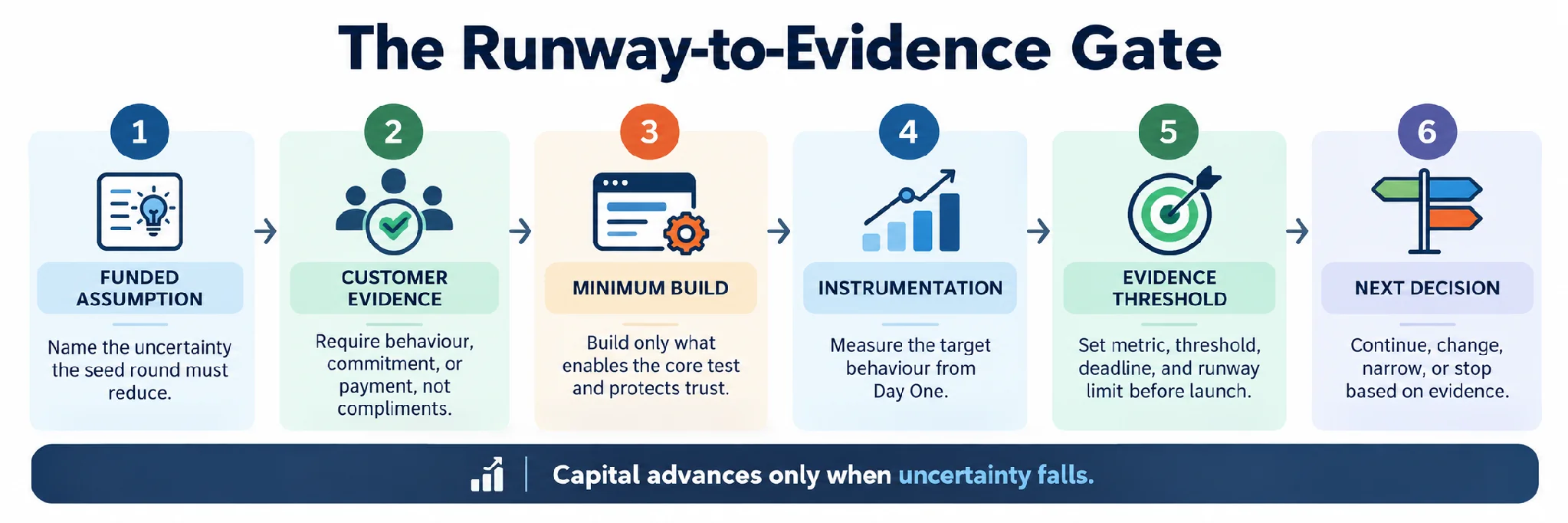
The Runway-to-Evidence Gate turns post-funding MVP planning into six linked decisions. It connects customer proof, scope, measurement, runway, and ownership to one clear funded assumption.

Runway-to-Evidence Gate

The Six Evidence Gates

Funded Assumption

Name the uncertainty the seed round must reduce. Write it as one falsifiable claim. Avoid broad goals that cannot produce a clear next product decision.

Customer Evidence

Require behavior strong enough to justify engineering. Opinions can guide discovery. Commitments, repeated workarounds, payments, or pilots provide much stronger evidence for the funded action.

Minimum Build

Build only the journey needed to produce target behavior credibly. Keep foundations that protect customer trust. Defer capabilities that do not materially change the test.

Instrumentation

Measure target behavior from Day One. Instrumentation belongs inside the experiment. Missing events can make an otherwise useful MVP result much harder for founders to interpret.

Evidence Threshold

Set the metric, threshold, deadline, and runway limit before launch. These boundaries prevent teams from redefining success when the expected customer behavior fails to materialize.

Next Decision

Assign one founder to own the next funded decision. Evidence should lead to continuing, changing, narrowing, or stopping. V2 should never become the automatic next step.

Won’t building cheaply now mean a painful rebuild later?

Minimal scope should not mean weak foundations. Bytes Technolab pressure-tests product architecture decisions against validation risk before shortcuts become expensive technical distractions during early validation.

Keep foundations durable when failure would damage trust, security, data, measurement, or iteration speed. Defer infrastructure built only for hypothetical demand, then let launch evidence govern the next spend.

Turn Launch Evidence Into the Next Decision

Launch evidence should change what gets funded next. Compare actual behavior with the threshold set before launch. Then clearly separate demand failure from execution failure.

A usability problem may justify fixing the journey and retesting. Weak payment or repeat behavior may instead require changing the hypothesis rather than polishing screens.

Founder ownership matters because teams naturally defend shipped work. One named decision owner should have authority to continue, narrow, change direction, or pause further spend.

How do I know if my MVP is ready to launch?

An MVP is ready when the hypothesis, cohort, and core journey are explicit. Instrumentation, threshold, review date, and decision ownership must also be clear before launch.

  • Re-read the funded hypothesis.
  • Confirm meaningful evidence exists.
  • Confirm every feature supports the test.
  • Confirm behavior is instrumented.
  • Confirm the threshold and review date.
  • Name the founder decision owner.
  • Choose the possible next decisions.

An MVP development partner should challenge unnecessary funded scope before estimating it. The partner should also expose hidden assumptions that could weaken evidence after launch.

If results miss, diagnose the failure before funding more work. Separate usability, trust, pricing, and demand issues. Each problem implies a different next focused test.

The launch is not the finish line. It is the point at which customer behavior finally determines what deserves the next funded dollar of available runway.

Turn Seed Capital Into Proof, Not Scope

The seed round did not remove product risk. It changed who pays for the next experiment. That makes disciplined product learning more important after funding, not less for founders.

Keep each funded decision tied to observable customer behavior. Scope, architecture, analytics, and spending should reduce a named uncertainty within a clearly defined review period.

The strongest post-funding teams do not measure progress by backlog size. They measure how quickly real behavior turns a risky assumption into a clearer decision.

  • Fund evidence, not backlog growth.
  • Let behavior earn the next spend.

Bytes Technolab works as an AI-first Product Engineering partner for founders who need sharper MVP decisions. Our role is to connect engineering choices with measurable learning.

That discipline also makes difficult calls easier to defend. A deferred feature or a changed hypothesis becomes evidence-led capital allocation rather than unexplained product hesitation later.

Capital creates options, but evidence decides which options deserve more investment. The next funded dollar should follow what customers prove, not what the roadmap imagines.

Vibe Coding vs Engineered MVPs: What Investors Actually Want to See in 2027

An MVP no longer needs months of work before anyone can see it. A founder can now put a simple version of an idea in front of people within days. That is why vibe coding is so tempting.

But speed alone does not make a product ready for an investor conversation.

The real vibe coding vs engineered MVP decision is about the proof you need next. Do you need to see whether people understand the idea? Or do you need to show that customers will use, return to, and value the product?

For Australian founders, that distinction matters. A quick prototype can open the first conversation. An engineered MVP can help turn that conversation into evidence.

The Question Investors Are Really Asking

Most early-stage investors do not expect a finished product. They do, however, want to understand what you have learnt, why the problem matters and what makes your business worth backing.

A polished screen is useful. It gives people something concrete to react to. But it cannot answer the questions that sit behind an investment decision:

  • Is this a problem people genuinely want solved?
  • Who has felt that problem often enough to care?
  • Has anyone tried the product and come back?
  • What changed after the founder listened to customers?
  • What will the next round of funding make possible?

That is why an investor-ready MVP is not simply the quickest product you can build. It is the smallest version that helps you learn something meaningful about customers and the business.

Where Vibe Coding Earns Its Place

Vibe coding is useful when you need to bring an early idea to life quickly. It can help you show a customer what you mean, test a simple journey, or make an idea easier to discuss.

At this stage, the goal isn’t to prove that every part of the product is ready. The aim is to learn whether the idea is clear enough to spark interest.

It can be a good fit when you need to:

  • test several versions of an idea before choosing one;
  • show a simple concept during customer interviews;
  • create an early demonstration for advisers or potential partners;
  • test the wording, flow, or value of a single customer journey; or
  • build a waitlist around a problem people recognise.

This is where vibe coding development can be useful, particularly when the goal is to turn an early concept into something people can interact with and respond to.

This is valuable work. Founders should not spend months building something detailed before they have heard from the people they hope will use it.

The risk comes when a quick first version is treated as final proof. A customer saying, “That looks interesting,” is different from a customer using the product to solve a real problem.

Where a Quick Prototype Can Stop Being Enough

A simple prototype may work well for a planned demonstration. Real customers bring different questions, choices, and habits.

They may leave and return later. They may use the product on a phone instead of a laptop. They may expect their information to be handled carefully. They may ask for one part of the journey to work in a way the first version did not anticipate.

If the product needs to support a pilot, collect reliable customer feedback, or demonstrate repeat use, the founder needs more than a convincing screen.

Common signs that it is time to move beyond a quick build include:

  • prospective customers want to trial the product properly;
  • the same fixes keep taking time or creating new issues;
  • the founder cannot easily see which parts customers use and where they stop;
  • the product needs to support payments, sensitive information, or a more detailed customer journey; or
  • an investor wants to understand what users have actually done, rather than what they might do.

This does not mean vibe coding has failed. It means it has done its job: it helped the founder get to the next, more important question.

What an Engineered MVP Gives You

An engineered MVP is not a larger version of the same idea. It is a more deliberate version.

It focuses on one valuable customer journey and builds enough around that journey for real people to use it, give feedback and help the founder decide what should happen next.

Good MVP development for startups keeps the scope small. It avoids adding every possible feature. Instead, it makes the core experience clear, usable, and ready for learning.

That gives founders stronger evidence to take into an investor meeting:

  • a customer can complete the main task the product promises to solve;
  • the founder can show what customers used, where they paused, and what they asked for next;
  • feedback can lead to practical improvements rather than a complete rebuild; and
  • the product tells a more credible story about how the business could grow.

This is where product engineering matters. It makes the first version useful enough to test in the real world, while keeping the work focused on the decisions that matter now.

talk to an MVP specialist

The same principle applies to an AI MVP development project. The label does not change the investor question: does this product solve a meaningful problem for a specific customer, and can the founder show evidence of that?

Vibe Coding vs Engineered MVP: Choose by the Proof You Need

The right choice depends less on the method and more on the next decision in front of you.

If you need to… Start with
Show an idea and gather first reactions Vibe coding
Compare a few possible approaches quickly Vibe coding
Test whether customers will use the product more than once An engineered MVP
Run a pilot with prospective customers An engineered MVP
Demonstrate real progress to investors An engineered MVP
Turn early interest into clearer customer evidence An engineered MVP

Some teams describe this next step as rapid MVP engineering. The word “rapid” should not mean rushed. It should mean moving quickly towards a focused test, then learning from the result.

A custom MVP development approach is useful when the product has a specific customer journey, business model, or market need that a generic template cannot show well. The goal remains the same: build enough to test the right assumption and no more.

The Investor Proof Test

Before you decide whether your product is ready to show investors, use this simple test.

1. Does it prove that the problem is real?

Be clear about who has the problem, how they deal with it today, and why the current approach is not good enough. Customer conversations, trial interest, and early sign-ups can all help.

2. Does it prove that your solution helps?

A good MVP does not need to solve everything. It should let a customer complete one important task and show whether that experience has value.

3. Does it prove that you can learn?

Investors know the first version will change. What matters is whether you can explain what you heard from customers, what you changed because of it, and what you plan to test next.

This is the point many founders miss. Investors are not looking for a product that claims to have every answer. They want to see a founder who knows which answers still need to be found.

What to Bring to an Investor Meeting in 2027

If your MVP is part of the funding conversation, prepare five things.

A clear problem statement
Explain the customer problem in plain language. Avoid a broad market claim that could apply to everyone.

A short live demo
Show one customer journey from beginning to end. Keep it short enough for someone to understand the value without your narration doing all the work.

Evidence of customer interest
Share relevant signals: interviews, a waitlist, pilot discussions, early use or feedback. You do not need to pretend these are bigger than they are.

What you learnt
Show one or two decisions that changed because of customer feedback. This makes the business feel active and grounded.

A focused next step
Be able to explain what the funding will help you test, build, or prove next. A specific plan is more convincing than a long feature list.

discuss your MVP

Build for Learning, Then Build for Proof

Vibe coding can be the right first move when you need to test whether an idea deserves more attention. It is a fast way to get a conversation started.

An engineered MVP is the better next move when you need a product that customers can use properly, and investors can assess with confidence.

The best choice is not about picking one side forever. It is about matching the build to the proof your startup needs now.

How to Choose the Right SaaS Development Agency in Australia Based on Your Funding Stage (2027)

Choosing an agency not built for your funding stage can waste cash on work your product doesn’t need yet. You may still not have the features or reliability your next customer requires.

Evaluate Bytes Technolab, an AI-first Product Engineering partner, against that customer need. Use the process below to align your scope, spending, and delivery expectations with the next milestone.

Match a SaaS Development Agency in Australia to Your Next Milestone

Start with the outcome your next release must prove. Use the funding stage to frame the discussion, then adjust for your actual customers and product maturity.

Funding stage Next milestone Agency capability Evidence to request
Pre-seed Validate a paid problem Small core workflow, scope discipline Pilot behaviour or payment evidence
Seed Test repeatable customer value Usage tracking, billing, rapid iteration Activation, retention, working release
Series A Support repeatable growth Reliable releases, integrations, and performance testing Measured performance, release records
Later growth Meet larger customer requirements Migration, operations, team integration Tested rollback, service targets, handover

Security and customer data separation matter at every stage. A pre-seed startup with contractual integration requirements may also need specialised engineering before a larger feature set is available.

When assessing an MVP development company, ask which features it would exclude and why. The proposed scope should make your next product decision easier.

Put the agreed outcome and exclusions into one brief. Every shortlisted team should price that same brief so you can compare proposals fairly.

Compare Total Cash Commitment Before Choosing an Engagement Model

Compare the full cash commitment before choosing an engagement model. A lower engineering quote can leave less runway once missing delivery costs and ongoing expenses are factored in.

This hypothetical example starts with A$300K cash and a three-month project. Assume A$15K monthly spending outside the project, with no new funding or additional product receipts.

Cash comparison Proposal A Proposal B
Headline quote A$60K A$50K
Total project costs A$66K A$75K
Cash at completion A$189K A$180K
Monthly spending after launch A$18K A$20K
Runway after launch 10.5 months 9 months

Both proposals cover the same milestone and timeline. Total project costs include delivery expenses and applicable taxes; no tax recoveries are modelled. Ongoing costs begin after launch.

The cheaper quote leaves less time to fund the next experiment. These invented figures illustrate cash planning, not market prices or a quote for custom Saas development services.

Engagement model conditions

Choose a fixed price when the scope and acceptance tests are settled. Use capped iterative work when learning will change the scope, or dedicated capacity when you can prioritise continuously.

Check testing, cloud costs, currency, tax, scope changes, and termination charges. Ask each team to identify exclusions before treating its quoted price as your total commitment.

Test the Architecture Against the Customers You Need Next

Test whether the proposed architecture meets the customer requirements in your brief. Ask for demonstrations of the risks that matter to your product, rather than broad claims about scale.

A successful login does not establish tenant isolation. Ask the team to demonstrate that one customer cannot access another customer’s records through the application.

For recovery readiness, request a restore using representative data. Compare the result with the downtime and data loss your customer workflow can tolerate.

When should a SaaS startup invest in architecture improvements?

Invest when measured failures or committed customer requirements threaten the next milestone. Choose the smallest change that addresses the constraint, and verify its effect before expanding scope. A funding announcement alone is not a reason to rewrite the product.

Request load tests based on expected usage, including slow integrations. The team should explain which limits the tests reveal and which improvements can safely wait.

For a migration, require the cost, customer impact, and rollback plan. A technically sound change still needs a workable route from the current system.

Conditional AI evaluation

Consider AI only when it helps achieve the milestone. Assess a SaaS AI development company in Australia against a non-AI approach to the same task.

Compare output quality and cost per successful task. Require a fallback for unacceptable results, and check where customer data travels and who can access it.

Apply these checks to Bytes Technolab as you would any prospective partner. Confirm the proposed team and Australian working-hour overlap; a local service page alone cannot establish either.

Apply the Stage-Milestone-Evidence Test Before You Commit

Use the Stage-Milestone-Evidence Test to assess whether an agency’s promises have support. This editorial framework turns the earlier scope, cost, and technical checks into a partner decision.

For a scale-up, involve the internal engineering lead. Agree who owns releases and technical decisions before an external team joins the product.

How do you choose a SaaS development agency for your funding stage?

Choose a SaaS development partner whose proposed team can demonstrate relevant capabilities, meet clear acceptance criteria, and leave you with usable operating assets. If evidence is missing, limit the next commitment to resolving that gap. Reject proposals that depend on unverifiable promises or deny necessary access.

Stage capability

Ask the proposed delivery lead for a comparable example, with permission to verify it. Examine the constraints, their contribution, and the result the customer could observe.

Milestone evidence

Turn the milestone into a testable deliverable. Record the customer workflow, expected performance and acceptance test; a completion percentage does not establish whether the product works.

Operating evidence and handover

Check repository and cloud access, deployment instructions, and the dependency/licence inventory. Have the receiving team demonstrate a release using those materials before accepting the handover.

Run a Final Selection Checklist Before Signing

Convert your preferred proposal into a bounded first commitment. A SaaS development company in Australia should make the following commercial responsibilities clear before work begins.

  1. Attach the agreed brief to the engagement. Record assumptions and exclusions so the signed scope matches what you evaluated.
  2. Name the delivery lead and required skills. Agree on how staffing changes will be communicated and approved.
  3. Set the first deliverable, spending cap, and payment conditions. Specify who accepts work and authorises scope changes.
  4. Record ownership, access, support, notice periods, and transition obligations. The agreement should explain how work can stop or be transferred.
  5. Commission discovery only where unanswered questions justify it; otherwise, start with a delivery milestone. Set a review date and conditions for continuing.

Choose the Partner Your Next Milestone Requires

Choose a partner for the milestone your product must reach next. Compare the full cash commitment, test the proposed architecture, and require evidence from the actual delivery team. Apply the same standards to Bytes Technolab.

Keep control of the next decision

Your first commitment should produce an accepted result and a usable handover. Continue only when the evidence supports further spending, and your team retains control of the product, its operating assets, and access.