

 July 3, 2026
 2 mins to read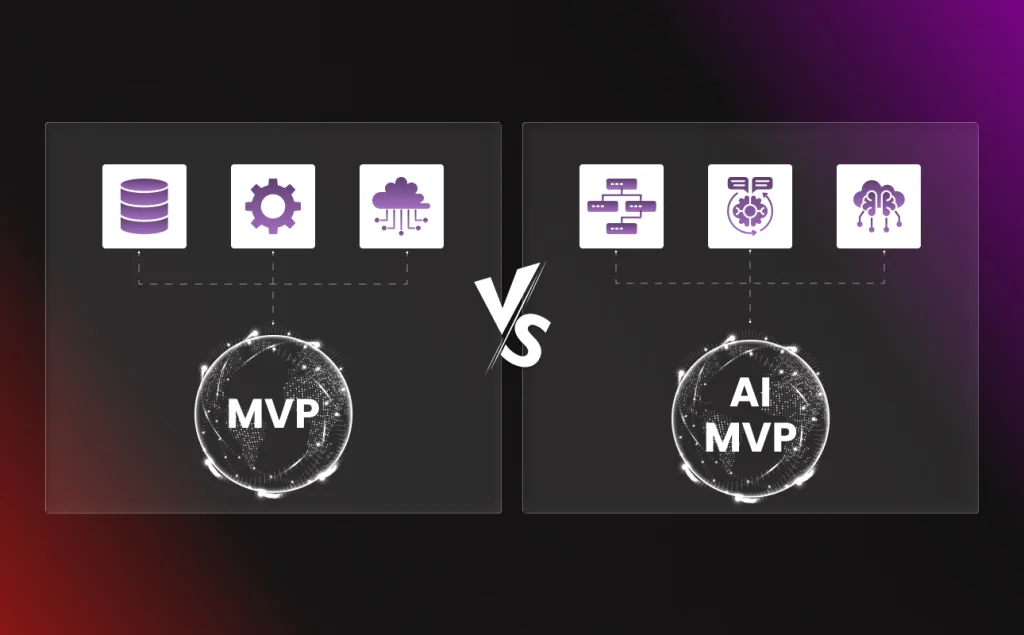
Your investor asks why users should trust the AI answer, and your demo has no evidence. MVP vs AI MVP decisions change workflow planning, data readiness, monitoring, and release confidence. Bytes Technolab brings an AI-first Product Engineering focus to help funded founders choose the right validation path.
MVP vs AI MVP Decisions Change Validation Risk
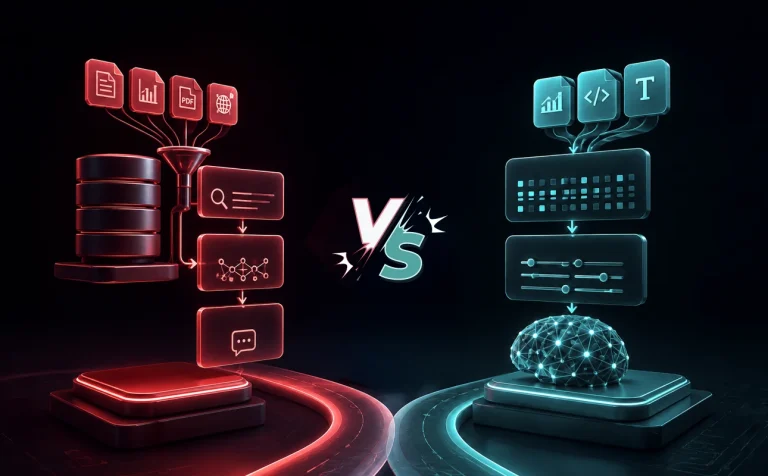
MVP vs. AI MVP planning becomes difficult when founders treat AI as a feature rather than an operational dependency. Standard MVPs validate workflow demand, while AI MVPs must also validate output trust, data quality, and response consistency.
A startup may spend 6 weeks refining onboarding and dashboards, only to discover that the real failure risk lies in unstable outputs or poor data access.
Gartner warned that teams may abandon at least 30% of GenAI projects after proof of concept by the end of 2025 because of poor data quality, weak risk controls, rising costs, or unclear business value.
- Standard MVP Failure Looks Different
A standard MVP usually fails because users ignore the workflow. The system itself still behaves predictably.
- AI MVP Failure Looks Different
An AI MVP can fail even when users engage actively. Trust breaks when outputs behave inconsistently.
- Architecture Changes Funding Risk
Founders often underestimate how quickly architectural assumptions affect investor confidence. A wrong validation path can force rebuilds after roadmap approval.
Founders need a clean baseline before AI complexity enters planning.
MVP Development Validates Workflow Before Scale
MVP development focuses on proving workflow demand before infrastructure expands. The architecture supports measurement, onboarding, usability, and controlled iteration cycles.
– Workflow Validation Matters First
A standard MVP should confirm that users complete a valuable task repeatedly. The product must answer whether customers return or pay.
– Standard MVP Architecture Stays Narrow
A focused release usually includes event tracking, stable APIs, analytics visibility, payment handling, and admin controls.
– Workflow Risk Decides The Build Path
Use standard MVP development when uncertainty sits inside adoption behavior rather than intelligence quality. Scheduling tools, approval systems, and internal dashboards often fit this category.
– Restraint Protects Product Budgets
Founders reduce risk by validating one commercial assumption at a time. Early complexity increases cost before demand becomes measurable.
The comparison changes once intelligence shapes product value.
AI MVP Development Tests Intelligence Quality
AI MVP development company validates both workflow adoption and the reliability of the intelligence. The product must behave consistently under real usage conditions before scale planning starts.
- Data Infrastructure Changes Product Risk
AI products depend on data quality before interface quality matters. Weak labeling, stale records, or missing permissions can break output quality quickly.
- Inference Flow Becomes Operational Infrastructure
Inference pipelines, vector search, prompt orchestration, and retrieval logic become production dependencies early.
- Observability Becomes Part Of Product Architecture
AI systems need output tracking, latency monitoring, and correction visibility from the first release cycle.
- Feedback Loops Change Release Planning
User corrections should influence prompts, moderation logic, or dataset reviews during later iterations. AI products continue learning after launch instead of stabilizing permanently.
- Human Review Paths Protect User Trust
High-risk outputs require fallback handling and review queues before public rollout. Trust drops when users cannot verify generated recommendations.
McKinsey reported that the shift from pilots to scaled impact remains unfinished for many organizations. How enterprises rewire for AI at scale shows exactly why architecture discipline cannot be skipped during early product decisions.
The deeper decision starts when workflow risk meets intelligence risk.
Architecture Criteria Separate MVP Product Development From AI MVP Builds
The main difference between MVP product development and AI MVP builds lies in the ownership. Standard MVPs validate user behavior, while AI MVPs also validate reliability, observability, data readiness, and acceptable output variance.
Choose a standard MVP when users mainly need workflow access, dashboards, payments, or admin control. Choose an AI MVP when value depends on ranking, matching, summarizing, predicting, or generating.
– Data Dependency Changes Build Sequencing
AI products fail early when datasets contain gaps, duplicates, stale records, or unclear ownership rights. Standard MVPs usually validate workflows before data complexity becomes operationally dangerous.
– Output Risk Alters Trust Requirements
A hallucinated summary, inaccurate recommendation, or missing audit trail can damage adoption because users judge more than the interface. They judge whether the system deserves trust.
– Monitoring Requirements Increase Operational Load
Inference costs, latency spikes, review queues, and feedback operations create hidden pressure after launch. Founders often underestimate these scaling constraints during roadmap planning.
– Workflow Tolerance Shapes Architecture Decisions
Some products tolerate occasional output variance without major damage. Healthcare, finance, legal, and compliance-sensitive workflows rarely allow the same flexibility.
– When does an AI MVP need a POC before MVP development?
An AI MVP needs a POC before development, when model feasibility remains uncertain, and engineering has not yet begun.
Start with small datasets, target accuracy marks, review workflows, latency ceilings, compliance exposure, and inference costs before funding full product work.
Use the POC route when datasets contain inconsistent records, unclear permissions, or weak labeling quality. Choose POC-first validation when unreliable outputs could affect trust, safety, compliance, or unit economics directly.
If these checks are still unanswered, shipping faster only moves the rebuild risk closer.
The Right MVP Development Partner Evaluates Risk Layers
The right MVP development partner identifies the highest-risk assumption before recommending a build path. Strong evaluation separates workflow uncertainty, data readiness, intelligence dependence, and scaling pressure.
- Architecture Reviews Should Precede Estimates
Engineering estimates become unreliable when the core risk remains undefined. Structured assumption mapping before MVP helps product teams avoid sprint timeline failures that compound later.
- Workflow Risk Requires Separate Analysis
Workflow risk measures whether users gain value without intelligence layers. Weak workflows become harder to diagnose after AI complexity increases.
- Data Risk Determines AI Stability
Data reviews should check freshness, ownership, duplication risk, and labeling consistency.
- Intelligence Risk Requires Acceptance Thresholds
Recommendation, summary, and ranking flows need measurable acceptance standards before production planning.
- Scale Risk Exposes Hidden Operational Cost
Inference cost, monitoring visibility, and feedback operations become operational burdens after adoption grows. AI products fail operationally when teams never plan how the system learns after launch.
The 4 Layer MVP Architecture Fit Check Creates Decision Control
The 4 Layer MVP Architecture Fit Check gives founders a structured evaluation process. Bytes Technolab applies it to compare standard MVP, AI MVP, and POC first paths before sprint planning.
- Workflow Fit checks whether users gain value before intelligence enters the product.
- Data Fit evaluates source quality, ownership rights, freshness, and exposure to duplication.
- Intelligence Fit measures whether generated outputs improve real decisions rather than just demos.
- Scale Fit evaluates inference cost, monitoring visibility, latency tolerance, and feedback operations after growth begins.
CB Insights reported more than $200B in AI funding activity in its 2025 AI coverage.
The next step becomes clearer when founders validate assumptions before locking architecture permanently.

Rapid Prototyping And POC Development Reduce Rebuild Risk
Rapid prototyping and POC development services expose architectural risk before major engineering spending begins. Founders should isolate the riskiest assumption before funding broad product work.
- Workflow Prototypes Validate User Movement
A workflow prototype answers whether users can complete the product journey successfully.
- POC Development Validates Technical Feasibility
POC development tests whether intelligence layers perform reliably enough to justify product investment. The focus stays on technical confidence instead of usability polish.
- Early Validation Requires Measurable Thresholds
Teams should define pass thresholds for latency, accuracy, review time, and inference cost before roadmap approval. Undefined success metrics create confusion during release planning.
- Small Data Tests Expose Large Risks
Testing 50 to 200 records can reveal labeling problems, unstable outputs, or cost spikes before engineering expands.
- Founders Need One Clear Decision Sheet
Mark assumptions as validated, prototype ready, POC ready, or unsafe for funding. Structured visibility reduces emotional decision-making during roadmap pressure.
Run these validation checks within the first working week:
– Map the workflow using Figma or a clickable prototype
– Test 50 to 200 records against the AI task
– Define pass marks for latency, accuracy, and review time
– Estimate cost per inference under expected usage
– Identify whether human review remains necessary
Choose MVP development first when adoption risk outweighs intelligence risk. Choose POC-first validation when unreliable outputs could damage trust, compliance posture, or product economics before traction appears.
Build Around The Riskiest Assumption First
The safest startup decision is to choose the architecture around the largest unresolved risk. Standard MVP development validates workflow demand, while AI MVP development validates workflow demand plus intelligence reliability.
POC development exists for situations where the AI claim still lacks operational proof. Founders who separate workflow validation from intelligence validation reduce the risk of rebuilds before engineering budgets escalate.
Bytes Technolab helps startups evaluate architecture readiness through discovery, model-readiness reviews, workflow analysis, and release planning for intelligent products. The goal is not just faster coding.
The goal is to fund the correct validation path before scaling pressure arrives. We own the outcome. Not just the delivery.
Frequently Asked Questions
MVP vs AI MVP architecture differs in what the first release must prove. A standard MVP validates workflow demand, while an AI MVP also validates data quality, model behavior, fallback logic, monitoring, and feedback capture before users can trust the product.
A startup should choose MVP development when the main risk is user adoption, not machine intelligence. If users must sign up, complete a task, pay, or return before AI adds value, prove the workflow first, and keep the architecture ready for later intelligence.
AI MVP development services should include data readiness review, model checks, risk scoring, architecture spike planning, feedback design, and fallback logic. These checks expose accuracy, latency, compliance, and cost issues before the team commits budget to a full product build.
POC development proves whether a risky technical assumption can work, while MVP work proves whether users want a usable product. A POC can test model accuracy, data quality, or latency before the product turns that evidence into a working market release.
The right partner gives founders, product leads, and technical teams stronger evidence before budget moves. Discovery, model-readiness reviews, and workflow analysis show whether a standard MVP, AI MVP, or POC first path can reduce rebuild risk and protect launch momentum.

Mitul Patel
Founder & CEO at Bytes Technolab Inc.
17+ years of experience in leading global digital initiatives by delivering transformative solutions across AI, ML, SaaS, product engineering, and enterprise-grade platforms. As a visionary strategist and mentor to 120+ tech experts, he has played a pivotal role in scaling Bytes Technolab’s presence in the USA, Canada, India, and beyond. Under his leadership, the company has delivered 300+ business-critical solutions for 500+ clients in 30+ countries, driving revenue growth through innovation in web, mobile, eCommerce, and digital transformation. Mitul combines business acumen with deep technical insight to help global startups, SMEs, and Fortune 500 enterprises accelerate their digital journeys.
Table Of Content
- MVP vs AI MVP Decisions Change Validation Risk
- MVP Development Validates Workflow Before Scale
- AI MVP Development Tests Intelligence Quality
- Architecture Criteria Separate MVP Product Development From AI MVP Builds
- The Right MVP Development Partner Evaluates Risk Layers
- The 4 Layer MVP Architecture Fit Check Creates Decision Control
- Rapid Prototyping And POC Development Reduce Rebuild Risk
- Build Around The Riskiest Assumption First