How a Digital Product Engineering Company Fixes Your Product Development Cycle

Your roadmap slipped again and your team did not fail you. Sprint slippage at funded UK scale-ups working with a digital product engineering company is almost always structural, not a headcount problem. You will find the exact break point in your cycle. Bytes Technolab, an AI-first product engineering partner, starts with diagnosis, not a proposal.

What a Digital Product Engineering Company Finds in Your Sprint Data

Sprint slippage is what most CTOs report to the board. The cause sitting underneath it is rarely what the post-mortem identifies.

Most engineering leaders diagnose this as a bandwidth problem. They look at the backlog, count open tickets, and conclude they need two more engineers.

That conclusion is wrong more often than it is right.

Why Do Sprints Keep Failing Even When the Team Works Harder?

The real signal in persistent slippage is structural. When a sprint fails in week two of a two-week cycle, the failure did not start at standups.

It started three or four sprints earlier, where an architectural choice closed off a path the team needs this quarter.

PDMA data from 2025 confirms it: top-performing product teams run their development cycles 20 to 25 per cent faster than peers.

The gap is not talent. It is a process structure, built or broken from the first sprint.

What Does a Structural Problem Look Like in Practice?

A structural problem repeats regardless of how hard the team works. If your velocity trend is flat or declining over four or more consecutive sprints, effort is not the constraint.

The break sits at a specific point in your cycle. It is almost never the one your post-sprint review identifies.

Identifying it correctly changes what the right intervention actually is.

What Fragmented Product Engineering Services Cost Per Quarter

Fragmentation in a product development cycle does not announce itself with a single failure. It hides in handoff gaps.

The cost shows up in delayed features, lost sprint days, and board credibility.

Four specific points in the cycle account for the majority of that cost.

Where Does a Broken Engineering Process Actually Lose Time?

Misaligned Discovery

Requirements that shift after sprint planning started cost an average team two to three additional sprints per quarter.

That rework rarely appears in the post-sprint report. It shows up in velocity data as an unexplained slowdown.

Late Architecture Decisions

When architecture choices are deferred until after the build begins, the cost multiplies.

A decision available in week two, made in week six, typically adds four to six weeks to the delivery timeline.

QA Bottlenecks at the Wrong Stage

Quality checks at the end of a build cycle surface bugs, and fixing them is most expensive.

Research on software delivery teams shows bugs caught in QA cost six to ten times more to fix than those found during design review.

Handoff Debt Between Design and Engineering

When design hands off to engineering without a shared definition of done, every sprint carries hidden rework.

Teams that resolve this at the process level, rather than the individual level, recover two to five sprint days per quarter in net capacity.

The cost does not appear where the failure occurred, and most teams keep paying it.

The Real Reason Hiring More Engineers Slows Your Cycle Down

Adding engineers to a broken process does not accelerate it. It amplifies the fragmentation already there.

A road with five potholes does not get fixed by adding more traffic. The repair requires the right intervention at the exact break point.

Why Does Adding Engineers Make a Broken Cycle Worse?

When a process lacks structure at discovery and architecture, each new engineer adds more surface area for the same failures to spread across.

They inherit unclear requirements. They make architectural decisions in isolation.

Each new handoff point carries the same risk of misalignment, compounding what was already broken.

What Does a Structurally Sound Engineering Process Actually Look Like?

McKinsey’s 2025 research confirms the pattern: 78 per cent of companies that found product-market fit fail to grow at speed, and the failure point is almost always process, not talent.

A structured process separates discovery, architecture, and build into distinct phases, with clear handoffs and defined outcomes at each gate.

PwC research explains why embedding AI tools in that structure boosts team efficiency by 19 per cent and cuts production costs by 13 per cent.

The difference is not the tool. It is where the tool sits in the cycle.

When the process architecture is scoped before the first build sprint, that is the point where most delayed roadmaps are already lost.

The real question is which specific part of your cycle is broken, and that requires a diagnostic framework to answer correctly.

Worried You Will Pick Wrong Again?

How to Diagnose If You Need a Digital Product Engineering Company

Four questions can tell engineering leaders at funded scale-ups which intervention to start with, using data already available to them.

Each question can be answered within a single working session. Most teams identify the primary constraint before the session ends.

How Do You Run This Diagnostic on Your Own Roadmap?

Sprint Velocity Trend

Pull velocity data for your last six sprints. If velocity is declining or flat while the backlog grows, the constraint is structural.

If velocity varies but trends upward, you have an execution issue, not a cycle issue.

Architecture Decision Speed

If architecture decisions take more than two weeks from the moment a requirement is understood, architectural debt is accumulating in real time.

Teams extending MVP development services into a full SaaS build engagement typically surface this when a Q1 feature is still blocked by an unmade decision.

Handoff Failure Point

Map your last three sprint failures to the handoff point.

If more than two failures trace back to the same handoff, the problem is not the individuals at that point. It is the handoff process itself.

Partner Accountability Model

If you have an external development partner and they report on hours rather than outcomes, the accountability structure is wrong.

A partner who owns the outcome flags architectural risk before the build sprint begins. A partner tracking hours flags it in the retrospective.

What each answer points to:

  • Declining velocity with long architecture lag: cycle structure is the problem. Consider a Product Discovery engagement before adding any resource.
  • Variable velocity with handoff failures: process design is the problem. Redefine “done” at each stage before the next sprint starts.
  • Consistent velocity with partner accountability gaps: the partner is the problem. Evaluate whether your engineering partner is advising or executing.

Teams pursuing SaaS development services from a single partner report that this diagnostic runs in one working day when the data is available.

Getting the diagnosis right before committing budget is what separates teams that fix the cycle from teams that repeat it.

The First Step That Changes Your Next Quarter’s Delivery

The first step is not a conversation with an engineering partner.

It is a structured Product Discovery session that maps your current cycle, identifies the primary bottleneck, and produces an engineering roadmap with a prioritised build order.

That sequence matters. A proposal before a diagnosis is how funded teams repeat the same mistake with a different supplier.

Most CTOs who run this exercise identify the primary constraint within 20 minutes, because the bottleneck was already visible in the data they had.

What Should You Prepare Before Engaging Any Engineering Partner?

Four things to have ready before your first external conversation:

  • Sprint velocity data for the last four to six sprints, showing planned versus actual delivery
  • Current architecture documentation, even if partial. The gaps matter as much as what is there.
  • Your roadmap with board-committed delivery dates and the three features most blocking growth
  • A clear description of where the handoff most consistently fails

With these four inputs, any serious engineering partner can map your primary bottleneck in a single session rather than a multi-week discovery exercise.

What Should You Realistically Expect From a Discovery Engagement?

A Product Discovery engagement runs two to four weeks and produces two outputs: a prioritised engineering roadmap and an architectural recommendation.

This is not a proposal or a pitch. It is a map of your cycle, with the primary break clearly marked.

If your current approach skips dedicated prototyping services before full build, that gap will surface in your architectural recommendation as the first item to resolve.

A full SaaS development or product development services engagement typically follows within four to eight weeks of Discovery sign-off. Build-phase code does not start before the roadmap is clear.

Pre-Partner Checklist

Before committing to any engineering engagement, answer these five questions:

  • Is your sprint velocity trend flat or declining over the last four to six sprints?
  • Is your architecture documentation current enough for an external review?
  • Do you know which handoff point most often breaks your cycle?
  • Does your team share a single definition of “done” across design and engineering?
  • Do you have board-committed delivery dates for your next two quarters?

If three or more answers reveal a gap, you need Product Discovery before build. If all five are solid, you are ready for a build engagement.

The conversation with the right engineering partner starts there, not with a proposal.

Three Months Spent With No Progress

The Next Sprint Can Be Different When You Fix the Right Thing

Your development cycle is fixable. The repair starts with identifying where the break actually sits, not with adding resources to a broken system.

The teams that ship on time don’t have more engineers. They have a structured process with clear handoffs and a partner who owns the result.

Bytes Technolab engineers product development engagements from the ground up, starting with a Product Discovery Workshop that maps the cycle and names the bottleneck before build begins.

Product Solution Architecture and SaaS Development capabilities engage only after discovery is complete. The partner who commits before diagnosing is the wrong one.

If your next board cycle is two months out and the roadmap has already slipped, that conversation is worth starting now.

The 7 Stages of the Digital Product Development Cycle

We have the idea and the budget, but our build process won’t survive real users. Most UK founders reach that critical moment too late. Teams working with Bytes Technolab, an AI-first product engineering partner, use this cycle map to spend the right budget at every stage, in the right order.

What a Digital Product Development Company Sees That Most UK Founders Miss

What experienced product teams recognise early is simple: product failure usually begins before development starts. The cycle exists to reduce that risk by validating assumptions, sequencing decisions, and protecting the budget before execution begins.

Why Does the Cycle Exist at All?

Most UK founders don’t start with the wrong idea. They start with the right idea and the wrong stage.

According to CB Insights, 42% of startups fail because they build a product nobody actually wants.

That failure doesn’t happen at launch. It happens at Stage 1, when founders skip discovery and move straight to engineering.

What Does a Structured Partner Actually Change?

A digital product development company makes stage-skipping structurally impossible.

Each stage gate requires a defined output before the next opens, and founders who skip those gates accelerate past the point where the most expensive mistakes happen.

That gap is where most UK product budgets disappear.

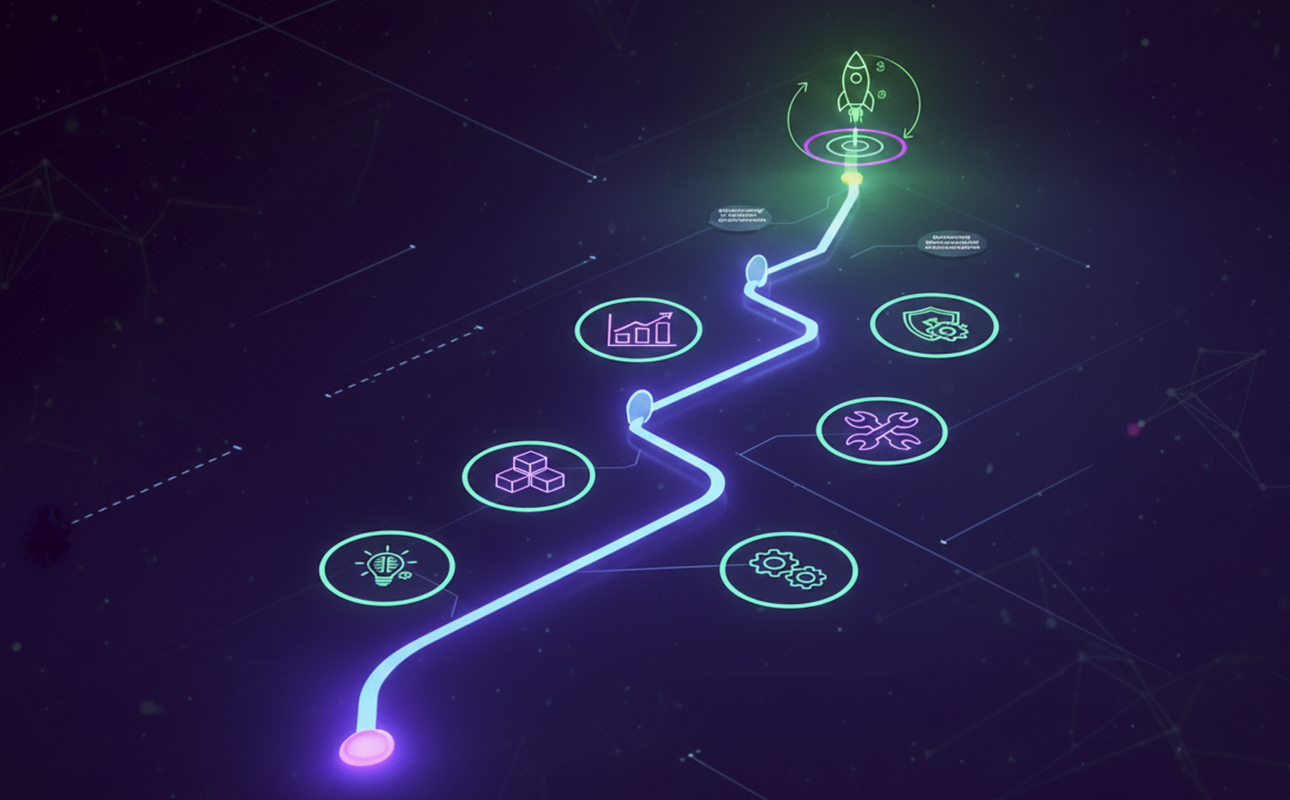
The 7 Stages of the Digital Product Development Cycle and What Product Development Services Actually Do

Product development services that cover the full cycle work through seven defined stages. Each stage has a distinct job and a specific output.

Sequence matters because every stage feeds the one after it.

Stage 1: What Happens During Discovery and Idea Generation?

Discovery is the highest-risk stage in the entire cycle. Most founders assume Stage 4 is the danger zone.

Stage 1 determines whether everything that follows is worth building at all.

This stage draws on two types of input: internal data from your product team and external validation from target users.

The goal is a single, testable problem statement that survives contact with real people.

Money spent on bad engineering is recoverable. Money spent engineering the wrong thing is not.

Stage 2: How Do You Screen Ideas Before Committing to One?

Idea screening filters what Discovery uncovers.

Your team evaluates each idea against four criteria:

  • Technical feasibility
  • Marketability and demand signal
  • Resource fit for your current team
  • Budget reality against expected return

Most products that fail were doomed here, before a single wireframe was drawn, because the screening assumptions were wrong.

The most common screening mistake is filtering ideas in-house only. External experts catch assumption failures that internal teams can’t see because they’re too close to the idea.

Stage 3: What Is Concept Development and When Do PoC Development Services Enter?

A screened idea becomes a product concept at Stage 3. That concept needs three things: a defined target market, a proposed price, and a mapped benefit set.

PoC development services enter the cycle here. A Proof of Concept proves technical viability before full investment is committed.

It answers the question investors actually ask: can this be built at the cost and quality you’re claiming?

Testing your concept with real users at this stage produces market validation data that changes the entire engineering plan downstream.

Stage 4: What Does Business Analysis and Marketing Strategy Actually Decide?

Stage 4 is the gate between a promising concept and a fundable product.

Business analysis here means building revenue projections, cost forecasts, and a realistic sales model.

The marketing strategy component defines how the product reaches its first users: pricing, positioning, and channel.

Founders who skip or rush this stage consistently underestimate launch costs by 40 to 60%.

You don’t need a full go-to-market plan at Stage 4. You need enough of one to know whether the numbers work.

Stage 5: How Does Product Engineering and Build Actually Work in 2025?

Stage 5 is where the product is engineered. Prototype development produces the first tangible version: testable, demonstrable, and built for feedback, not perfection.

The AI Era Build Stack

In 2025, AI-driven product development has changed this phase significantly.

AI tools now handle code generation, design iteration, and automated testing across agile sprints.

McKinsey data shows teams using AI-powered digital product engineering services reduce development time by up to 50% and cut costs by 20 to 30%.

The output at Stage 5 is not a finished product. It’s a working MVP, shipped iteratively, validated by real users at each sprint boundary.

Stage 6: Why Does Structured QA Determine Whether Early Users Stay?

Quality Assurance is not the last step before launch. It runs in parallel with Stage 5 from the first sprint.

Structured QA at this stage covers three layers:

  • Functional testing across all user flows
  • User acceptance testing with your target audience
  • Performance testing under real traffic load

AI-automated test case generation now produces test suites in hours rather than weeks.

Teams that ship without this stage lose on average 66% of new users within two years of launch.

That retention figure comes from skipping structured QA, not from poor product design.

Stage 7: What Happens to the Cycle After Launch?

Launch is not the end of the development cycle. It’s the beginning of the most data-rich phase.

Product engineering services at Stage 7 maintain a live feedback loop: user behaviour data, conversion metrics, and support signals feed directly back into the next iteration plan.

It restarts at Stage 1 with real-world data instead of assumptions.

Where founders lose budget is at the decision points between them.

 Most Product Mistakes Begin Before The First Step

Where the Cycle Breaks Down and What Rigorous Product Engineering Services Actually Prevent

Three stage-failure patterns account for most wasted product budgets in the UK tech market.

What Are the Three Failure Points Founders Repeat Most?

First: skipping Discovery entirely and treating a founder’s instinct as validated demand. This produces a product built for a problem nobody confirmed existed.

Second: treating a PoC as an MVP. A PoC proves feasibility.

An MVP proves market fit. Conflating the two means committing full engineering spend on an idea that only passed a technical test.

Third: launching without structured QA. Early retention loss is almost always a QA failure, not a product failure.

How Do Product Engineering Services Stop the Compounding Effect?

Rigorous product engineering services prevent these failures by making each stage-gate a hard stop.

A partner who owns the cycle can’t skip Stage 1 because Stage 2 has no input without it.

The compounding cost matters: one skipped stage doesn’t cost one stage. It costs every stage after it.

For scale-ups with products already live, the risk doesn’t disappear at launch. The cycle resets.

After Launch, the Cycle Resets

Sixty-six per cent of new products fail within two years of launch.

Most were not bad products. Their teams stopped the cycle at Stage 7 instead of restarting it.

How Do Product Modernisation Services Bring Scale-Ups Back Into the Cycle?

Product Modernisation Services exist for this exact moment.

Bytes Technolab structures this re-entry as a full cycle restart, not a patch job.

Scale-ups returning to the cycle after launch need a Stage 1 data reassessment, a new Stage 2 screening pass, and updated Stage 5 engineering priorities.

The best UK digital products don’t treat launch as a finish line. They use live user data to loop back to Stage 1 every 90 to 120 days.

Owning that loop takes a partner who understands every stage of the cycle, not just the build.

Still Have Questions Before You Decide?

Your Cycle Is Only as Strong as the Partner Who Owns It

The 7-stage cycle is not a theory. It’s a map for spending the right budget at the right stage, in the right order.

Bytes Technolab is an AI-first product engineering partner working with UK startups, scale-ups, and mid-size enterprises across every stage of the cycle.

From Product Discovery Workshop through PoC and MVP to SaaS architecture, the team owns each stage outcome, not just the code.

That approach means founders arrive at each stage gate with the evidence the next stage needs.

The cycle stays intact. The budget goes where it should.

If the runway is counting and the cycle feels unclear, the conversation worth starting is with someone who already knows every stage.

How to build AI-first products vs adding AI to existing products

Your next architecture call will either compound your advantage or create 18 months of rework, and most co-founders commit before they have enough signal to know which UK AI revenue hit £23.9 billion in 2024, up 68% year-on-year. Bytes Technolab, an AI-first product engineering partner, resolves the build direction before any sprint begins.

Why Digital Product Development Services Must Resolve AI Strategy Early

The wrong AI direction does not just slow delivery. It fractures your data model, generates technical debt that compounds with every sprint, and creates a product that cannot support the business model you actually need.

Most teams treat the AI-first versus AI-added choice as a feature decision. It is not.

It is a product architecture, data strategy, and business model decision, and each layer carries a compounding cost when chosen for the wrong reason.

When AI is added late to a product that needed it at its operating core, the rework is not cosmetic. You are restructuring data flows and rewriting UX logic that was never designed to carry model-led outputs.

That cost surfaces 12 to 18 months in, showing up as slower iteration cycles, weak differentiation, and a product that reads as AI bolted on rather than built in.

The business model consequence is the layer most teams overlook entirely. AI-first products support usage-based pricing, outcome-based contracts, and continuous improvement loops that traditional engineered products cannot.

Building an AI-added product when you actually need AI-first logic means eventually retrofitting a business model that the architecture cannot support. That is a harder problem than rewriting feature code.

A late course correction on AI architecture typically costs three to six months of engineering time before the product re-enters a normal release cadence. That is the recoverable version of this mistake.

Experienced digital product development services address this question before a single sprint is planned. The build direction is the most consequential decision on the roadmap.

What Makes This Decision Harder Than It Looks

Most teams underestimate this decision because the gap between the two paths is not visible at sprint one. It becomes visible at scale, under funding pressure, or when a competitor with the right architecture ships faster.

The signals that separate the two paths do not live in your feature list. They live in your data model, your core user workflow, and whether your product’s primary value is something a model produces or something a model enhances.

The question is not whether to use AI. It is whether AI is the engine or the accessory, and that distinction shapes everything from data architecture to the go-to-market model.

Avoid Costly AI Architecture Mistakes Early

AI-First vs AI-Added Products: The Comparison That Decides Your Architecture

AI-powered product development creates two fundamentally different kinds of products, and the distance between them is larger than most teams expect before committing to one.

In 2025, McKinsey reported that 46% of companies surveyed were seeing real financial or productivity impact from AI, up from 33% the previous year. That gap is driven less by which AI features teams chose and more by whether the architecture was built to absorb and improve on model intelligence over time.

The surface difference between the two paths looks like a feature question. The real difference runs through purpose, data ownership, architecture, and how value compounds.

AI-First vs AI-Added: Side by Side

  • Core purpose: An AI-first product exists to perform, predict, or orchestrate. An AI-added product uses AI to accelerate a workflow that already delivers value independently.
  • Data model: AI-first products require proprietary data loops that improve the model over time. AI-added products run on third-party foundation models without custom data infrastructure.
  • Architecture: AI-first products are built around model inference, feedback loops, and data pipelines from day one. AI-added products integrate AI at specific feature layers without restructuring the core architecture.
  • Time to market: AI-first products require a longer lead time as data readiness and model validation come before features. AI-added products deliver faster on a stable existing base.
  • Differentiation ceiling: AI-first products build moats through proprietary model behaviour competitors cannot replicate. AI-added products risk commoditisation as AI assistance becomes standard across SaaS categories.
  • Business model fit: AI-first products suit usage-based and outcome-based pricing. AI-added products align with traditional feature-led SaaS models.
  • Primary risk: AI-first products carry model quality, inference cost, and data readiness risk. AI-added products carry integration debt and feature fragility risk.

What Is the Real Difference Between AI-First and AI-Added Products?

An AI-first product cannot fulfill its core promise without the model in the active loop. Remove the model, and the product stops working, not because a feature breaks, but because the entire value proposition depends on what the model does.

An AI-added product works without AI. The model makes specific parts of the experience faster or smarter, but the core value exists independently.

The practical test: if you removed every AI component from your product today, would users still get the core value they came for? If yes, you have an AI-added product. If not, you have an AI-first product or an AI-added product that should have been built AI-first.

That last scenario is the costly one. A contract intelligence platform whose product is clause extraction cannot remain competitive as a feature layer beyond 12 months. A CRM with an AI-powered email summary can.

The architecture decision must match the product’s actual value proposition, not its current feature list.

Architecture Signals Every Product Development Company Should Know

Most teams answer the build direction question at the product management level. The right level is the architecture level, and the two assessments regularly produce different conclusions for the same product.

An architect sees data flows, model dependencies, and what breaks at ten times the current load. A product manager sees features, timelines, and user stories. The gap between those two views is where expensive misdirection lives.

How Do You Know Which Path Your Product Actually Needs?

These signals indicate AI-first fit:

  • The core user outcome depends on a model prediction, recommendation, or autonomous decision
  • The product generates proprietary interaction data that improves model performance over time
  • The product needs to take agentic actions, such as scheduling, drafting, or deciding, not just surface-processed information
  • Personalization at scale is the primary UX differentiator, not a supporting feature
  • Users cannot achieve the same outcome without the model actively in the loop

These signals indicate AI-added fit:

  • The product already delivers stable, clear value without AI in the workflow
  • AI accelerates specific tasks such as summarisation, classification, search, or automation within a mature product
  • The data required to support AI features already exists in third-party foundation models
  • Speed to market is the primary constraint and model differentiation is not yet a commercial priority

A product development company with genuine architecture depth understands these signals rarely arrive in clean categories. Many products sit between both paths: stable in core workflows, but dependent on model intelligence at specific decision points.

That middle ground is where a product engineering company earns its weight. The right call is sometimes a phased architecture, starting with AI-enhanced workflows and migrating specific functions to AI-first logic as proprietary data accumulates and model performance validates against real user behavior.

What Does a Phased Path Actually Look Like?

An early-stage SaaS product launches with AI-enhanced search and summarisation. Over six to nine months, as interaction data accumulates, specific high-value workflows migrate to AI-first logic with proprietary fine-tuning.

That sequence reduces initial engineering cost while preserving the option to build genuine model differentiation as data matures. It is not a compromise. It is the correct sequencing for products that need time to generate the data that the AI-first architecture depends on.

The data flywheel only starts spinning when the product has real users generating real interaction signals. Engineering for AI-first logic before that data exists means building a model on assumptions rather than evidence, and assumptions at the architecture level are expensive to correct.

The teams that get this wrong are those assessing the question at the feature level. They discover the correction cost at their first real-scale milestone, typically 18 to 24 months in, not before.

How to Build Without Locking Yourself Into the Wrong AI Future

The build direction follows from the architecture signal. How you build determines whether the product stays adaptable as AI capabilities, user expectations, and business models shift beneath it.

The most common build mistake across both paths is optimising for today’s model capabilities instead of designing for capabilities that will exist in 24 months. What production models handle routinely in 2025 was out of reach two years earlier, and your architecture needs to absorb that change without a full-stack rebuild.

How Should You Approach the Build for Either Path?

The answer differs significantly depending on which path your product is on. Conflating the two build approaches is where teams lose six to twelve months of engineering velocity.

For AI-First Products:

Design data pipelines before designing features. The model is only as good as the data architecture feeding it, and retrofitting pipelines after launch costs significantly more than designing them correctly at the outset.

Build model observability from day one: drift detection, inference logging, and output auditing are not optional at scale. SaaS AI Development Services that skip governance at the MVP stage create regulatory and operational risk that surfaces under compliance scrutiny.

Separate the model layer from the application layer architecturally. Model versioning and application versioning need independent release cycles, and coupling them creates fragility that slows both teams as the product scales.

Set inference cost controls before the product reaches scale. An AI MVP development company that does not model the unit economics of inference at projected user volume is leaving a pricing model risk open that becomes a real problem at Series A.

For AI-Enhanced Products:

Do not architect around the AI feature. Architect around the core product and let the AI layer connect cleanly at defined interfaces.

AI and ML development services that treat integration as an afterthought create brittle feature layers that break silently when underlying models update, or API contracts change.

In both paths, governance is mandatory in regulated sectors. Model outputs in financial services, healthcare, and legal technology require audit trails, explainability layers, and human-in-the-loop checkpoints designed in from the start, not retrofitted under compliance pressure.

Bytes Technolab works with startups, scale-ups, and mid-enterprises to get these decisions right at the architecture level, across AI Product Development, Product Solution Architecture, and SaaS engineering. The goal is not a perfect roadmap at day one. It is an architecture that keeps the product adaptable as the AI era moves faster than most product plans expect.

The teams moving fastest in 2025 are not the ones with the most AI features. They are the ones who got the architecture right 18 months earlier.

Not Ready For Full AI Development

Choose the AI Path That Matches the Product You’re Really Building

AI-first and AI-added are both legitimate directions. They are only wrong when chosen for the wrong product reason.

The teams that move fastest are not those that committed to AI-first earliest. They are the ones who read the architectural signal correctly before locking a direction and built with enough structural clarity to remain adaptable as the market shifted.

Answer the question at the architecture level: where does intelligence need to live for this product to deliver what users actually need? Bytes Technolab partners with technical teams on Architecture Review, AI Product Development, Product Solution Architecture, and SaaS engineering to get that answer right before it becomes expensive to change.

We do not build for today. We engineer for the AI era.

If the next product decision needs a build direction review before a roadmap locks, that conversation is worth having now.