
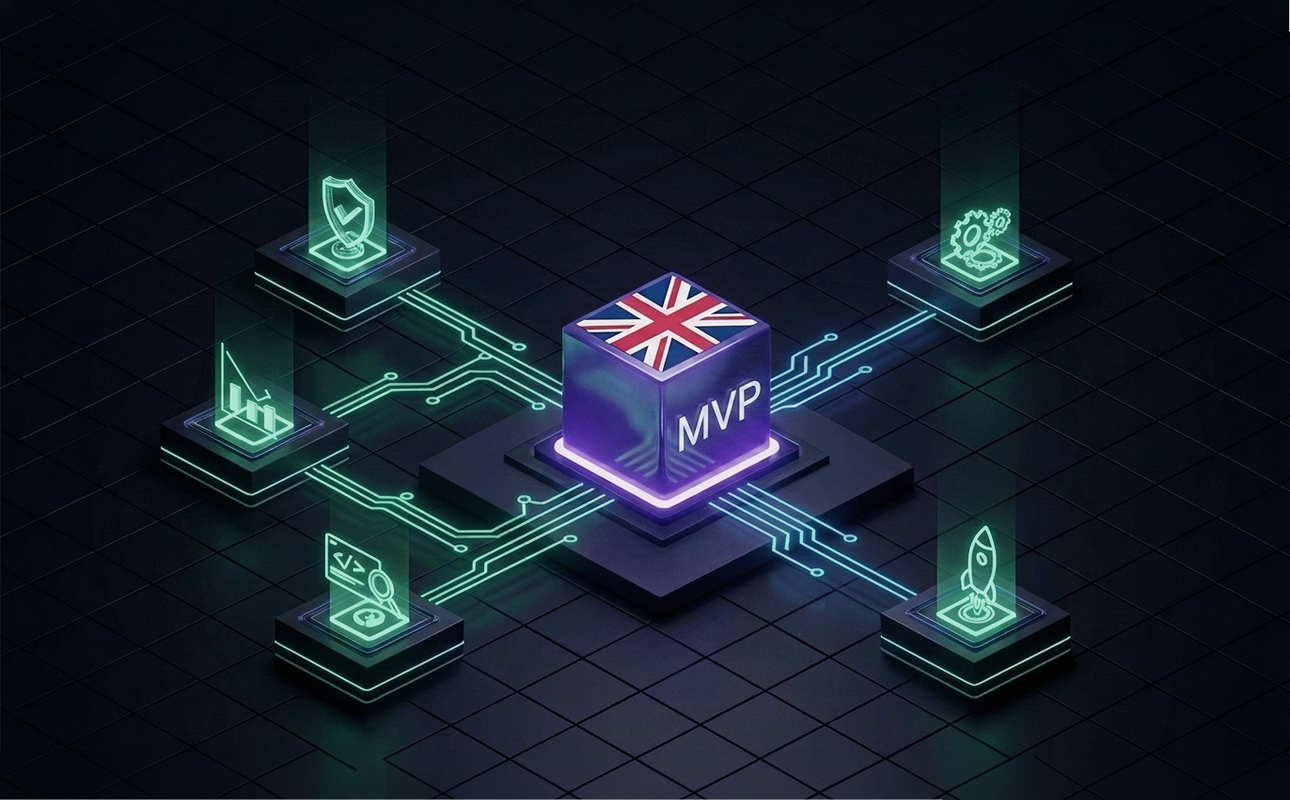
How UK Founders Reduce Product Risk with MVP Development

You have funding, a deadline, and one question nobody says out loud: what if the market does not want this? That fear is harder to manage than the build itself. Bytes Technolab, an AI-first Product Engineering partner, helps UK founders structure products to answer it before the runway runs out.

The Real Reason Founders Burn Budget Before Launch

Most founders who overspend on MVP product development do not do it because they hired bad developers. They do it because they locked a full-scope build around assumptions that were never tested.

When a founder believes the product is right, every feature feels essential. Discovery gets skipped, scope expands, and six months of engineering ships to users who never asked for it.

Why Does Assumption-Driven Scoping Cost So Much?

Unvalidated assumptions do not cost money at the point of decision. They cost money at the point of delivery, when architecture, UI, and onboarding are already built around bets that nobody checked.

CB Insights data shows 42% of startups fail due to a lack of market need. That is not a failure of execution.

It is a failure of assumption validation, and it happens to technically competent teams every day.

The fix is not to build less. It is to build in a different order, starting with the assumptions that carry the highest financial risk if wrong.

What MVP Actually Protects and What It Does Not

An MVP is a risk instrument, not a budget shortcut. Most founders treat it as the cheaper version of the full product, and that single misread leads to the scoping decisions that destroy the runway.

When scoped as a stripped product, an MVP becomes a half-built version of the wrong thing delivered faster. Nothing about the core risk changes.

What Risks Does an MVP Actually Eliminate?

A properly scoped MVP eliminates two specific risks: market fit risk (does anyone want this?) and feature bloat risk (are we building the right things in the right order?). It does not eliminate technical feasibility risk, compliance exposure, or infrastructure risk in hardware-adjacent builds.

This matters especially for FinTech and HealthTech founders operating under FCA or MHRA oversight. In those cases, compliance must be scoped alongside the MVP, not deferred to a later version.

The question to ask before finalising any scope is not “what can we remove?” It is “what assumption, if wrong, would end this product?

That question also points directly to where the budget disappears in a typical product development company UK engagement before a single user logs in.

Where Founders Actually Lose Money Using MVP Development Services

There are three predictable failure patterns in product builds, and each one has a moment where it could have been stopped. Most teams do not recognise that moment until the budget is already gone.

Across practitioner analyses, MVP development services can reduce initial build costs by up to 50% versus fully-featured product builds.

What Are the Three Cost Failure Points?

The first is the overscoped first build: a full feature set justified by confidence, not validation. Teams in this pattern typically spend between £60,000 and £90,000 before receiving a single meaningful user signal.

The second is skipped discovery: no user research, no assumption mapping, no defined success metric before work begins. Skipped discovery typically costs four to six weeks of rework after launch.

The third is premature scaling: team and infrastructure expansion before product signals justify the spend. This pattern is the most expensive because it compounds the cost of the first two.

The Three Cost Failure Points

  • Overscoped first build: full feature set on unvalidated assumptions, typically £60,000 to £90,000 before first user feedback
  • Skipped discovery: no user interviews, no success metric defined before work begins
  • Premature scaling: team and infrastructure expansion before the product has proven demand

All three share one root cause: building before validating.

very idea gets tested before we write code

Start With a PoC If the Tech Itself Is the Risk

Most product articles skip this decision entirely: what if the core technology has not been proven yet? Building on unvalidated technical foundations is a different class of risk, with a different solution.

PoC Software Development exists to answer the question your product build cannot: does this technology perform the way you are assuming?

A PoC tests the machine, not the market.

When Should You Build a PoC Before the Product?

You need a PoC before your product build, when you cannot point to a working example of your core technical component performing at the scale your plan requires within 12 months. If the honest answer is “we think so,” you are carrying technical risk into your entire budget.

A PoC typically runs four to eight weeks and costs a fraction of what a failed build sprint costs when a fundamental technical assumption breaks mid-project.

What a PoC Answers That a Product Build Cannot

  • Does the core technology perform as expected under realistic load?
  • Are integrations between key components stable enough to build on?
  • What are the actual infrastructure requirements, not the estimated ones?
  • Are there licensing or open-source dependency issues that would surface later?

Once the technical question is settled, the next decision is scope.

How to Scope a Product That Actually Reduces Risk

Right scoping is not about cutting features. It is about identifying which parts of the build test the assumption that the product’s survival depends on, and building only those first.

The logic works in three steps: name every assumption baked into the concept, rank them by consequence, then scope the build to test only the ones that would collapse the product if wrong.

How Do You Know What Belongs in the First Build?

A feature belongs in the first build if removing it would make the product unable to meet the primary assumption. A feature does not belong if it makes the product nicer without affecting whether that assumption holds.

Product Discovery sessions run by Bytes Technolab with funded startups and scale-ups typically remove 30% to 40% of originally requested features before development begins. That reduction sharpens what the product is actually testing.

Before locking scope with any MVP development services partner, define success in one sentence: what user behaviour would tell you the build has worked?

What Comes After the Build and Why Your Product Development Company Choice Matters

A validated first product is not a finished product. It is proof that the problem is real and the approach is worth continuing toward custom saas development or a scaled platform.

The path to a scaled product typically starts when data shows strong retention in a specific segment, a repeatable activation pattern, and a commercial signal worth backing.

What Should You Look for in a Product Development Company?

The right product development company for post-build work is the one that built the first version with extensibility in mind, not the one that delivered the cheapest, fastest version. Architecture decisions made early compound into every future sprint.

When evaluating a software product development company for scale-up work, ask one direct question: if a full rebuild were needed today, what would it cost and why? Awareness of digital product development trends also signals whether the team thinks ahead or just ships to spec.

That answer reveals how the team thinks about long-term product ownership. The right choice is the one that builds for where the product is going, not just where it is today.

Still Thinking About Where to Begin

The Cheapest Product Is the One That Finds the Market

You started with a specific fear: spending £50,000 to £80,000 on something the market does not want, then explaining that to the people who gave you the money. That fear is exactly what happens when a product is built before its assumptions are tested.

The structured approach covered here changes that sequence: PoC first if technical risk exists, well-scoped build second, discovery before either.

Bytes Technolab works with funded startups, scale-ups, and mid-enterprises across the UK as an AI-first Product Engineering partner. The team brings PoC Development, Product Discovery, and build scoping under one roof, with context carried through from the first technical decision to the final sprint.

The next step is a working call where your product assumptions get mapped, your scope gets pressure-tested, and you leave with a clear view of what to build first.


How AI is Transforming Digital Product Engineering

You can build a digital product faster than ever today. But speed is no longer the advantage; INTELLIGENCE is.

Across the UK and global markets, founders and product teams are realizing something critical: products that don’t learn, adapt, or automate are quickly becoming irrelevant. AI is no longer an enhancement layer; it’s reshaping how digital products are imagined, built, and scaled.

Teams working with modern product engineering services and advanced AI ML services are no longer asking, “What should we build?”
That shift is where transformation begins.

Why Most Digital Products Still Fail Despite AI Hype

Most digital products fail because AI gets added to broken workflows, not because the models underperform. The first crack usually shows in discovery, when teams confuse automation with value creation.

Why does AI strategy need to happen during discovery, not development?

Because late AI decisions double the cost and delay the launch. A SaaS platform designed for manual workflows can’t easily shift to usage-based pricing tied to model inference. Enterprise requirements such as audit trails and explainability should be incorporated from the start, not added as patches afterwards.

Users now expect:

  • personalized experiences
  • automation over manual workflows
  • faster outcomes with less effort

A traditional product, even if well-built, often delivers static value. But modern users expect dynamic value, something that improves with usage.

Where Things Break First

The first gap appears in user experience:

  • dashboards that don’t surface insights
  • workflows that require manual input
  • features that don’t adapt to behavior

A CRM that only stores data feels outdated. A CRM that predicts next actions feels indispensable.

The Real Risk

Many teams still treat AI as a future upgrade. In reality, delaying AI decisions creates:

  • rigid architectures
  • higher rework costs
  • limited scalability

By the time AI is added later, the product often needs restructuring.

Why AI Strategy Must Start Early

Late AI decisions don’t just slow you down; they increase cost.

A SaaS product built for manual workflows cannot easily shift to:

  • usage-based pricing
  • automated decision-making
  • AI-driven experiences

Enterprise needs like audit trails, explainability, and data control must be designed early, not patched later.

fix software mistake

AI in Product Engineering Is Not a Feature: It’s a System Shift

AI in software product engineering is not about adding chatbots or recommendations. It’s about redefining how products operate at their core.

Product engineering services in 2026 answer different questions than they did in 2023. It’s no longer a question of whether to add AI but where intelligence actually improves margin, retention, or speed and where it just burns budget.

Traditional thinking:

Build → Launch → Improve

AI-first lifecycle:

Validate → Learn → Prove → Scale

This is where product engineering services evolve from building features to designing intelligent systems powered by AI ML services.

So, what turns an AI feature into an AI product?

Architecture that treats intelligence as a layer, not a plugin. An AI-native support system routes tickets, drafts responses, and learns from corrections. A retrofitted system just adds a “summarise” button that users ignore.

The difference matters commercially. AI-native products can price on outcomes—time saved, errors prevented, and decisions accelerated. Bolt-on features compete on speed alone, which APIs commoditize within months.

The New Product Engineering Lifecycle When AI Is Core, Not Optional

Software product engineering changes fundamentally when AI enters discovery. The lifecycle still follows validation, prototype, MVP, and iteration, but each stage now tests model behavior, data quality, and cost sustainability alongside product-market fit.

Skipping steps leads to expensive rewrites. Teams that jump straight to MVP often discover their training data is too narrow, their prompts too brittle, or their inference costs too high to sustain freemium pricing.

Discovery: Defining Where Intelligence Creates Value

Discovery is no longer about listing features or mapping user journeys alone.

It now focuses on:

  • Identifying where decisions can be automated
  • Understanding what data is available and usable
  • Defining how AI improves outcomes, not just experience

The key question shifts from “What should we build?” to “What should the product handle without user effort?” Without this clarity, AI becomes an expensive experiment rather than a strategic advantage.

Prototype Development: Testing Feasibility Before Commitment

AI introduces uncertainty that cannot be solved through planning alone. This is where prototype development becomes critical.

At this stage, teams test:

  • model accuracy under real conditions
  • data quality and structure
  • cost per operation or prediction

A strong prototype answers one thing clearly: Does this idea work outside of theory?

This is where prototype development becomes critical within modern AI and ML development services.

Skipping this step often leads to products that are technically complete but commercially weak.

MVP Development: Proving Intelligent Value Early

In an AI-first approach, MVP development services are not about launching quickly; they are about proving value swiftly. Release the smallest version that proves AI value but includes spend monitoring from day one.

A customer support bot may process 10,000 queries monthly. If each query costs £0.08 in API calls, that’s £800 before considering infrastructure. MVPs that ignore unit economics fail when usage scales.

A well-structured MVP should:

  • Solve one high-impact use case
  • Demonstrate measurable improvement (time saved, accuracy, efficiency)
  • Validate user adoption with minimal complexity

The goal is not feature completeness, but decision confidence.

Iteration: Training the Product, Not Just Improving It

Iteration in AI-driven software product engineering is fundamentally different.

Instead of refining features, teams focus on:

  • improving model performance
  • optimizing data pipelines
  • reducing error rates
  • enhancing automation logic

The product evolves through usage, becoming more accurate, faster, and more reliable over time.

This stage determines whether the product becomes truly valuable or remains average.

Scale: Expanding Intelligence Without Breaking Economics

Scaling an AI-driven product is not just about handling more users.

It involves:

  • managing model performance at scale
  • controlling infrastructure and compute costs
  • maintaining consistent output quality

At this stage, AI ML services play a key role in:

  • optimizing models
  • improving efficiency
  • ensuring sustainable growth

Scaling too early, without stable performance, often amplifies inefficiencies.

What AI Enables in Products Today

Modern products are built differently because AI and ML development services unlock capabilities that were previously impossible.

  • Personalisation at scale: Allows products to adapt to each user automatically. Instead of one standard experience, users get contextual interactions that improve engagement and make the product feel more relevant over time.
  • Predictive functionality: Shifts products from reactive to proactive. Instead of waiting for user input, products can anticipate needs, suggest next steps, and reduce decision-making time.
  • Workflow automation: Removes repetitive manual tasks. Processes become faster, more efficient, and less dependent on user effort, improving overall productivity.
  • Continuous improvement: Ensures that products don’t stay static. They learn from user behaviour, improve accuracy, and deliver better outcomes with every interaction.

Difference Between AI-Native and AI-Added Products

AI-native products are designed around intelligence from the start. They integrate AI directly into workflows, allowing the product to learn, adapt, and deliver consistent value over time.

In contrast, AI-added products simply layer AI on top of existing systems. As a result, they often struggle with adoption and fail to show a clear return on investment. This distinction plays a critical role in determining long-term product success.

SaaS in 2026 Means AI-First Architecture, Not AI Features

AI is fundamentally reshaping saas application development services. In 2026, AI is treated as infrastructure, not enhancement. Buyers nowadays expect automation as standard workflow tools; without intelligence, they lose relevance within one budget cycle.

AI-first architecture changes pricing, onboarding, and competitive positioning. It’s no longer enough to be faster or cheaper. The question is whether your product learns, adapts, and reduces manual work continuously.

New SaaS Architecture Considerations

Modern SaaS products must support:

  • real-time data processing
  • scalable AI models
  • usage-based pricing

What AI-native SaaS looks like in practice:

1 Usage-based pricing tied to AI value

Seat-based pricing fails when AI handles tasks. A tool that auto-generates reports might charge per report, not per user. A scheduling assistant could price out meetings, not logins.

2 Onboarding that trains the model

First-session setup now includes feeding the AI context from the company data, workflow preferences, or past decisions. Meanwhile, an AI sales coach learns from previous deals. An AI writing assistant adapts to brand voice. This setup becomes a product moat.

3 Automation that improves with use

AI-first SaaS gets better as users engage. A customer support platform learns which responses resolve tickets fastest. A financial planning tool refines forecasts based on actual vs. predicted performance. Traditional SaaS stays static between releases.

4 Competitive necessity, not differentiation

In competitive fields like project management, CRM, and analytics, AI is expected, not a differentiator. Products without features like recommendations, summaries, or insights are often dismissed early. Buyers assume AI is built-in and notice its absence.

How to Choose an AI and ML Development Company That Actually Ships Product

The right AI and ML development company helps shape product decisions before selecting models or frameworks. A partner that jumps to technical architecture without validating assumptions increases risk and cost.

Evaluation checklist for AI product partners:

Approach to AI validation, not just implementation

Do they ask what happens when the model is wrong? Do they test user tolerance for errors? A serious partner protects you from building automation that nobody trusts.

Data strategy before model selection

Do they audit your data early? A partner that recommends models without seeing your actual inputs, messy CSVs, incomplete CRMs, and unstructured PDFs hasn’t done this before.

Cost transparency on inference and hosting

Do they explain unit economics? A partner should show projected cost per user action, break-even thresholds, and how pricing models (API vs. self-hosted) affect margin.

Post-launch support for model drift

Do they include monitoring and retraining? AI products degrade. A partner that treats launch as the finish line will leave you with a model that stops working within six months.

Schedule free consultation

Execution Team vs Product Engineering Partner

Execution teams focus mainly on delivery. They build what is asked and aim to complete it quickly.

On the other hand, Product engineering partners, take a more strategic approach. They help make the right decisions early, reduce risks, and design products that can grow smoothly over time. This difference becomes especially important in AI-driven products, where early decisions directly impact scalability, cost, and long-term success.

Build the Product That Can Survive AI’s Next Wave

A scalable AI product is shaped by early decisions, not by chasing the latest model release. Strong products avoid the need to rebuild foundations when GPT-6 launches or when regulations tighten around automated decision-making.

Bytes Technolab supports startups, scale-ups, and mid-market companies with structured AI discovery, prototype validation, and product engineering that balances capability with sustainability. The focus remains on decisions that protect both the product and the business as intelligence becomes infrastructure, not innovation.

SaaS Product Development: How to Build, Launch & Scale Successfully

You can raise funding, hire a team, and still lose months on a SaaS product nobody keeps using. That risk gets sharper in 2026, when AI expectations, pricing pressure, and UK buyer scrutiny all hit at once. Teams working with Bytes Technolab, an AI-first Product Engineering partner, usually need one thing first: better decisions before code.

Why Most SaaS Products Fail Before They Even Launch

Most SaaS products fail before launch because the early assumptions are wrong, not because the engineering team is weak. The first break usually happens in discovery, pricing logic, or user workflow design.

A funded founder often sees risk in building speed. The larger risk lies in solving a weak problem, copying a crowded category, or designing an onboarding experience nobody finishes.

In the UK, pressure is rising with $7B+ SaaS funding in 2025. More competition means faster imitation and less room for unclear positioning.

False validation is common. Ten positive calls with friendly prospects do not equal demand.

Teams usually miss three things:

  • whether the pain is frequent enough to drive monthly retention
  • whether the buyer and user are the same person
  • whether the product improves after week four, not just day one

What Usually Breaks First In Early SaaS Planning?

The value assumption behind the product breaks first. Founders test interest, while buyers decide based on workflow change, switching cost, and time to outcome.

A finance lead may like a demo but reject rollout if migration takes six weeks. A RevOps team may request automation, yet churn after 30 days due to weak reporting.

Why Is Early Demand Validation So Often Misread?

Early demand is misread when teams count compliments instead of commitment. Real validation appears when users share data, accept pilots, or pay for trials.

A waiting list of 400 names can matter less than five active users. The real signal is repeated usage before scaling begins.

Saas product development Is Not Building Software, it’s Designing A Scalable Business

Saas product development works when product, pricing, and operations are designed together. A feature list without these links creates software, not a SaaS system.

SaaS fails when acquisition cost, activation, support load, and retention do not fit together. That makes early system design more important than feature count.

A founder planning ten features may still underbuild. The stronger question is whether onboarding, permissions, data handling, and pricing support growth.

What Founders Need To Define Before Sprint One

  • Core user action that shows value within 10 minutes
  • Account structure for roles and permissions
  • Pricing unit such as seat, usage, or transaction

What Turns A Product Into A Platform

  • Data model that supports expansion without rewrites
  • Audit logs and admin control for trust
  • Integrations that reduce manual work

What Makes SaaS Different From Traditional Software?

SaaS must prove value continuously after purchase. Traditional software can win once, while SaaS must earn renewal through consistent usage.

Login friction, failed imports, and poor analytics directly impact revenue. These issues are not technical problems alone but business risks.

Why Does Business Model Thinking Need To Happen Early?

Business model thinking must happen early because architecture limits pricing options later. A service-heavy system cannot easily shift to self-serve growth.

Enterprise needs, such as SSO and audit logs, should be planned during discovery. Late decisions increase cost and delay growth.

The saas development lifecycle That Actually Leads To Product Market Fit

The saas development lifecycle that leads to product-market fit follows discovery, PoC, MVP, iteration, and scale. Skipping steps leads to rework and weak outcomes.

This sequence reduces wasted build effort and produces clearer launch data. It turns development into a structured learning process.

A strong lifecycle includes:

  • Discovery to confirm real demand
  • PoC to test risky assumptions
  • MVP to release the smallest usable version
  • Iteration to improve retention
  • Scale when metrics support growth

What Should Happen Before An MVP Gets Approved?

Before an MVP gets approved, the team must define what success looks like in 90 days. That includes one user segment, one repeatable use case, and one retention metric.

For example, a workflow SaaS may track weekly active teams. An AI product may measure time saved across 20-30 sessions.

Why Does PoC Matter More Than Founders Expect?

PoC matters because it answers whether the product works under real conditions. It tests data quality, integration limits, and operational constraints before making a major investment.

Teams working with Bytes Technolab often use PoC to test model behaviour, cost per request, and fallback logic before defining MVP scope.

When Is A Team Ready To Scale Beyond MVP?

A team is ready to scale when retention is stable, and support costs do not rise faster than revenue. Growth before that stage often hides weaknesses.

Activation should happen within the first session. At least one segment must return without assistance before scaling begins.

SaaS development cost In The UK: What Really Drives £50K Vs £200K Outcomes

SaaS development cost in the UK is shaped by product decisions, not just hourly rates. The gap between £50K and £200K comes from architecture, integrations, and system complexity.

One founder builds a testable MVP. Another builds multi-tenant infrastructure with AI features from day one.

Key cost drivers include:

  • Multi-tenant architecture and permissions
  • Integrations with platforms like Stripe or Salesforce
  • AI features with ongoing cost
  • Compliance requirements, such as GDPR
  • Design changes during development

Why Do Some SaaS Builds Cost Four Times More?

Some builds cost more because they solve more complex problems. Engineering effort depends on data logic, scale, and edge cases, not just visible screens.

A dashboard for three users differs greatly from a system serving thousands with roles and subscriptions.

How Should UK Founders Budget More Accurately?

UK founders should budget by stage, not by total estimate. Each stage must justify the next investment.

A typical split includes:

  • £8K to £20K for discovery
  • £15K to £40K for PoC
  • £40K to £120K for MVP
  • reserved budget for iteration

AI First SaaS: Why Modern Products Are Built Differently In 2026

AI SaaS development solution integrates intelligence into core workflows from the start. It affects pricing, automation, and user expectations across the product.

UK buyers expect automation as standard. Basic workflow tools without AI lose relevance quickly.

Modern teams plan for:

  • Prompt logic and control
  • Data context and retrieval
  • Human review for sensitive actions
  • Usage pricing tied to cost

What Makes AI Native SaaS Different From AI Added Later?

AI-native SaaS solutions build workflows around automation from the beginning. AI added later often lacks adoption and economic clarity.

An AI-native support system routes tickets and automatically drafts responses. A retrofitted system only adds surface-level features.

Where Do Founders Go Wrong With AI Product Planning?

Founders go wrong when AI is treated as a feature instead of a system layer. This leads to high cost and unclear value.

AI must improve retention, margin, or speed. Without that link, it adds complexity without impact.

How To Choose The Right saas development company Without Overpaying Or Underbuilding

The right saas development company helps shape product decisions before development begins. A partner that jumps to estimates without validation increases risk.

Many founders confuse execution teams with product partners. A strong partner focuses on reducing uncertainty before code.

Evaluation checklist:

  • Approach to discovery
  • Ability to reduce scope
  • Lifecycle planning
  • Clarity on AI and integrations
  • Documentation and handover process

What Red Flags Should Founders Catch Early?

Fast certainty and vague estimates signal risk. A serious partner asks questions and explains trade-offs clearly.

A quick quote without understanding onboarding or retention goals usually means surface-level planning.

How Do You Tell Execution Vendors From Product Partners?

Execution vendors focus on delivery speed. Product partners focus on sequence, logic, and scalability.

This difference becomes critical when AI, pricing, and architecture decisions must align early.

From Idea To Scalable SaaS: What You Should Do Next

The next step is to reduce risks before building begins. Scaling problems usually start from early decisions, not late execution.

A clear approach includes:

  • Confirming one core workflow
  • Validating through PoC or MVP
  • Structuring budget by stage
  • Defining AI role in value delivery

Teams that follow this approach move with control. Others often pay twice through rebuilds.

Build The Product That Can Survive Growth

A scalable SaaS product is shaped by early decisions, not long feature lists. Strong products avoid the need to rebuild foundations during growth.

Bytes Technolab supports startups, scale-ups, and mid-enterprises with structured discovery, architecture planning, and MVP validation. The focus remains on decisions that protect both the product and the business as growth begins.