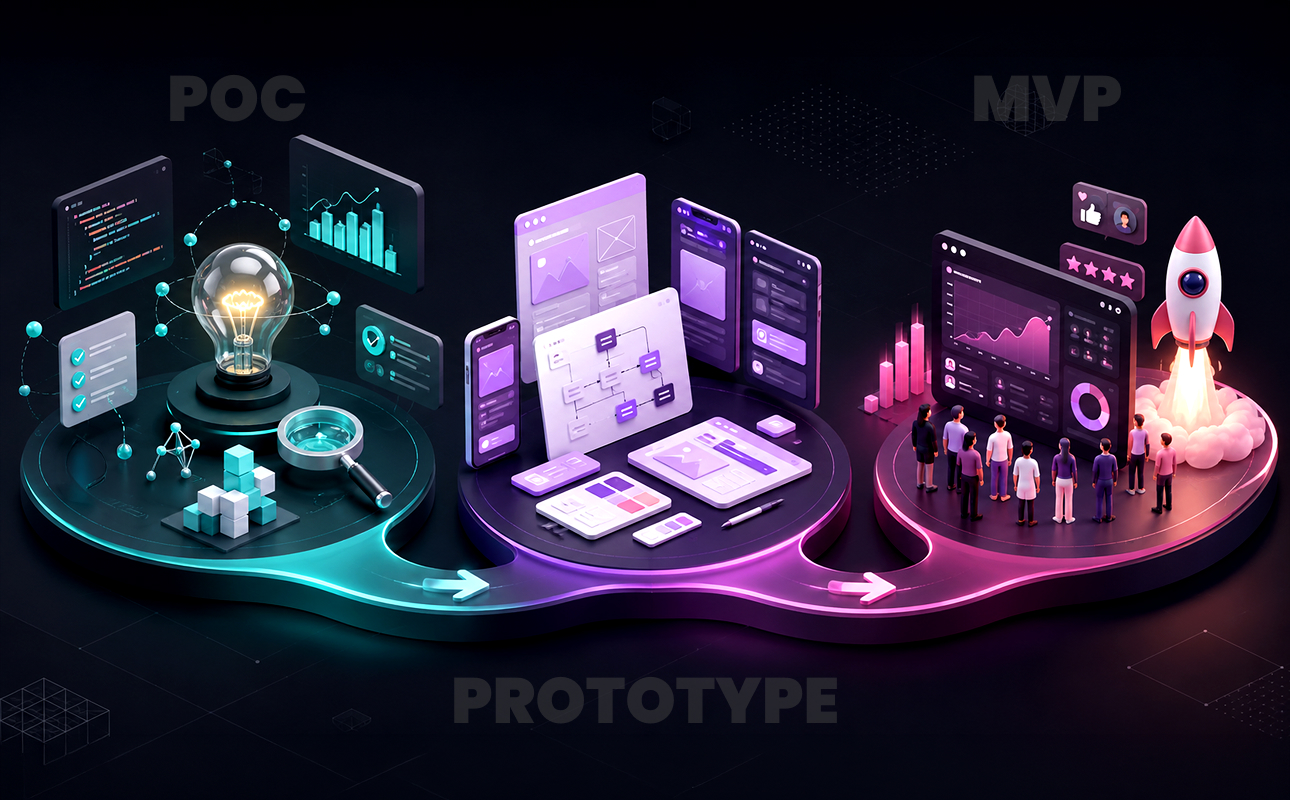


Your CTO says the riskiest feature should work, then an investor asks what proves it. A weak answer can burn runway, delay first customers, and turn one hidden assumption into expensive rework before the product has real evidence at all. A focused PoC turns belief into test evidence before heavy build pressure grows.
Why Startups Should Prove the Risk Before Development
Startup development should start after the riskiest assumption has evidence. A founder with 9 months of runway cannot treat paid engineering sprints as real proof.
Australian startups recorded 390 announced deals and about $5.4B in 2025. Selective capital rewards founders who prove risk before spending heavily too early.
Early proof makes the team choose the smallest risky slice first. It turns confidence into a written record before the pressure gets loud internally.
That record helps investors, engineers, and founders discuss the same risk clearly. It also stops the loudest feature request from setting the roadmap alone.
The next decision becomes sharper after that record exists. The first reason starts with whether the hard feature can actually work under pressure.
1. Proof of Concept Development Proves the Core Feature Can Work
The core feature deserves proof before the product receives a sprint plan. A PoC reduces the idea to one testable technical claim.
Founders gain more from testing one hard workflow than from polishing 8 easy screens. The risky feature should face realistic input and timing pressure.
A useful feasibility slice checks 3 signals before engineers commit more time. Keep the slice narrow enough to judge within days.
- Core logic under realistic input
- Data response within the target time
- Failure point visible to engineers
Technical confidence becomes a traceable record through Proof of Concept development. When the feature fails here, the plan needs a reset before the cost grows.
This is where the first engineering conversation changes. The team stops debating belief and starts reviewing evidence from the riskiest workflow.
2. It Turns Startup Product Validation Into Real User Evidence
Startup product validation works when users reveal behaviour, not polite interest. A PoC tests whether the pain changes real action.
CB Insights names poor product-market fit and running out of cash among the major startup failure reasons. Those risks grow when feedback replaces evidence.
A useful PoC gives users a narrow task. Watch whether they finish it, ask for it again, or abandon it without explanation.
The signal lives in behaviour, not compliments. Once users react to the proof, the budget question becomes sharper than any survey answer.
Real user evidence also protects the founder from overreading investor enthusiasm. The product still has to survive use without the founder’s explanation.
3. PoC Development Protects Runway Before Full Build
PoC development protects the runway by testing the decision before the engineering team expands. Wrong sprints can look productive while draining scarce startup time.
A failed sprint not only wastes code. It locks founders into promises, architecture choices, and investor updates that become harder to reverse.
Capital pressure and weak demand often arrive together. A PoC moves learning into the smallest test before money tightens.
Runway protection is not only about spending less. It is about spending after the riskiest assumption has been earned in the next sprint.
The next risk is less financial and more practical. A feature can work on its own and still fail when the real workflow emerges.

4. It Exposes Workflow, Data, and Integration Gaps Early
Workflow, data, and integration gaps should appear before the full build begins. Many weak ideas survive mockups because real operating constraints stay hidden.
A founder may test a booking idea in Figma. Stripe rules, calendar conflicts, and CRM fields can still break the flow.
A PoC forces a single live data path from the source to the output. The team records API limits, weak fields, delays, and every manual workaround.
Those details matter because they change the estimate. A simple screen can become an expensive workflow when data is missing.
That record changes the build conversation. The team stops asking whether the feature sounds useful and starts asking whether the workflow can support it.
5. It Sharpens Digital Product Development Scope Before Sprints Begin
Scope gets sharper for digital product development when founders know which risks have passed. The PoC result decides what enters the MVP sprint.
Without proof, every feature feels equally possible. After proof, founders can separate feasibility, usability, and demand instead of mixing them together.
What is the difference between a proof of concept and a prototype?
A PoC proves whether the idea or core feature can work. A prototype tests whether users understand the flow before product engineering begins
| Stage | Main question | What it proves | When to use | Development risk reduced |
|
PoC |
Can the idea or core feature work? | Feasibility | Before full development | Technical and assumption risk |
|
Prototype |
Can users understand the flow? | Usability and experience | Before heavy UI and product work | UX and adoption risk |
|
MVP |
Will real users use or pay? | Market response | After proof and scope clarity | Demand and commercial risk |
The table prevents one common mistake. A founder should not use an MVP to answer a question that a cheaper PoC could answer.
That scope discipline also protects the first release. The MVP becomes a smaller proof path, not a warehouse for every possible feature.
6. A PoC Development Company in Australia Can Turn Proof Into Investor-Ready Evidence
A PoC development company in Australia should leave founders with decision evidence, not a disposable demo. Investors need the logic behind the next spend.
Antognolli and Petrillo argued in 2026 that PoCs stay underdefined and ad hoc too often. They frame PoCs as decision instruments.
Bytes Technolab turns proof into decision traceability by connecting success criteria, user signals, and sprint readiness before the founder funds the next build step.
How do you measure the success of a POC in development?
PoC success means the founder can make a go, pivot, or pause decision with evidence. The result should leave one’s next move.
Use 3 measures together: feasibility score, user signal strength, and decision trace. Each measure should point toward the same product direction.
- Feasibility score
- User signal strength
- Decision trace
Go, Pivot, Pause Evidence – The Go, Pivot, Pause Proof Gate gives founders one decision language. It links technical proof, user behaviour, and sprint readiness in sequence
Go Evidence – Go evidence means the core feature worked more than once under realistic inputs. Users understood the value, and known risks fit the next sprint.
Pivot Evidence – Pivot evidence means the problem matters, but the first path failed. The founder keeps the learning and changes workflow, user segment, or scope
Pause Evidence -Pause evidence means the assumption failed without a strong recovery path. Spending more before a Product Discovery Workshop would bury the real issue
The decision gate matters because investors do not fund hope alone. They fund the next step when proof explains why it deserves money.
7. PoC for Startups Creates a Safer MVP Path
PoC for startups creates a safer MVP path because the next sprint starts from evidence. The founder no longer guesses what deserves development.
After proof, the team should choose between prototype, MVP Development, discovery, or pause. Each option answers a different risk before spending rises.
What comes after proof of concept?
The next step after a PoC depends on the evidence. Strong technical results can move into prototype, MVP, discovery, or development planning.
Weak evidence should not move into development. It should trigger a smaller question, a tighter user test, or a sharper data review.
Before moving from PoC to MVP, confirm these 5 points. Each one turns the proof into a safer sprint decision.
- The core feature worked under realistic input
- Real users understood the value
- Workflow and data gaps are known
- MVP scope is smaller and clearer
- Next sprint has a go, pivot, or pause decision
The urgency is not to engineer faster. The urgency is to stop spending until the proof shows which product path deserves the next sprint.
Build Only After the Proof Is Clear
The first tension was never whether the idea sounded strong. The real tension was whether the riskiest part deserved development budget yet.
A founder who proves feasibility, user value, workflow fit, and sprint direction gets a cleaner decision. The next cheque’s funds have already been earned.
Bytes Technolab brings an AI-first Product Engineering partner approach to PoC planning, product discovery, engineering scope, and MVP readiness for Australian startups.
That support matters because proof must survive more than a demo call. Investors, users, and engineers need a single shared record before spending increases.
The better path is not bigger development by default. It is proving the riskiest part, small enough that the bigger decision becomes obvious.