
Strategic Benefits of MVP Development for Scaling Businesses in Australia

Your product roadmap keeps growing, but nobody can prove which features will drive revenue. Scaling teams face pressure to ship faster while avoiding wasted effort. Teams that work with Bytes Technolab (an AI-first Digital Product Engineering Partner) shift toward validation-first decisions that protect capital and accelerate real outcomes.

Why Scaling Teams in Australia Get MVP Wrong and Pay for It Later

Scaling teams treat MVP as a startup phase they have already passed, and that assumption creates expensive mistakes. Product roadmaps expand based on internal assumptions rather than validated demand.
In Sydney and Melbourne, feature creep adds two to three extra sprints per release cycle. Each feature introduces new dependencies across infrastructure, APIs, and compliance layers.

Why Does Overbuilding Happen During Scaling?

Overbuilding happens because leadership equates growth with feature expansion instead of validated outcomes. Teams add features without testing whether each one contributes to revenue, retention, or operational efficiency.

A fintech team in Brisbane added identity verification, referral systems, and analytics in one cycle, increasing delivery time by 40% without improving activation rates. That cost only became visible after release.

The real issue is not speed. It is direction.

MVP Development in Australia solves this by putting validation before commitment, not after.

The Real Cost of Skipping MVP Thinking During Scale

Skipping MVP thinking during scale creates hidden costs that never appear in initial budgets. These costs surface in rebuild cycles, delayed releases, and infrastructure inefficiencies that compound over time.
Australian MVP builds typically range between AUD 50,000 and AUD 200,000, depending on complexity and integrations.

Where Does the Budget Actually Get Wasted?

Budget waste happens in layers that most teams never track together. Small decisions stack into large financial impacts before anyone notices.

The MVP development benefits for scale-ups become clear when teams compare the cost of validation against the cost of full builds that miss the mark.

Hidden Cost Layers That Compound Quickly

  • Feature expansion adds 15% to 30% more development effort per cycle
  • Compliance requirements consume 10% to 20% of the total budget in regulated sectors
  • Cloud costs rise post-launch when the architecture is not built for early-stage usage
  • QA and iteration cycles extend timelines by multiple weeks

A Sydney-based team planned a four-month build but saw timeline expansion after incremental features were added across sprints without validation gates. Each unvalidated addition pushed the release date further while user feedback remained absent.

The cost is not just financial. It is a strategic drift away from what users actually need, and that drift compounds with every sprint.

wasting budget

MVP Development in Australia Is Not a Startup Tactic. It Is a Scaling Strategy

MVP Development in Australia is a capital allocation strategy that helps scaling teams validate decisions before committing engineering resources. It shifts focus from building more to building what matters.

Every feature becomes an investment decision with a measurable return. Teams that treat product decisions this way stop debating scope and start evaluating evidence.

How Does MVP Thinking Change Scaling Decisions?

MVP thinking forces teams to test assumptions before committing engineering capacity. It replaces roadmap expansion with controlled experimentation that produces real data.

A team using the MoSCoW prioritisation framework cut 40% of planned features and reduced time to market by six weeks without losing core functionality.

The Capital Allocation Filter Most Teams Skip

  • Must-have: features directly tied to revenue or user retention
  • Should-have: features that improve usability without blocking adoption
  • Could-have: enhancements that wait for validation data before build

MVP thinking is not about reducing scope. It is about increasing the certainty of every decision made.

This is the shift that separates scaling teams that grow efficiently from those that rebuild constantly.

How Smart Teams Use MVP Development Services to Scale Without Slowing Down

MVP Development services help scaling teams maintain delivery speed by structuring releases around validated learning instead of full builds. The goal is not fewer releases. It is the smarter ones.

Digital Product Development Services that follow this model break product expansion into controlled iterations tied to measurable signals.

What Does Execution Look Like in Real Scaling Environments?

Execution means each release answers one specific question about user behaviour or system performance. Teams stop guessing and start measuring.

A SaaS platform in Australia released three phased MVP iterations over 12 weeks instead of one large release, improving feature adoption rates by 28%.

Execution Model Used by High-Performing Scaling Teams

  • Release cycles: 2 to 4 weeks with clear validation go
  • Metrics tracked: activation rates, retention, and feature usage data
  • Architecture approach: modular builds that avoid full rewrites at scale

Teams that apply this model ship faster, waste less, and carry less technical debt into the next phase of growth. Bytes Technolab structures every engagement around this iterative release model, ensuring that scaling clients validate before they commit.

Australian Government MVP Grant: MVP as a Funding, Compliance, and Risk Strategy in Australia

MVP thinking is no longer just a product shortcut.

For Australian scaling businesses, it shapes funding eligibility, compliance readiness, and risk management.

A structured MVP can support grant eligibility, investor due diligence, and financial incentive claims.

The Australian Government business portal lists the Minimum Viable Product (MVP) Ventures NSW grant.

This program helps eligible businesses commercialise innovative products and processes.

  • Stream 1 offers a maximum grant of $50,000 with a minimum 50% co-contribution.
  • Stream 2 offers a maximum grant of $75,000 with a minimum 25% co-contribution for priority groups.

How Does MVP Connect to Funding and Grants?

MVP projects qualify when they involve structured experimentation, hypothesis testing, and documented uncertainty.

These elements can also support Research and Development Tax Incentive claims.

The R&D Tax Incentive helps companies offset some eligible research and development costs.

To access the R&D Tax Incentive, companies must conduct at least one eligible core R&D activity.

Eligible R&D activities must be registered with the ATO before claiming the benefit.

MVP documentation makes the build easier to assess for AusIndustry, the ATO, grant reviewers, and investors.

AI-driven product engineering services strengthen claims by building documented validation cycles into the product roadmap.

Where MVP Strengthens Funding and Compliance Readiness

  • Investor due diligence: validated demand replaces assumptions in pitch decks.
  • Grant eligibility: documented experimentation cycles support MVP grant applications.
  • Compliance readiness: regulatory requirements are built in early, not retrofitted later.
  • Risk management: technical, financial, and market risks are tested before full-scale development.

A product that validates assumptions early and documents its learning is easier to fund, review, and defend.

How to Apply MVP Thinking Without Slowing Your Growth Roadmap

Applying MVP thinking requires decision rules that guide what gets built, when, and why. Growth does not slow when decisions become clearer and more deliberate.

The challenge is not execution. It is disciplined prioritisation before execution begins.

What Should Be Included in a Scaling MVP?

A scaling MVP includes only features that directly support measurable outcomes such as revenue, retention, or compliance readiness. Everything else waits until validation data supports the addition.

Teams following this approach reduce development cycles by 20% to 30% while maintaining product quality benchmarks, and the MVP development benefits for startups apply equally to scaling teams.

Decision Checklist Before Adding Any Feature

  • Does this feature affect revenue or retention within 90 days?
  • Can it be validated with a smaller version before full build?
  • Does it introduce new dependencies or compliance risks?
  • When usage data exceeds defined thresholds, move to full build

This is not about limiting growth. It is about directing engineering effort where it returns the most value, and removing the guesswork that slows scaling teams down at exactly the wrong moment.

what to build next

Scaling Without Waste: The Right Way Forward

Scaling teams do not fail because they build too little. They fail because they build too much without knowing what drives results.

MVP thinking replaces guesswork with controlled decision-making and turns product development into a measurable, repeatable system. Bytes Technolab works with scaling businesses across Australia to apply this through structured validation, modular architecture, and disciplined release strategies that keep products moving without burning capital.

The next step is not adding more features. It is deciding which ones deserve to exist.

 

Why Building an MVP is a Smart Move for Aussie Founders

Building the first version of your product works best when it is treated as a risk-control decision. Founders usually regret version one when they build for completeness instead of proof.

That mistake looks reasonable at first. It becomes expensive the moment features start answering internal opinions instead of market behaviour.This is exactly the trap a well-scoped MVP for startups is designed to prevent.

A founder adds dashboards, billing logic, role management, and edge-case handling. Then the first ten users reveal they only cared about one painful workflow getting solved properly.

Australia gives that mistake less room to recover. By 30 June 2025, Australia had 2,729,648 actively trading businesses, with a 16.4% entry rate and a 13.9% exit rate across 2024 to 2025.

That level of movement matters because market position changes quickly. Slow learning is not neutral in that environment.

Money also disappears quietly at this stage. Six extra weeks of design, two contract engineers, and one delayed investor update can turn a promising sprint into a credibility problem.

Why do founders build too much before they learn enough?

Founders build too much when they confuse readiness with completeness. Investor pressure, customer requests, and competitor anxiety make extra features feel safer than they really are.

A Melbourne SaaS team with A$450,000 in seed funding can lose control of this fast. If A$120,000 goes into permissions, reporting layers, and integrations before the core workflow is validated, almost 27% of runway is gone before the market says yes or no.

That is not a product problem alone. It is a sequencing problem.

What does a smarter first release actually prove?

A smarter first release proves one commercial belief, one behaviour pattern, and one retention signal. It answers whether a buyer will try, whether a user will repeat, and whether the problem is painful enough to justify more spend.

That is a higher bar than shipping screens. It asks for evidence that changes the next decision.

What proof should matter first?

The first proof should be tied to one action that signals value. That could be a completed booking, a successful upload, a matched transaction, or a repeated team workflow inside the first month.

A founder does not need a broad story at this point. A founder needs one signal strong enough to earn the next build decision.

The first release should not chase applause. It should reduce uncertainty in a way that makes later decisions easier.

Why MVP Development for Startups in Australia Makes More Sense Than a Full Product Launch

MVP Development for Startups in Australia makes more sense because local founders face concentrated capital, high hiring costs, and pressure to prove traction earlier. A full launch can look bold while acting like a slow and expensive guess.

Australia’s tech sector contributes about A$167 billion and has grown 80% in five years. That growth creates real opportunity, but it also raises the standard for what early customers, investors, and advisers expect to see.

The 2025 startup funding market reached about A$5.1 billion. Capital also became more concentrated, which means fewer founders get room for broad experimentation without real proof.

That changes how smart teams should behave. The goal is not to impress the room with breadth. The goal is to show the room something the market has already started confirming.

A lean release travels better in this context. It gives boards, angels, and pilot customers something concrete to react to before a founder commits to a heavier team and a larger burn.

Why does the Australian market reward faster validation?

The Australian market rewards faster validation because distance, talent costs, and category competition punish slow learning. Many founders are testing demand across Sydney, Melbourne, Brisbane, and overseas at the same time.

A Brisbane healthtech founder may need usable proof inside eight weeks, not eight months. The market is more forgiving of an imperfect interface than a product nobody asked for twice, especially when the goal is to build an MVP in 60 days and learn from real customers quickly.

That is why speed matters here in a specific way. Fast validation is not about rushing development. It is about shortening the time between assumption and evidence.

What happens when you skip lean validation?

When founders skip lean validation, later decisions start resting on false confidence. Hiring, pricing, investor messaging, and roadmap promises all become harder to defend.

The damage is not limited to cost. Overbuilding distorts judgement because every next choice starts leaning on features instead of behaviour.

Here is what usually follows when version one is too broad:

  • Pilot users give mixed feedback because the core workflow is buried.
  • The team cannot tell which feature created value and which feature created noise.
  • Investor updates sound busy, but they still do not answer whether demand is real.

That is the real Australian tension. The market rewards proof faster than polish, which makes the next scoping decision far more important than it first appears.

The Smartest MVP Is Built for Learning, Not for Impressing

The smartest AI-powered MVP is designed to test assumptions, not to impress a demo room. If version one cannot teach you why users act, hesitate, return, or ignore, it is already larger than it should be.

Most founders still scope from features outward. They write down what a mature product should contain and then try to shrink that list.

The better path starts somewhere else. It starts with the decision that must be earned next.

You are not asking what version one could include. You are asking what version one must prove before a larger release deserves time and budget.

That framing changes how teams work. Feature discussions stop sounding like ambition and start sounding like trade-offs.

MVP development

What should an MVP be designed to learn?

An MVP should be designed to learn whether the problem is painful, whether the workflow reduces friction, and whether users return without heavy hand-holding. Those three signals usually shape the next six months of spending more than surface polish does.

A tight assumption map helps before building starts:

  • State the buyer’s problem in one sentence and tie it to cost, delay, or lost revenue.
  • Name the single action that proves value, such as booking, uploading, matching, or reconciling.
  • Set one 30-day success threshold, such as 20 active accounts or a 25% repeat rate.

That is enough to guide version one. It is also enough to expose whether the current feature list is too wide.

Where does AI help without expanding the scope?

AI helps when it reduces manual effort in the core workflow. It becomes a mistake when it adds decorative intelligence around the edges.

Used well, it shortens the path to proof. An AI triage step, summarisation layer, or recommendation engine can test value faster than a large admin suite ever will.

A Perth operations product might add an LLM-based classification step, reducing processing time by 60%. It can ignore the rest of the nonessential dashboard ideas until usage proves they matter.

That is why an AI-powered MVP can be smart without becoming bloated. The AI should strengthen the main workflow, not distract from it.

What is the difference between learning features and vanity features?

Learning features expose behaviour. Vanity features create presentation value without helping the founder decide what should happen next.

A waitlist conversion tracker is a learning feature. A complex role matrix for five pilot users is usually not.

Use this filter when the scope starts drifting:

  • Keep features that create or measure the main user action.
  • Delay features that only support scale you have not earned.
  • Reject features added mainly because a competitor already has them.

Once that lens is in place, scoping becomes less emotional. The next challenge is making sure version one stays lean from first workflow to final release brief.

How to Scope the Right Product Development Solutions Without Turning Your MVP Into a Half-Built Product

The right product development solutions for an MVP support one core workflow from start to finish. Everything else should wait unless it changes the learning outcome in a direct way.

Founders usually keep the central action lean at first. Then they add weight at the boundaries through onboarding layers, reports, notifications, permissions, and integrations.

That pattern feels responsible. It usually creates maintenance work before it creates market proof.

A better method is to draw the shortest complete path from problem to value. That path should show how one user reaches one meaningful outcome with as little supporting structure as possible.

This is where version one either stays clean or turns into a half-built product. The difference is rarely ambition. The difference is discipline.

What belongs in version one and what should wait?

Version one should contain only the steps required for a user to reach the promised outcome once, clearly and repeatably. Features added for flexibility, edge-case coverage, or future scale should wait until usage makes the case.

A Sydney founder building a field-service product may only need job creation, technician assignment, and status completion in release one. Multi-team permissions, analytics, and custom invoice logic can move to release two without weakening the test.

Keep in version one

  • Include the shortest path that delivers value in one session or one work cycle.
  • Add measurement points that capture drop-off, repeat use, and time to first outcome.
  • Build admin controls only when the pilot cannot operate safely without them.

Push to version two

  • Delay edge-case workflows that affect a small share of early users.
  • Delay reporting layers unless a buyer needs them to approve the pilot.
  • Delay broad integrations until manual work proves the process itself is sound.

How do you avoid building a half-built product?

You avoid building a half-built product by defining done around learning, not completeness. That single shift changes the delivery brief more than most founders expect.

Use a three-part scoping test before every major feature is approved:

  • Can a user complete the main job without manual rescue in most cases?
  • Can the team measure whether that job created value inside 14 to 30 days?
  • Can every included feature be justified in one sentence?

If a feature fails that test, cut it. Founders who cut well usually learn faster than founders who can describe a broader roadmap.

That is the point where scope control becomes real. The next risk is who you trust to build it.

What Most Founders Miss When Choosing an MVP Development Partner

The right MVP development partner does more than deliver code on time. The team should protect validation logic, challenge bloated scope, and keep version one tied to evidence instead of feature volume.

Many founders still choose on price, speed, or design polish alone. Those factors matter, but they do not reveal whether the team understands the difference between a prototype, a proof of concept, and an MVP with commercial purpose.

That distinction changes the entire engagement. A prototype helps people react to an idea, a proof of concept checks technical feasibility, and an MVP tests whether users will adopt enough value to justify the next release.

A founder who misses that difference often buys the wrong outcome. The result may look like progress while teaching almost nothing useful.

How can you tell if a partner understands validation?

You can tell by the questions they ask before estimates appear. A serious team asks about assumptions, target users, success thresholds, and what must be learned in the first 30 to 60 days.

A weaker team asks mainly about screen counts, preferred stack, and delivery dates. That is delivery thinking before product thinking.

Use this first-call filter:

  • Ask what they would remove from the current feature list and why.
  • Ask how they would measure proof after launch through product events or pilot feedback.
  • Ask whether you need a prototype, a PoC, or a true MVP right now.

Ask these on the first call:

  • Which assumption would you test first if budget dropped by 30%?
  • What would you leave out of release one even if we requested it?
  • How would you define success after the first 50 users or first 6 weeks?

Why do cheap builds often cost more later?

Cheap builds often cost more because they optimise for shipping volume, not decision quality. The first invoice looks attractive, but the real cost appears later through rework, weak instrumentation, and missed learning windows.

A founder who spends A$35,000 on the wrong brief may still need another A$50,000 to rebuild the product around actual usage. That is not only a pricing issue. It is a framing issue from the start.

The team you choose shapes what you learn and how fast you learn it. That is why the final section matters more than simple build capacity.

When MVP Development Services Actually Create Momentum for Fundraising, Feedback, and Scale

MVP Development Services create momentum when they reduce wasted decisions before development starts and turn launch into a learning event. Founders need more than code delivery. They need a sequence that connects discovery, scope, build, measurement, and next-step clarity.

Many engagements break down because the team starts building too early. Discovery stays light, success metrics stay vague, and release week arrives without a clear answer to what the product was supposed to prove.

Good execution fixes that before sprint one. It gives founders a scoped outcome, a lean roadmap, and a practical view of what must be measured during the first pilot cycle.

That is where disciplined support changes the fundraising story. A small launch stops looking small when it is attached to strong evidence.

What should strong services include before the build starts?

Strong services should include problem framing, feature pruning, workflow mapping, and launch metrics before a single ticket is approved. Those pieces stop the common slide from small build to open-ended product effort.

A sound pre-build process usually covers:

  • A decision on whether discovery needs one week, two weeks, or a short technical audit.
  • A release scope tied to one user journey and one measurable business result.
  • A post-launch plan for feedback loops, event tracking, and backlog priorities.

That work may feel slower for a moment. It usually speeds up the part that matters most, which is learning from the release.

When do founders need discovery before development?

Founders need discovery first when the product idea is clear but the release boundary is not. They also need it when stakeholder opinions are pulling in different directions or when technical unknowns could distort budget and timing.

A founder preparing to raise in 90 days cannot afford a vague build brief. That is when a focused discovery phase helps define user flow, trim feature weight, identify smart AI opportunities, and map the fastest route to usable proof.

Book a free session

How does structured delivery help with fundraising and feedback?

Structured delivery helps because investors and early users respond better to evidence with context. A launched product alone is not the story. What matters is what the product proved, how quickly it proved it, and what decision follows.

When the first release shows activation, repeat use, and a backlog shaped by real behaviour, every conversation improves. Founders stop defending why version one is small and start explaining why version two now deserves the spend.

That is the shift this whole process is trying to create. It leads directly to the final decision every founder eventually has to make.

Build Less First, Learn More Faster

The smartest founders do not win early by shipping the biggest first version. They win by reaching the clearest proof before money, confidence, and timing begin working against them.

That is the real tension underneath this decision. You are not trying to avoid effort. You are trying to avoid spending serious effort on the wrong evidence.

When the first release is scoped around one painful workflow, one measurable action, and one clear user response, the next move gets easier. Hiring becomes easier to justify, investor conversations become easier to support, and expansion begins from behaviour instead of hope.

Bytes Technolab helps startups, scale-ups, and mid-enterprises shape that path with AI-first product engineering, lean scoping, and execution planning that keeps version one usable and defensible. The outcome is not a larger first release. It is a sharper one that gives founders something real to act on.

If you are close to building, now is the right moment to pressure-test the brief. A tighter first move often creates room for every stronger move after it.

From Idea to AI-Powered MVP in 60 Days: How We Transformed an Aussie Startup

When you speak to founders in Sydney or Melbourne, one thing becomes clear. Every startup begins with a spark. An idea that feels powerful but is fragile at the same time. The real challenge is not the idea itself, but how fast you can bring it to life before someone else captures the market. In Australia’s highly competitive startup ecosystem, speed matters as much as innovation.

At Bytes Technolab, we’ve seen this story unfold countless times. In this article, we’ll share how we partnered with an ambitious Australian startup, helping them transform a simple concept scribbled on paper into a fully functioning AI-powered MVP in just 60 days. Not only did we help them launch, but we also scaled their MVP into a complete SaaS product within the year, using the insights gathered directly from their first users.

This is more than a project showcase. It’s a story of how a solid digital product engineering partner can accelerate the growth of a startup and set the foundation for long-term success.

Why Speed and Execution Define Startup Success in Australia

Australia has become a thriving hub for innovation. Cities like Sydney, Melbourne, and Brisbane are home to tech-driven ventures competing to disrupt industries. But while the appetite for digital products is high, the window of opportunity is often narrow.

Investors and customers want to see tangible proof quickly. That’s why MVP development services play such a critical role. An MVP, or Minimum Viable Product, gives startups the chance to validate their idea, test market fit, and secure funding without pouring months (or millions) into development.

Yet building an MVP is not just about writing code. It’s about creating the simplest version of your vision that still delivers real value. And that’s exactly what Bytes Technolab, a leading MVP development agency in Australia, specialises in.

The Challenge: Turning a Raw Idea into Reality

Our Australian client came to us with a bold idea. They wanted to harness AI to improve decision-making in small business operations, but they had no technical background and limited time to validate their concept.

The questions they were wrestling with were the same ones most early-stage founders face:

  • How do we translate an idea into a workable product without over-engineering?
  • How do we ensure AI isn’t just a buzzword but actually adds value?
  • How can we go live quickly to test our assumptions with real users in Sydney and Melbourne?

They needed more than developers. They needed a product engineering partner who could guide them strategically, provide technical clarity, and build the product efficiently.

The Turning Point: Choosing the Right Product Engineering Partner

Bring-your-digital-product-idea-to-life-in-60-days-with-rapid-development-service

The founders remember those early days vividly. They had a bold idea, plenty of passion, and a clear problem they wanted to solve for Australian small businesses. But every time they tried to take the next step, the same doubts surfaced.

  • Would they be able to turn this concept into something real?
  • Could they build fast enough before someone else launched a similar solution?

Like most entrepreneurs, they had options.

They could have pieced together a team of freelancers, hoping that everyone would align. Or they could have delayed the launch while trying to raise more funds to hire an in-house tech team. Both routes came with risks: wasted time, inconsistent execution, and the very real possibility of burning through their budget without anything to show investors or users.

What they truly needed was not just coders but a product engineering partner. A team that could guide them strategically, help sharpen their vision, and deliver a functional MVP in record time. That’s when Bytes Technolab stepped into the picture.

From the first conversation, the synergy was clear. We understood the urgency of the Australian market, where speed often determines whether an idea sinks or soars. More importantly, we brought more than MVP development services. We offered clarity, confidence, and the experience of having scaled other startups from concept to SaaS success. 

For the founders, this was the turning point. Partnering with us meant they could finally move from dreaming to building. And what followed was a journey that transformed their idea into an AI-powered MVP in just 60 days, setting the stage for a scalable SaaS solution that continues to grow across Sydney and Melbourne today.

Blueprint of How We Transformed an Aussie’s Product Idea

Blueprint-of-How-We-Transformed-an-Aussies-Product-Idea

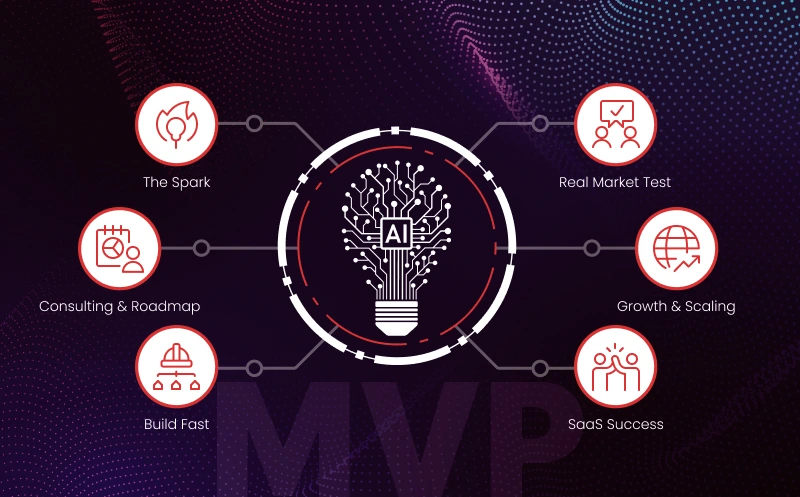
Step 1: Laying the Foundation with AI MVP Consulting

Before writing a single line of code, our team spent two weeks working closely with the founders through workshops and consultation sessions. We clarified the vision, prioritised features, and mapped the product journey.

Our AI MVP consulting services played a pivotal role here. We helped the team identify the necessary components of the first version, as well as what should be excluded. Instead of building every shiny feature they imagined, we focused on three core functionalities that would deliver value to the end-user while proving the AI concept. If you’re weighing whether your own first release needs AI from day one, our comparison of MVP vs AI MVP breaks down that exact decision.

This clarity saved them time, money, and frustration later in the journey.

Step 2: Building the AI-Powered MVP in 60 Days

Once the roadmap was set, our product engineering services came into full play. Using agile sprints, our developers, AI engineers, and UX designers collaborated with the startup’s founders daily.

  • Design-First Approach: Our team created intuitive user flows, ensuring even non-technical users in Sydney’s SME sector could interact with the AI seamlessly.
  • AI Model Development: We integrated lightweight machine learning models to provide predictive insights, ensuring fast processing without heavy infrastructure.
  • Rapid Iterations: Every fortnight, we delivered working builds to the founders for feedback, making them part of the development journey.

Within 60 days, the startup had a functional, tested AI MVP that could be demonstrated to early adopters and investors. The speed stunned them. For us, it was the result of years of refining our MVP development services process.

Step 3: Learning from Real Users in Sydney and Melbourne

Launching the MVP was just the beginning. Bytes Technolab helped the startup roll it out to a small group of businesses in Melbourne and Sydney. These were their first testers, providing unfiltered feedback on usability, performance, and value.

This stage highlighted why MVPs are so crucial. Some features the founders thought were vital turned out to be rarely used. Meanwhile, users requested new capabilities we hadn’t initially considered.

Instead of wasting resources on unnecessary features, we used these insights to adjust the product direction. Real-world feedback became the compass guiding the next phase.

Step 4: Scaling the MVP into Full-Scale SaaS Solution

Over the following 12 months, Bytes Technolab helped transform the MVP into a robust AI-powered SaaS solution. This was where our role as a long-term product engineering partner truly shone.

  • Cloud Infrastructure: We migrated the MVP onto a scalable cloud architecture, ensuring it could handle thousands of users across Australia.
  • New Features: Based on Melbourne and Sydney user feedback, we added integrations with accounting software, advanced reporting, and a mobile app.
  • AI Enhancements: The initial machine learning models were replaced with more sophisticated AI algorithms, increasing accuracy and delivering personalised recommendations.
  • User Experience Improvements: Continuous testing helped us refine interfaces, reducing friction and improving engagement.

What started as a two-month MVP was now a revenue-generating SaaS product, trusted by small and medium-sized businesses across Australia.

Why Bytes Technolab is the Startup Growth Partner You Need

This journey is proof that with the right partner, an idea can become a product, and a product can grow into a scalable business. Bytes Technolab is more than an MVP development agency. We are a digital product engineering partner who stands by startups from the first sketch to long-term success.

Here’s why Australian startups choose us:

  • Expertise in MVP Development Services: Whether it’s AI MVP development services or traditional SaaS MVPs, we know how to deliver functional products fast.
  • Proven AI Capabilities: Our AI engineers ensure intelligence isn’t just a buzzword but a driver of real value.
  • Scalable Product Engineering Services: We build with the future in mind, so your MVP can evolve into enterprise-grade SaaS solutions.
  • Local Understanding: From Sydney to Melbourne, we understand the dynamics of the Australian startup ecosystem and tailor strategies accordingly.

Make-Us-Your-Digital-Product-Engineering-Partner

The Takeaway for Aussie Founders

If you’re an entrepreneur sitting on a great idea, the difference between success and failure often lies in execution speed and product-market fit. Waiting for the “perfect product” means someone else will launch first. An MVP built with the right strategy gives you the power to test, learn, and grow.

This Australian startup’s journey, from idea to AI-powered MVP in 60 days and then to a SaaS platform within a year, shows what’s possible when you combine vision with the right product engineering services.

At Bytes Technolab, we make that journey less daunting, more efficient, and ultimately, more rewarding.

Explore more startup journeys in our case studies